China’s Next-Generation Industrial Policy
China’s industrial strategy now touches almost every major sector in the economy and their underlying supply chains. These state interventions are accelerating China’s trade dominance and expanding foreign dependence on Chinese supply chains.
U.S. Chamber of Commerce Preface
A decade after Made in China 2025 (MIC25), China is entering a new phase of industrial policy. Rather than retreating in the face of mounting domestic and international pressures, Beijing is doubling down. State intervention across the economy is becoming broader and more consequential for global markets than ever.
This report assesses how China‘s industrial strategy is evolving and what it means for global competition. Two overarching conclusions emerge. First, China‘s industrial policy is becoming more systemic and pervasive, extending across all layers of production from upstream inputs and industrial equipment to downstream applications, services, and frontier technologies. Second, these domestic dynamics are ushering in a new phase of global impact, characterized by accelerating trade dominance, deepening foreign dependencies on Chinese supply chains, and the rapid global expansion of Chinese firms. Beijing also increasingly deploys policy tools to entrench its dominant position in global value chains and counter foreign diversification strategies.
These conclusions, while significant, are not without precedent, and the analytical foundation for understanding them was laid years ago, in large part by the business community itself.
In late 2015, the U.S. Chamber of Commerce identified and translated the foundational planning document—commonly referred to as the “Green Book“—that set out the localization targets and strategic roadmap underpinning Made in China 2025. That translation was shared broadly with companies, governments, and leading research institutions, and it served as the basis for a series of independent assessments that followed: most notably by the Mercator Institute for China Studies (MERICS) in 2016, the European Union Chamber of Commerce in China in 2017, and the U.S. Chamber of Commerce in 2017.
Published within months of one another, these three reports delivered a strikingly consistent message:
- MERICS (2016): “If China succeeds with ‘Made in China 2025,‘ foreign companies and industrial countries will find themselves confronted with a powerful competitor backed by massive state support across a wide range of advanced manufacturing industries.“
- EU Chamber of Commerce in China (2017): “If implemented as currently envisaged, China Manufacturing 2025 risks distorting markets, crowding out foreign competitors, and fundamentally undermining the principles of fair competition.“
- U.S. Chamber of Commerce (2017): “Made in China 2025 represents a decisive shift away from market-oriented reform toward state-directed economic outcomes, with profound implications for global competitiveness and US economic interests if left unaddressed.“
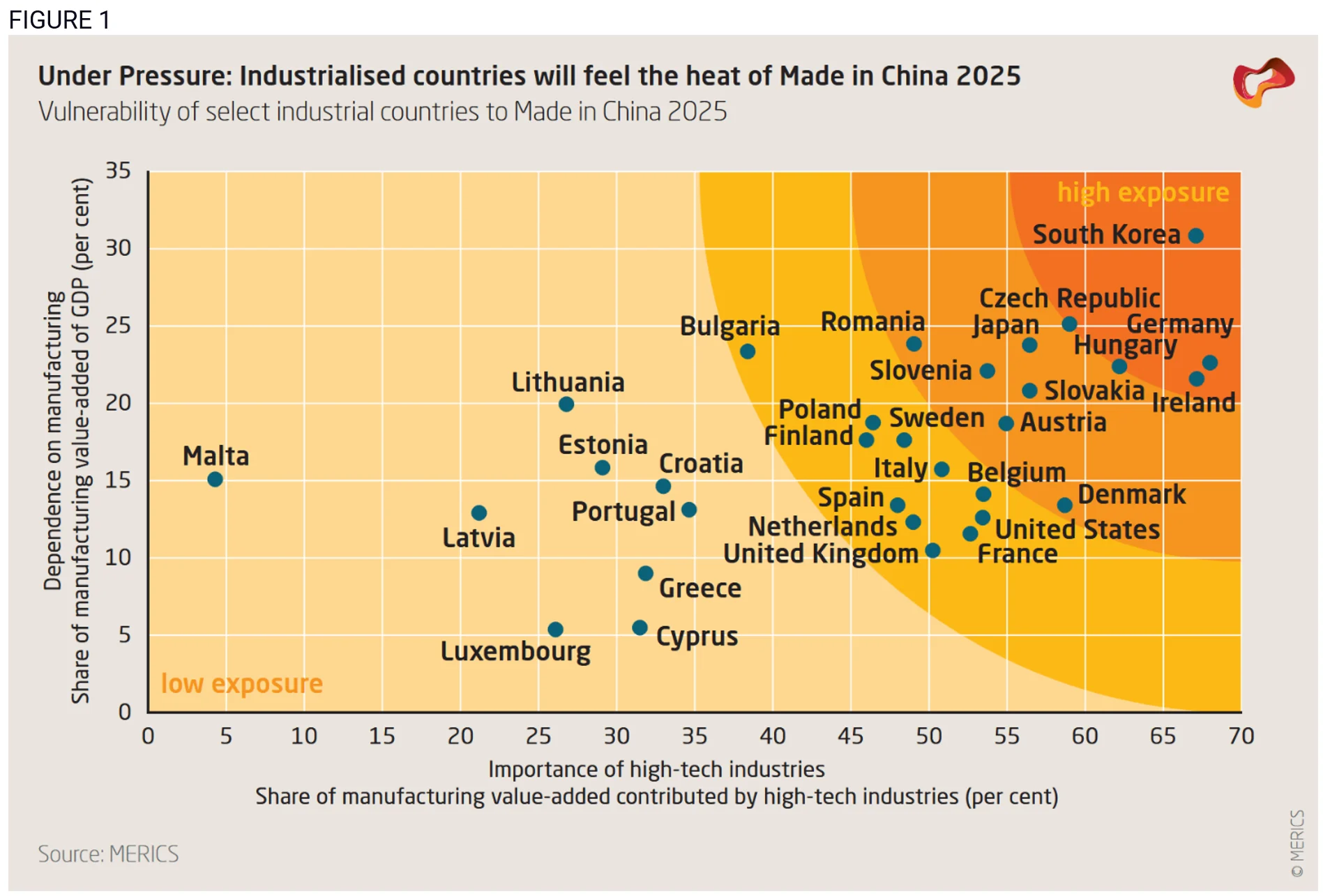
The analysis was clear. The evidence was made widely available. And the implications were articulated in direct terms across multiple credible, independent sources. One widely cited visual distillation was the 2016 MERICS Made in China 2025 Heat Map, which starkly illustrated the exposure of major manufacturing powers—South Korea, Japan, and Germany, along with other European industrial economies—to the blast radius of competitive pressure unleashed by China’s industrial push (Figure 1).
In the years that followed, China executed much—though not all—of the strategy it had outlined. A comprehensive assessment commissioned by the U.S. Chamber and prepared independently by Rhodium Group, Was Made in China 2025 Successful? (May 2025), confirmed that outcomes tracked the original ambitions to a striking degree. China made substantial progress in reducing import dependencies, displacing foreign firms in domestic markets, and building globally competitive positions in sectors ranging from new energy vehicles to information and communications equipment. At the same time, the Rhodium Group assessment found that significant vulnerabilities persist—particularly in high-end semiconductors, advanced aerospace, biomedicine, and other areas where Chinese firms have not yet closed the technological gap. The picture that emerges is not one of uniform success, but of a state-driven industrial campaign that achieved many of its core objectives while falling short in some of the most technologically demanding sectors. The competitive dynamics and supply chain shifts that were forecast a decade ago have, in large measure, become embedded features of the global industrial landscape. In hindsight, the early warnings were not alarmist—they were, if anything, measured.
It is worth acknowledging plainly that the challenge the world now faces is not the result of an intelligence gap. The translations existed. The reports were published. The warnings reached senior levels of government and industry across major economies. Yet in too many cases, the response was insufficient—whether due to competing priorities, political constraints, or a belief that market forces alone would provide an adequate counterweight. The costs of that delayed response are now visible in lost competitiveness, diminished industrial capacity, and strategic vulnerabilities that will require sustained effort to address.
This report is offered in the same constructive spirit as those earlier assessments: as a rigorous, evidence-based analysis of where China‘s industrial policy stands today and where it is heading. The Chamber‘s role is not to dictate policy, but to ensure that decision-makers in government, industry, and multilateral institutions have access to the clearest possible picture of the competitive landscape. The record of the past decade carries a straightforward lesson: When credible analysis is available and the trajectory is visible, the window for effective action is finite. What follows is an assessment of the next phase of China‘s industrial evolution—and of the strategic choices it presents.
Executive summary
China’s industrial strategy is evolving in two significant ways. First, it is becoming more systemic and pervasive, extending across all layers of production, from upstream inputs and industrial equipment to downstream applications, services, and frontier technologies. Second, these domestic dynamics are accelerating China’s trade dominance, deepening foreign dependencies on Chinese supply chains, and the rapid global expansion of Chinese firms in global markets. Beijing is also increasingly deploying policy tools to entrench its dominant position in global value chains and deter foreign diversification strategies.
A more expansive industrial policy
China’s next-generation industrial policy represents a shift from targeted sectoral intervention to what can be described as an “industrial policy of everything.” While MIC25 focused on a defined set of strategic emerging industries, current policy frameworks extend across mature sectors, foundational supply chain nodes, and frontier technologies alike. Chinese leadership views past policies as largely successful in building domestic capabilities and global competitiveness, even as they identify areas to improve policy execution and remain keenly aware of persistent technological dependencies in high-tech inputs. Beijing is not abandoning mature sectors but is instead pushing them toward higher-value segments, while focusing on new products and technologies. In several upstream segments, including critical minerals, wafers, and magnets, China already holds dominant positions, and policymakers are now seeking to extend this across a broader range of industrial products.
Even in mature industries facing overcapacity and severe price pressures, Beijing is providing continued support and pushing firms to upgrade production technologies to gain market share and lower production costs, rather than cutting capacity. While authorities have acknowledged the need to address imbalances, policy responses have so far fallen short of the structural reforms required to shift China’s growth model. Efforts to boost consumption also remain limited, leaving underlying demand weaknesses largely unaddressed.
Services, relatively neglected in earlier rounds of industrial policy, are getting more attention, with visible gains in areas like software, data processing, and drug development. Policymakers also view the current moment as a window of opportunity to pull ahead in disruptive technologies like artificial intelligence, quantum, and future energy systems, mobilizing China’s entire economic system to gain a foothold in future industries. These new technologies are no longer treated solely as areas for R&D and innovation. They are now also supported with public procurement and state-owned enterprises generating demand and adoption of new products at scale. AI has emerged as a central pillar, but the broader pivot to demand creation represents a step change in the leadership’s willingness to fund commercialization of cutting-edge technologies.
Refining the policy playbook under tighter constraints
This expansion is occurring in a more constrained macroeconomic environment. China faces slowing growth, weak domestic demand, rising fiscal pressures, and declining efficiency of capital allocation. Rather than scaling back intervention, Beijing is adapting to these constraints by recentralization and tighter coordination of financial resources. Authorities are strengthening control over fiscal spending, bank lending, capital markets, and state investment funds to ensure that scarce resources are directed toward strategic priorities. Government guidance funds are being consolidated and aligned more closely with national objectives, while bank lending is increasingly steered through targeted relending facilities and regulatory guidance, and wasteful or redundant tax and fiscal subsidies are being culled, especially at the local level. After decades of liberalization, the leadership is re-inserting non-market considerations into the DNA of banks, state-owned enterprises, and investment markets in ways that may prolong the potency of industrial policy, but which will have long-term ramifications for China’s overall economic vitality and efficiency.
However, the expansion of industrial policy across an ever-wider set of sectors risks diluting its effectiveness, while increasing state influence on financial markets may further reduce resource allocation efficiency. Evidence of strain is already visible in declining corporate profitability, weakening private investment, and slowing R&D growth in key sectors. Over time, these dynamics could weigh on China’s productivity and long-term growth potential, even as they support short-term industrial gains.
A new phase of global impact
The global impact of China’s industrial and economic policies has accelerated in the past three years and will likely continue to expand rapidly. The combination of sustained policy support and weak domestic demand has driven a rapid expansion of China’s manufacturing trade surplus, which many observers describe as a “China Shock 2.0.“ Since 2019, the surplus in manufacturing goods has roughly doubled to around $2 trillion, reflecting both rising exports and successful import substitution, and these trends are expected to grow.
While China’s most dramatic market share gains in the 2020s were in electric vehicles and clean energy, its current expansion is increasingly concentrated in key upstream segments of global value chains, such as chemicals, machinery, and industrial equipment—segments traditionally dominated by advanced economies. Chinese inputs and capital goods are increasingly also embedded in products manufactured and exported by third countries, creating indirect dependencies that are difficult to detect and manage. This expansion is also systematically underestimated, as falling producer prices mask the true pace of market share gains: Measured in volume, China’s market share gains are roughly twice as large as in value terms for many products.
As a result, global reliance on Chinese supply chains is deepening across a growing number of critical products. The number of products where China accounts for more than 50% of global exports, for example, nearly doubled between 2021 and 2024, from 192 to 315. China’s dominance of global manufacturing began with downstream assembly for foreign value-added, but has now flipped—extending into upstream materials, components, and production equipment, giving it increasing leverage over global industrial systems.
Beijing is actively reinforcing its control over value chains using regulations and economic coercion to pre-empt de-risking and lock in its dominance across critical supply chains. It has tightened controls on critical minerals and processing technologies, extended restrictions to downstream products through extraterritorial rules, and introduced new legal instruments that raise the cost for firms and governments seeking to diversify away from China.
Chinese firms are emerging as major global competitors, but Beijing is intent on ensuring that this overseas expansion does not lead to a hollowing out of production or capabilities in China or a loss of control over key supply chains. Overseas investment remains limited relative to domestic production, accounting for only a small share of firms’ total capital expenditure. Chinese firms typically localize assembly or sales abroad while continuing to rely on inputs, components, and technologies sourced from China. As a result, outward investment often reinforces, rather than reduces, global dependence on Chinese manufacturing.
Implications for global competition
Advanced industrial economies face the risk of sustained erosion in manufacturing competitiveness, particularly in sectors such as automotive, machinery, and chemicals. In aggregate, up to $650 billion—equivalent to around 12% of G7 manufacturing exports—could be directly exposed to Chinese market share gains by 2030 if they continue at the current pace. Over time, this could trigger broader effects, including declining investment, weakened innovation ecosystems, and the loss of industrial capabilities. Emerging economies also face challenges, as China’s continued upgrading limits opportunities to move up the manufacturing value chain. Growing dependence on Chinese supply chains raises strategic vulnerabilities. As China’s control over critical inputs and technologies expands, so too does its ability to weaponize this leverage.
The window for effective policy response is narrowing. While many governments have begun to react through trade defense measures, industrial policy, and efforts to de-risk supply chains, responses remain fragmented and largely uncoordinated. This risks amplifying trade diversion, duplicative investment, and intra-allied competition, while leaving underlying imbalances unaddressed. Without more coordinated action, China’s industrial policy is likely to continue reshaping global markets, entrenching dependencies, and eroding industrial competitiveness across both advanced and emerging economies.
Chapter 1: China’s next-generation industrial policy
China’s economic policy strategy is increasingly oriented around its aggressive pursuit of self-reliance, import substitution, technological leadership, and dominance across critical global value chains. China’s industrial policy extends far beyond traditional tools like subsidies or tax incentives to a pervasive, system-wide state role in shaping the economy. Chinese policymakers appear convinced that they have found a superior model that delivers results. Though cognizant that their model has shortcomings and produces unintended consequences, they believe they can refine and expand it to new industries and niche supply chain nodes to fuel economic growth, technological upgrading, and global competitiveness across multiple sectors.
This confidence is driving an expansion of policy ambition. Industrial policy is no longer confined to high-priority final goods but is increasingly focused on the foundational layers of production—materials, components, machinery, and industrial services—that underpin the entire industrial system. In several of these upstream segments, from critical minerals to wafers and magnets, China already holds dominant positions, and policymakers are now seeking to extend this across a much broader range of industrial products. Services, relatively neglected in earlier rounds of industrial policy, are getting more attention, with visible gains in areas like software, data processing, and drug development. Policymakers also view the current moment as a window of opportunity to pull ahead in disruptive technologies like artificial intelligence, quantum, and future energy systems, mobilizing China’s entire economic system to gain a foothold in future industries. Meanwhile, even in the face of excess investment and severe price pressures, Beijing is providing increased support and pushing mature sectors to upgrade and gain market share, rather than cutting capacity.
Yet Beijing is also confronting quickly growing constraints in its fiscal and financial system, which suffers from decades of misallocation. This evolution is unfolding against a weaker macroeconomic backdrop where growth is slowing, productivity growth is stagnant, and domestic demand is weak. Rather than retreating, Beijing is intensifying its control over the allocation of resources, both public and private. After decades of liberalization, the leadership is re-inserting non-market considerations into the DNA of banks, state-owned enterprises, and investment markets.
This chapter examines how China’s industrial policy is evolving, both in terms of its sectoral scope, and the instruments used. The first section looks at the sectoral expansion of China’s industrial policy to a wide range of critical inputs throughout the supply chain, to mature industries, to frontier technologies, and services. The second section examines the new instruments Beijing uses to tighten control over financial and capital markets to ensure that scarce resources flow to strategic sectors.
1. An industrial policy of everything
China’s leadership appears confident that its industrial policy playbook is working, despite the need for targeted adjustments. They are actively refining and expanding their policy focus to cover a huge range of industries and supply chains. The elevation of “new industrialization” to a central national priority, alongside repeated emphasis on strengthening supply chains and advancing technological self-reliance, shows industrial policy is at the center of all economic policy. Made in China 2025 (MIC25) largely focused on industries where Chinese companies still had to catch up, such as next-generation IT, high-end equipment, and new materials. This was seen in the original technology roadmap (the Green Book) accompanying MIC25. But now, coverage is expanding: A revised version of the Green Book released in 2023 included several traditional industries such as textiles and household appliances, as well as equipment such as measurement devices and engineering machinery. The latest 15th Five-Year Plan (FYP) issued in March 2026 expanded its sectoral coverage to many more frontier technologies, such as biomanufacturing, embodied intelligence, and intelligent driving (Table 1).
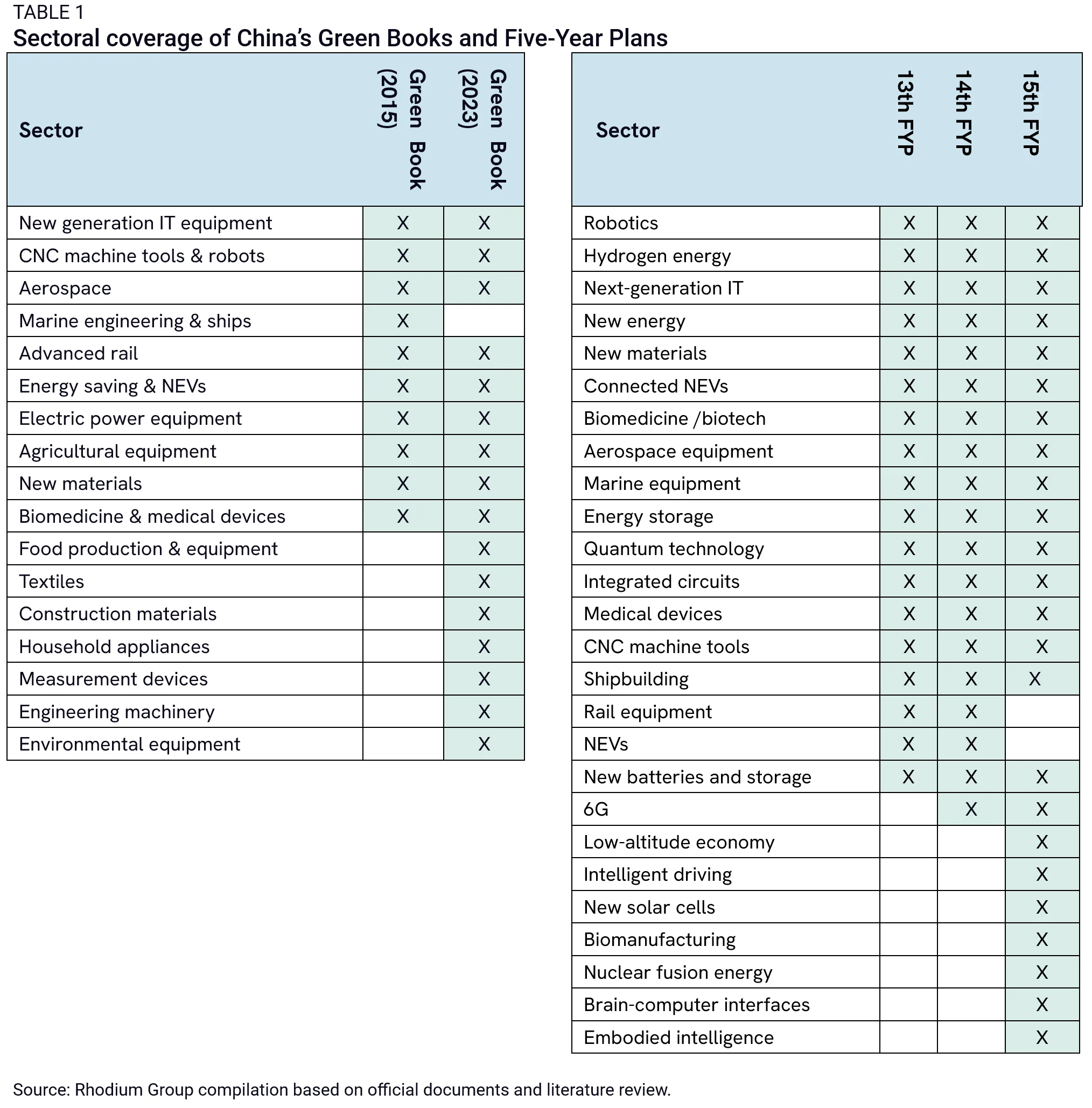
This sectoral expansion, from mature industries to cutting edge technologies, suggests that China’s industrial policy is evolving from a strategy focused primarily on breakthroughs in strategic sectors toward a broader effort to reshape the entire industrial ecosystem. The growing sectoral breadth of these objectives is complemented by an increasingly granular, product-level mapping within each sector, with different segments of the same industry subject to different policy objectives. The result is a much more comprehensive effort to target specific niche technologies and capabilities.
This section examines in more detail the expanding sectoral scope of China’s industrial policy, looking at emerging industries, established industries, frontier technologies, and services.
Strategic emerging industries and supply chain chokepoints
Beijing’s national industrial policy initiatives of the past decade have targeted a range of advanced manufacturing sectors, notably through MIC25 and the Strategic Emerging Industries (SEI) framework, introduced in 2010 and updated in 2016. While the emphasis differs across these policy frameworks, these industries share common characteristics: The Chinese leadership believes they underpin future economic growth and global competitiveness, and they are areas where China has faced persistent dependence on foreign technologies. These industries, from semiconductors to robotics and advanced pharmaceuticals, remain at the forefront of China’s industrial policy strategy.
However, as China progressively reaches greater self-sufficiency across sectors, its sectoral targets are shifting. Beijing is still laser focused on eliminating its dependencies on foreign countries for the most critical technologies. According to the 15th Five-Year Plan, it is implementing “extraordinary measures to achieve decisive breakthroughs in key core technologies” in sectors where it still lags foreign competitors. These are identified in the plan as “integrated circuits, industrial machine tools, high-end instruments, basic software, advanced materials, and biomanufacturing,” a list we also noted in previous reports (Was Made in China 2025 Successful?).
By contrast, some sectors such as high-speed rail or shipbuilding have moved out of the core policy spotlight, reflecting their global competitiveness and technological maturity. This does not mean support has disappeared. Leading firms continue to receive substantial state backing: For example, CRRC remains the 7th largest recipient of direct subsidies among listed companies, and China Shipbuilding Industry Company ranks within the top 3%. This is because support in China’s system is persistent, not temporary: Firms enter the policy ecosystem but rarely exit, especially when they are central state-owned enterprises.
In other sectors where China’s industrial upgrading has been extremely successful, like clean tech and automotives, policy attention shifts within them toward more advanced and specialized segments. For example, moving from batteries in MIC25 to “new types of batteries” in the 15th Five-Year Plan, from solar to “new solar cells,” and from NEVs to “connected and smart NEVs.” This reflects a continuous upgrading logic, where achieving dominance at one stage prompts a move to the next technological frontier.
While MIC25 emphasized catching up and attaining leadership in a set of strategic emerging end-use industries, Beijing is strengthening its focus on addressing gaps in the underlying layers of production across the entire economy. The objective of targeting supply chain chokepoints is not new: It was introduced in 2014 through the “four industrial foundations” framework and subsequently embedded in a range of targeted policy initiatives. But there are clear signs that this objective has since been elevated, with new tools and resources deployed to target specific nodes in supply chains. Official documents consistently stress that China’s manufacturing system is “broad but not strong,” with persistent weaknesses in foundational inputs. This shift is visible in successive five-year plans. References to “industrial foundations” and “industrial chains” rose sharply in the 14th and 15th Five-Year Plans, and the 14th Plan introduced the concept of “industrial foundation re-engineering,” signaling the renewed attention to strengthening underlying capabilities.
The list of supply chain gaps to address is also broadening. The earlier focus on the “four industrial foundations” (basic components, materials, processes, and technology platforms) expanded to six in the 2021 “Catalog of Industrial Foundation Innovation and Development,” adding industrial software and high-end equipment. The Catalog shifted from a targeted, sector-centric bottleneck list (682 items across 11 sectors) to a system-wide capability map (1,047 items across 21 sectors). In 2016, product coverage concentrated in a few strategic, high-end equipment sectors (such as IT, aerospace, marine equipment, and machine tools) reflecting a focus on closing critical gaps in core components and systems. By 2021, emphasis expanded horizontally to materials, industrial software, and energy systems, as well as into more industries (e.g., steel, textiles, home appliances, petrochemicals).
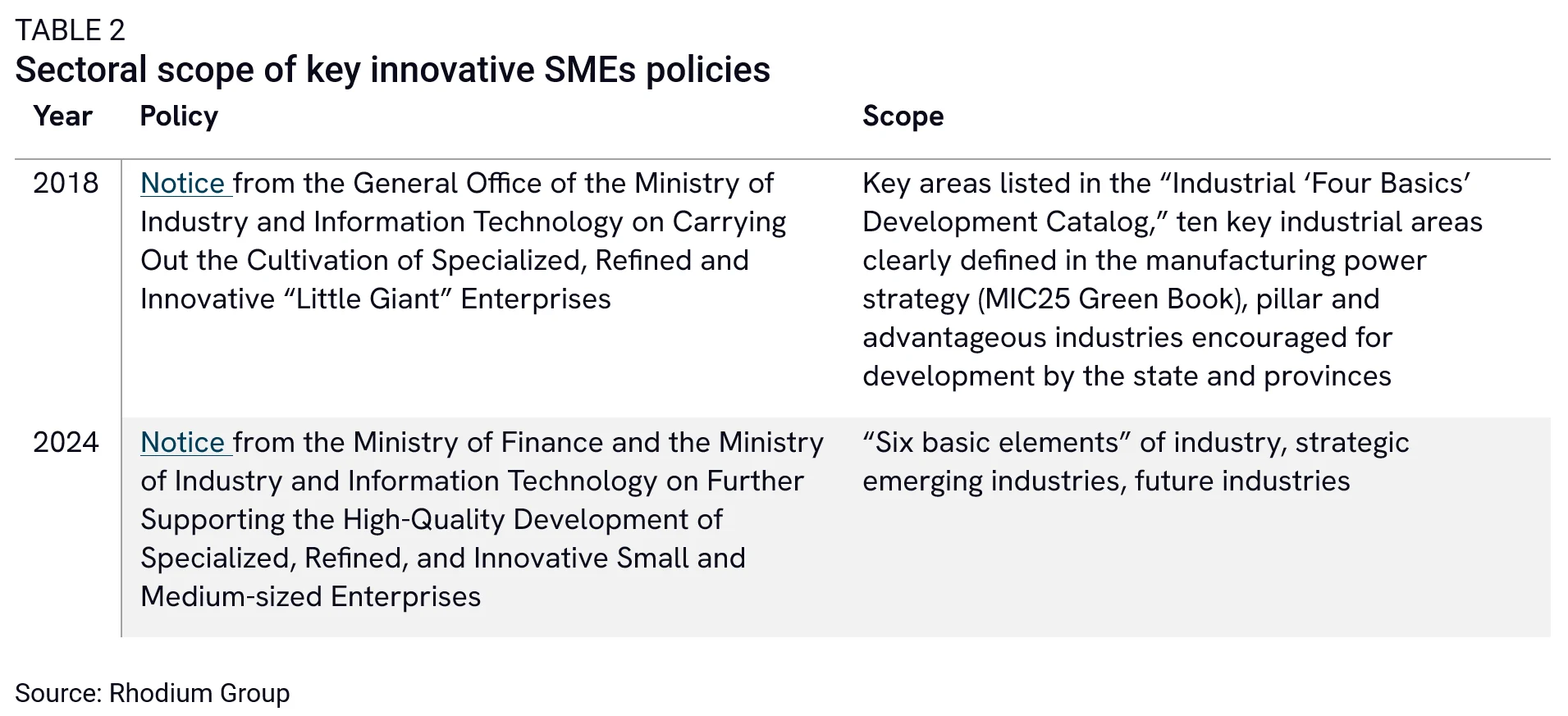
Policymakers are focusing on system-wide capacity-building through a tiered program for innovative small and medium companies. Launched in the late 2010s, the system allows firms to progress through a hierarchy: from Specialized, Streamlined, Characteristic, and Novel (SSCN), to “Little Giant,” and ultimately to “Individual Champion.” At its core, the program functions as an industrial upgrading mechanism. Firms must meet minimum thresholds on R&D intensity, technological capability, and operational efficiency to qualify. Firms that qualify receive a wide range of policy support, including central and local subsidies, tax incentives, and preferential access to financing and research programs.1 The program’s importance rose sharply under the 14th Five-Year Plan and was formalized in 2022 as the current three-tier system. As its role expanded, policymakers set ambitious scaling targets—ultimately aiming for roughly 100,000 SSCNs, 10,000 “Little Giants,” and 1,000 “Individual Champions.” The innovative SME program illustrates the evolution of the core products targeted by China’s industrial policy, from four to six “industrial foundations,” but also to future industries (Table 2).
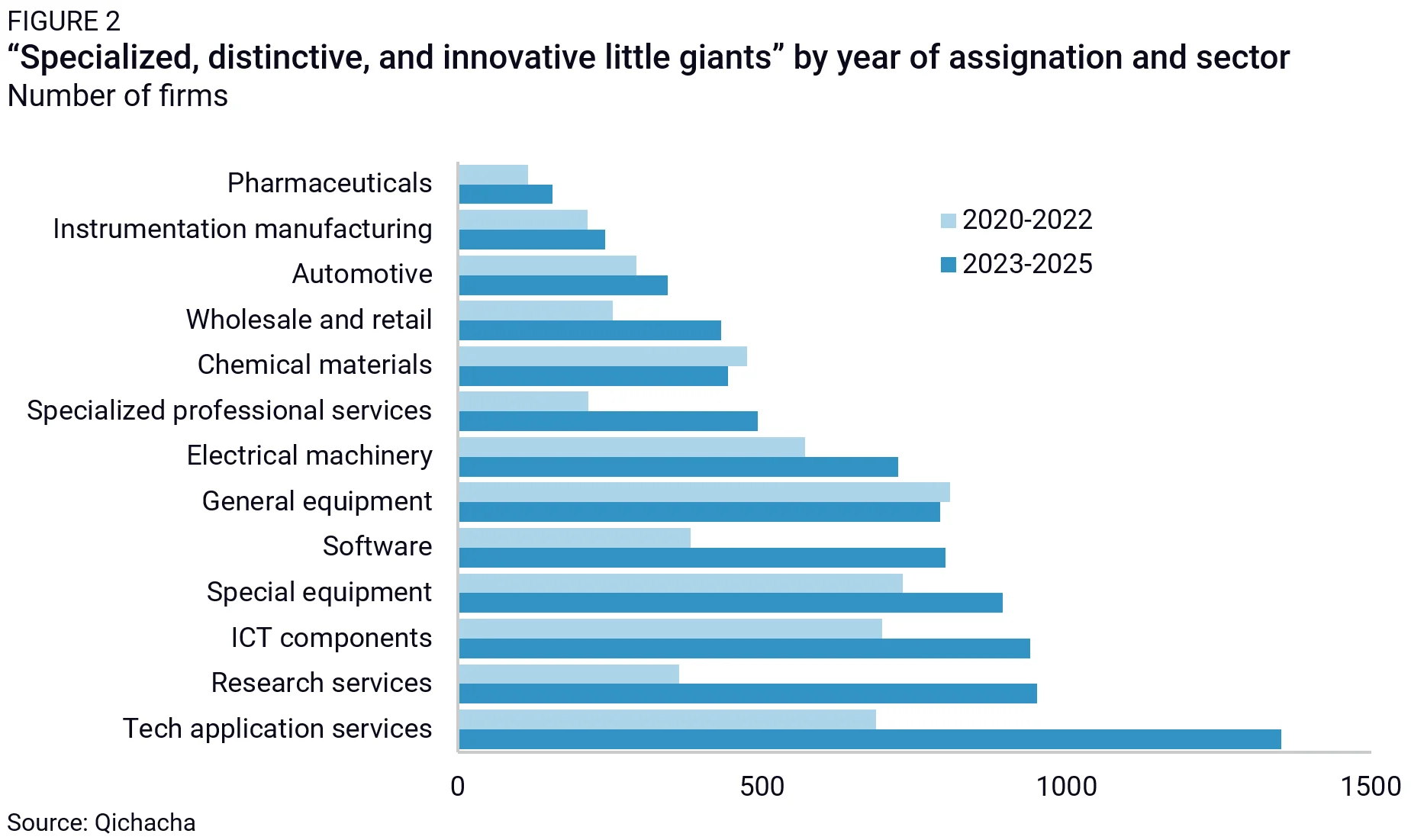
While the program initially focused on firms embedded in advanced manufacturing supply chains, it is also gradually expanding into services. The fastest growth in new program qualifiers between 2020-22 and 2023-25 occurred in technology services, research services, software, and professional services (Figure 2).
This expanding focus on every node of the supply chain may significantly reshape global value chains. It will likely displace incumbents, especially Japanese, German, and South Korean firms, in core upstream niches. China already dominates parts of this upstream landscape, from critical minerals to wafers and magnets. The next generation of China’s industrial policy may push this dominance broader and deeper, extending it across thousands of inputs, components, and production equipment products that underpin entire manufacturing systems.
Upgrading established industries
Established industries are increasingly at the center of China’s industrial policy. Established industries, such as steel, petrochemicals, shipbuilding, EVs, and solar, are characterized by technological maturity, where Chinese firms have largely caught up with global peers, but also by slowing growth and mounting overcapacity pressures. Each of these industries was at one point the object of intense policy support. For example, the 2009 Ten Major Industry Revitalization Plans introduced a set of industrial adjustment measures prioritizing automobiles, steel, electronic information, logistics, textiles, equipment manufacturing, non-ferrous metals, light industry, petrochemicals, and shipbuilding. Over time, Chinese firms mastered these technologies, expanded production at scale, reduced or eliminated import reliance, and achieved global competitiveness.
In earlier periods, the maturation of these sectors led policymakers to focus on rebalancing and capacity management. While these sectors remained central to employment, investment, and local GDP in the mid-2010s, policy focused on addressing the consequences of excess capacity, fragmentation, and pollution through capacity cuts, consolidation mandates, and tighter environmental enforcement.2 In the 2020s, however, mature sectors were revalorized as strategic pillars and increasingly treated as strategic assets to be supported and upgraded. The 15th Five-Year Plan reflects this shift: A dedicated section on “optimizing and upgrading traditional industries“ now occupies a leading position in the industrial policy chapter.
Growing emphasis on mature industries likely reflects the renewed importance of supply chain security in Beijing. First, maintaining and upgrading these industries is seen as a way to strengthen China’s control over key global chokepoints. The 15th Five-Year Plan, for example, mentions “enhancing the competitive advantages of rare earths,” an objective that was absent from previous policies. Second, the focus on traditional industries reflects a strategy to maintain labor-intensive manufacturing domestically. As the Central Commission on Financial and Economic Affairs highlighted in 2023, China must “insist on promoting the transformation and upgrading of traditional industries and cannot regard them as ‘low-end industries’ to simply abandon.” Last, traditional industries are increasingly viewed as a strategic industrial buffer that underpins supply chain resilience. The chapter on legacy industries in the 15th Five-Year Plan, for example, includes a section on “self-reliance and controllability of the industrial chain,” which calls for building redundancy and “backup of key industries,” to reduce exposure to external disruptions.
This renewed focus does not imply indiscriminate support across entire sectors. Policy is directed toward the most advanced segments in each sector, with the aim of accelerating the adoption of next-generation equipment, promoting higher value-added and technology-intensive product lines, and steering investment away from lower-end or redundant capacity.
Beijing recognizes the threat of overcapacity, but is still more focused on investing in advanced production technology than reducing capacity. Industrial upgrading is implemented through equipment renewal, investment guidance, and the expanded use of environmental and technical standards. Introduced through the “Two Policies” (Large-Scale Equipment Upgrades and Trade-in Program for Consumer Goods) in March 2024 and reinforced by the Guidelines for Equipment Upgrading and Technological Transformation in September 2024.
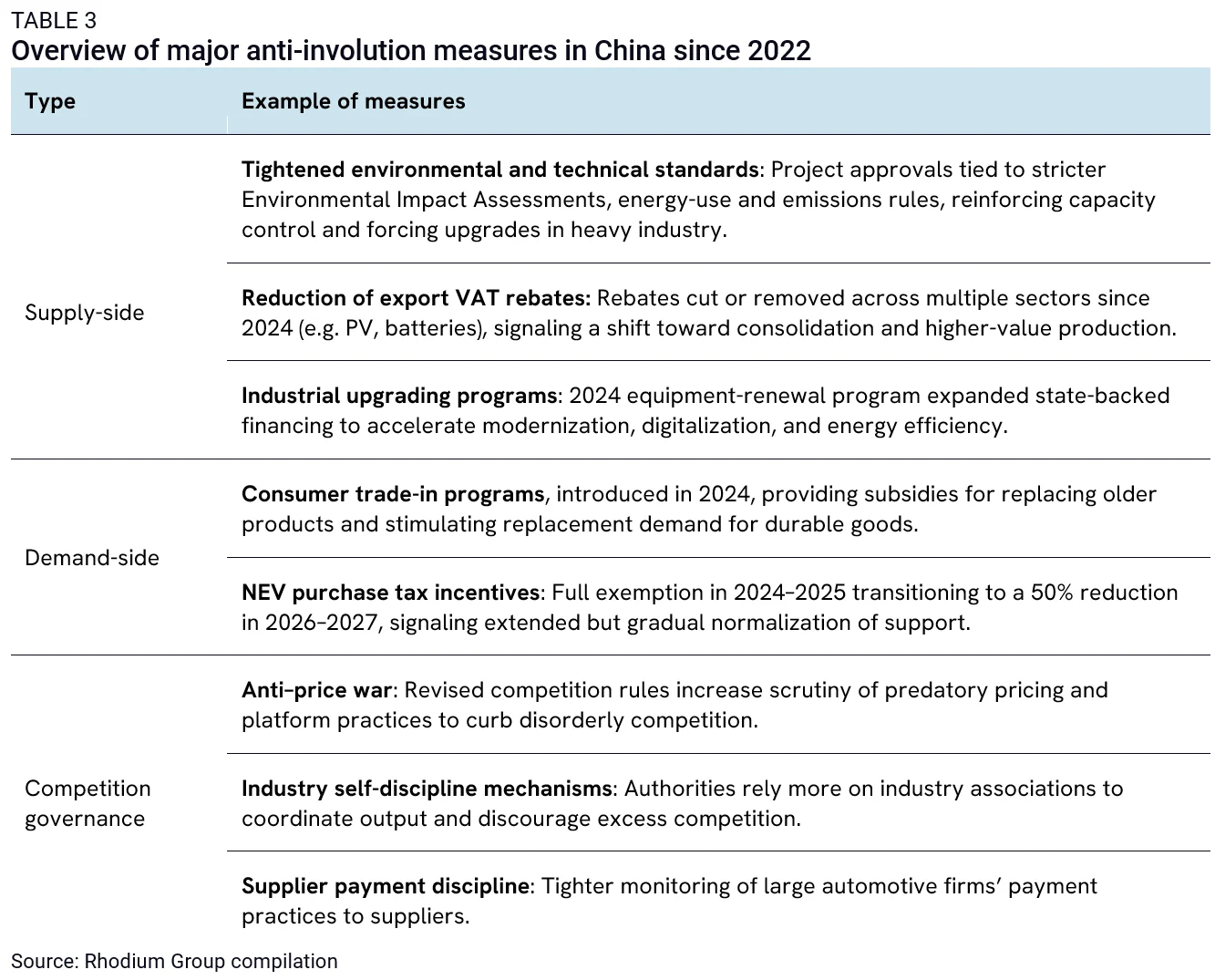
Unlike in previous rounds of supply-side reforms in response to overcapacity, current capacity upgrading is not accompanied by strict targets for cutting old capacity. In 2016-2018, central authorities assigned provincial quotas for factory closures and national capacity ceilings, enforced through local officials’ KPIs. Those instruments have largely disappeared in recent years (Table 3). Capacity replacement policies have not disappeared, but they are concentrated in a few heavy industries and are aimed primarily at regulating incremental capacity rather than mandating large-scale closures of existing plants. Similarly, consolidation through mergers and acquisitions has become more indirect and less binding, resulting in lower levels of restructuring activity than in the previous cycle.3
Anti-involution policies in the petrochemical industry show how the focus is on industrial upgrading, not demand-side stimulus or large-scale supply cuts. In September 2025, China released a national work plan aimed at stabilizing the chemicals sector, which was followed by local policy initiatives and corporate announcements. However, the scale of potential closures remains limited. The measures primarily target outdated facilities, but China’s petrochemical production base is relatively modern. For example, the “Action Plan for Intensifying the Upgrading and Transformation of Old Plants in the Petrochemical Industry” issued in April 2026 targets factories over 20 years old as outdated facilities, but only about 5% of polypropylene capacity and 6% of polyethylene capacity in China is more than twenty years old, meaning the scope for large-scale capacity reductions is inherently constrained.4 At the same time, the plan places strong emphasis on upgrading the sector’s product structure, particularly by shifting from bulk petrochemicals toward higher-value specialty chemicals. The document sets explicit growth objectives, stating that from 2025 to 2026 the added value of the petrochemical industry should grow by more than 5% annually while significantly strengthening technological innovation capabilities.
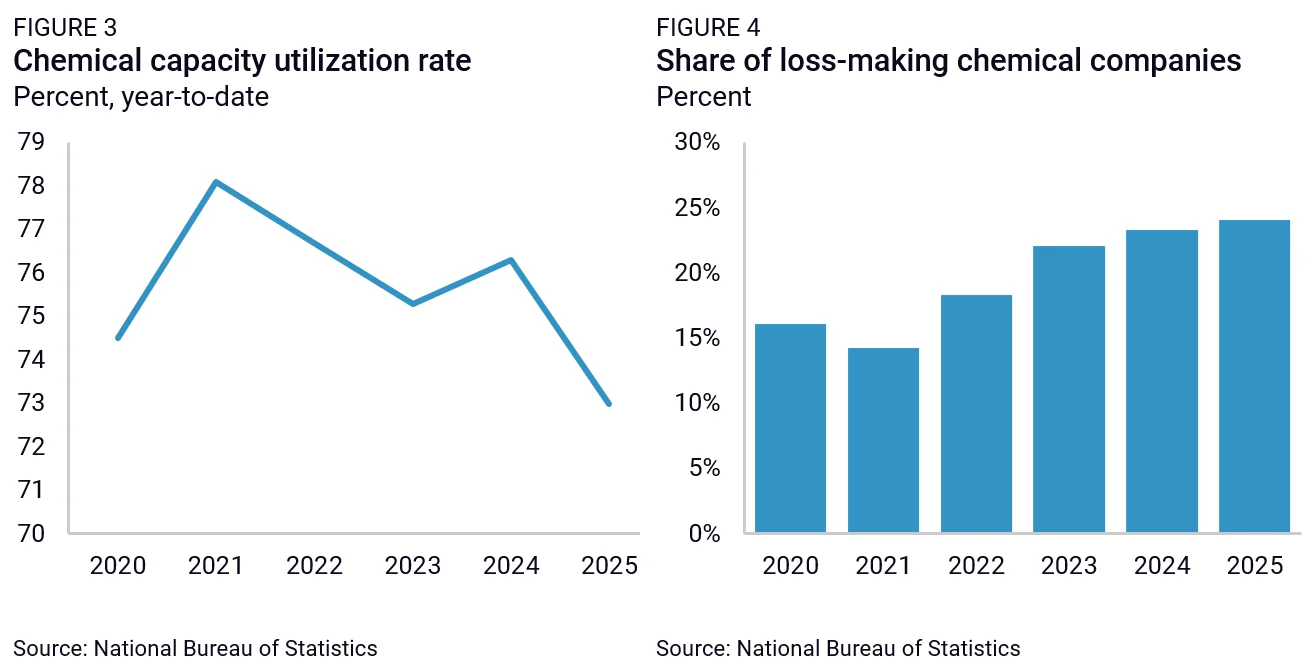
The chemical sector also provides a good illustration of the limitation of the current approach to significantly tackle overcapacity. Over the past few years, the chemical industry’s capacity utilization rate has continued to decrease, while its share of loss-making companies has continued to increase (Figures 3 and 4). The Iran conflict is likely to cement overcapacity in the sector by accelerating China’s efforts to reduce external dependence, thereby driving further investment in coal-to-olefins (CTO), a coal-based pathway to petrochemical inputs deployed at scale only in China.
Overall, the use of an industrial policy playbook in mature sectors that emphasizes continued investment in equipment upgrading and higher-tech segments of the industry will likely cement overcapacity in large parts of the Chinese economy. This will be particularly problematic, given weak domestic demand growth. Overcapacity may also appear in new product categories that are currently targeted as investment priorities—for example more high-tech specialty chemicals.
Promoting frontier technologies
Beijing is working to deploy frontier technologies at an accelerated pace, investing more in commercializing its cutting-edge R&D and innovation investments. In contrast to emerging industries, Chinese industrial planners define “frontier technologies“ as pre-commercial domains with high technological uncertainty and strategic importance for long-term competitiveness. Historically, China maintained a functional distinction between innovation policy that focused on foundational research, talent, and national S&T programs, and industrial policy that targeted sectors already commercialized or nearing commercialization.5 While closely coordinated under past policy regimes, these domains were distinct. For example, they featured in separate chapters of the 13th FYP issued in 2016. The 14th FYP began to blur these boundaries, but frontier technologies were still framed largely as areas for exploration and incubation rather than full-fledged industrial policy targets. By the 15th FYP, the focus has shifted toward industrial ecosystem development for frontier technologies, including through public investment in enabling infrastructure, direct incentives for market creation, and mobilization of central SOEs in purchasing key products.
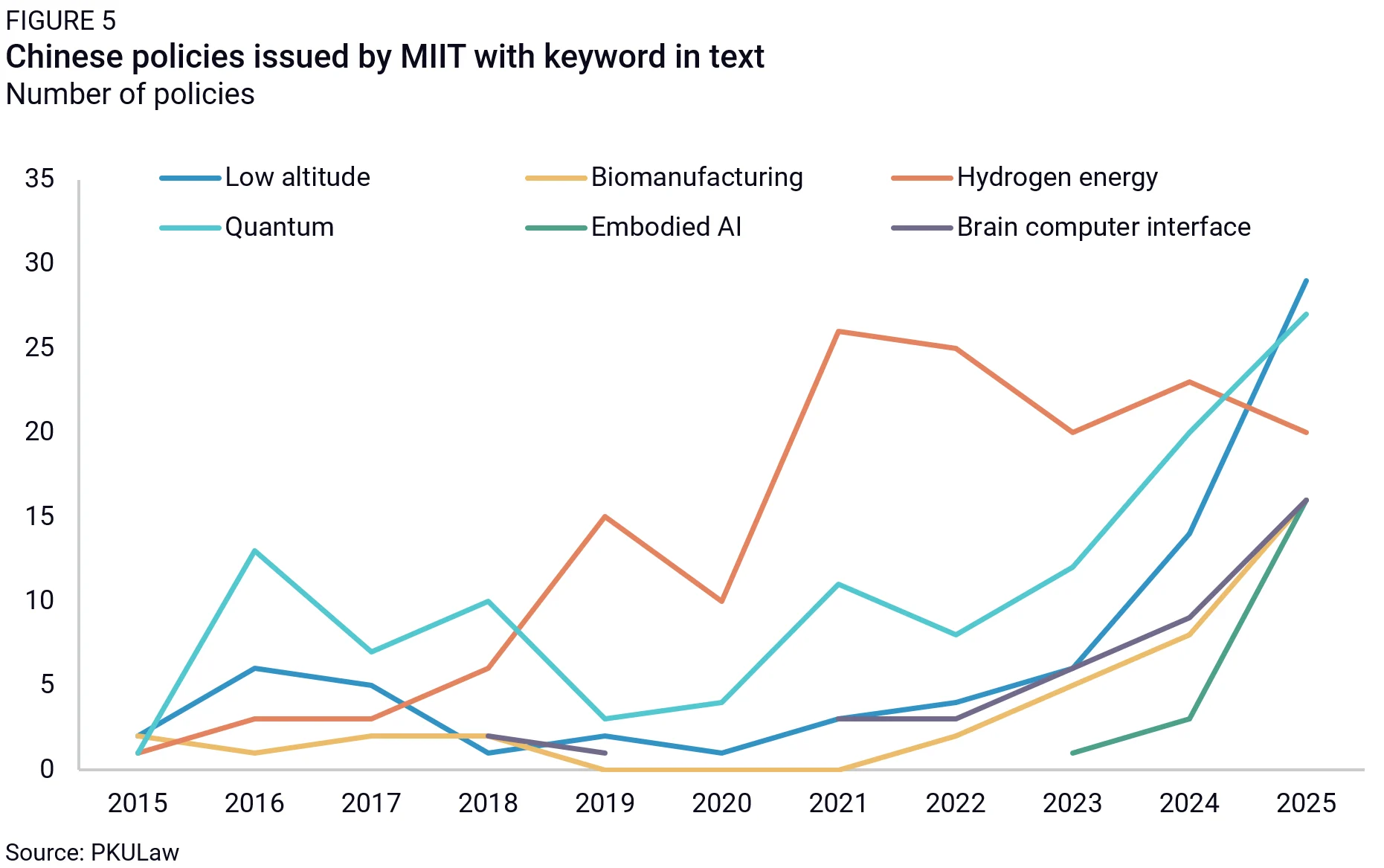
Frontier technologies such as embodied AI, brain–computer interfaces, fusion energy, and 6G are now supported by both R&D programs and efforts to commercialize nascent technologies. This elevation is also visible in the policy landscape, where the Ministry of Industry and Information Technology (MIIT), traditionally responsible for industrial policy, has published a rapidly growing number of policies on frontier technologies such as low-altitude aviation, embodied AI, brain–computer interfaces, biomanufacturing, hydrogen energy, and quantum technologies (Figure 5).
In practice, addressing frontier technology through the industrial policy toolbox means orchestrating downstream markets and resources to create demand. In earlier strategic sectors, from renewable energy to electric vehicles and batteries, China paired supply-side support for domestic producers with demand creation policies. The EV sector is a prominent example. Manufacturing subsidies and local content support were combined with consumer purchase incentives, charging infrastructure rollout, and regulatory measures such as license plate privileges and fleet electrification mandates.
A similar approach is increasingly used to encourage the commercialization of frontier technologies, with the concept of “scenario-based development.” First introduced by MIIT around 2021-20226 the concept quickly diffused across ministries and was incorporated in a State Council policy by 2025, before being incorporated into the 15th Five-Year Plan. Scenario-based policy aims to incentivize and subsidize demand for technologies that are not fully commercialized yet. The 2024 “Implementation Opinions on Promoting Future Industry Innovation” formalized this approach, identifying a range of technologies (from ultra-large AI computing centers, to satellite internet, eVTOL aircraft, deep-sea exploration equipment, and digital-twin-enabled healthcare), for commercialization.
In practice, this involves mobilizing firms, especially central SOEs, as well as local governments and public institutions to identify and create “use scenarios” that can absorb new technologies that do not yet have a demand base. For example, in the “low-altitude economy,” authorities are encouraging actors across sectors such as agriculture, urban governance, logistics, tourism, and public services to integrate drone and aerial technologies into their operations. Use cases for drones range from basic package delivery to spraying pesticides on crops and medical uses such as rapid medical supply delivery and emergency rescue. This is complemented by public investment in enabling infrastructure, including the use of local government special bonds to finance low-altitude networks and facilities. Policy tools also include direct incentives for market creation, with local governments offering cash rewards and subsidies to firms that develop and scale application scenarios. For instance, cities such as Suzhou have introduced financial incentives for companies operating low-altitude logistics distribution.
The 15th Five-Year Plan also more explicitly links large S&T research programs with industrial and technological applications. It elevates demand for key enabling technologies as a central criterion for public R&D support and opens the national system to the inclusion of enterprise-led projects. Large national S&T programs are operationalizing this through an increased focus on industrialization. For example, the “Pilot Projects for the Industrialization of High-Tech Achievements from the National Key R&D Program“ issued in 2025 identifies mature research outputs and pairs them with companies for industrial scaling. The pilot started with a first batch of 67 technologies, concentrated in sensors, advanced materials, industrial software, and advanced manufacturing equipment, illustrating a broader effort to connect state-funded R&D more directly with industrial supply chains and large-scale production.
Artificial intelligence as a core industrial policy strategy
Artificial intelligence (AI) illustrates both the promise and the constraints of China’s frontier technology strategy. It stands out as a special case because it has been elevated above other future industries to the status of a cross-cutting, foundational technology. The term appears four times in the 13th FYP, six times in the 14th FYP, and 52 times in the 15th FYP. At the local level, the number of policies with AI in their title has surged from two in 2016 to 235 in 2024 and 584 in 2025.7 The role of AI in China’s industrial policy ecosystem is also evolving. Rather than treating it simply as a technology to develop, the 15th FYP frames it as an infrastructure-like technology, underpinning entire industrial ecosystems. The goal is to use AI to achieve all the other objectives of China’s industrial policy: upgrading mature industries, addressing chokepoints in emerging industries, developing services, and accelerating productivity growth.
At the same time, AI policy closely reflects the standard industrial policy playbook China is now applying to frontier technologies. China is leveraging its entire industrial policy toolbox in the sector, with enormous resources dedicated to solving chokepoints in the semiconductor segment, encouraging innovation in the software segment, and incentivizing diffusion across the economy. Policy initiatives like the “AI+” initiative, issued in August 2025, and the subsequent “AI + Energy” and “AI + Manufacturing” policies issued respectively in September 2025 and January 2026, aim to create a market for AI applications. The government is mobilizing demand and asking state actors to contribute to demand for AI products. Public procurement (including both SOEs and government entities) has emerged as a particularly visible lever: In the first half of 2024 alone, government and SOE buyers issued hundreds of tenders for large-model-related projects, with total contract values exceeding RMB 1.3 billion, more than double the total for all of 2023. SASAC explicitly instructed SOEs to pursue “demand-driven” AI development strategies and accelerate the construction of enabling infrastructure. The new guidelines, effective January 2026, formalize preferential treatment for domestic products in public procurement, including in software development and digital infrastructure, thus effectively creating a protected market for Chinese players.
Because China already has a vast domestic demand base in its manufacturing industry, particular attention is given to scaling applications in that market. MIIT’s “Artificial Intelligence + Manufacturing” Special Action Plan, for example, focuses specifically on industrial adoption, targeting the deployment of 3-5 general-purpose large models in manufacturing, the creation of 1,000 industrial AI agents, 100 industrial datasets, and 500 application scenarios, alongside the development of globally competitive ecosystem leaders. The plan outlines the use of AI in smart robotics, predictive machine maintenance, automatic quality control, and AI-enhanced design and R&D.
However, the Chinese market remains structurally constrained in its ability to translate rapid AI deployment into sustainable revenues. Despite strong adoption metrics, monetization remains limited. In global comparisons of leading AI companies by annual recurring revenue, Chinese firms account for only a marginal share of total revenues. According to a joint analysis by Unique Research and Tech Buzz China, only four Chinese companies rank among the world’s top 100 AI applications by ARR, generating a combined $447 million (just 1.23% of the $36.4 billion total) while the overwhelming majority of revenues are captured by US-based firms.
These outcomes are closely tied to structural features of China’s domestic economy. First, low willingness to pay for digital services, both among consumers and enterprises (even SOEs), compresses pricing power and limits the scalability of recurring revenue models.8 This is reflected in pricing dynamics: Chinese AI developers have been undercutting international competitors by as much as 90–97%, triggering an intense price war that prioritizes user acquisition over profitability.
Second, the small size of China’s services sector limits the impact of the most potent applications of AI. Globally, services represent the fastest-monetizing segment for AI, due to their high data intensity, frequent user interaction, and standardized processes. Services (such as finance, e-commerce, logistics, customer service, search, marketing, coding, and professional services) are also among the earliest adopters in China as well, according to recent reports by the China Academy of Information and Communications Technology.9 Even in manufacturing companies, 74% of LLM adoption is concentrated in marketing, services, operations, although adoption in manufacturing processes is growing fast.10
These constraints are pushing Chinese AI firms to look outward and experiment with alternative commercialization strategies. A growing number are adopting a “born global” model, targeting overseas markets where pricing power is significantly higher. As Red Xiao, founder and CEO of Manus, put it: “Overseas users may be willing to pay up to five times more for software than Chinese users, and pricing can be set in US dollars. With an exchange rate of seven, that translates to a market that is at least 35 times larger.” So far, many Chinese AI companies have embraced open-source models as a means of expanding globally, rapidly capturing a growing share of global downloads with cheap high-end models.11 This strategy is already visible in firm-level data. In a ranking of the 100 largest AI products worldwide by annual recurring revenue, among the 23 Chinese developers, 19 generated most of their revenue overseas. Companies like MiniMax have rapidly reoriented toward international markets, with overseas revenue rising from 19% of their total revenues in 2023 to over 70% by 2025 (with 24% from the Americas). Others, such as Zhipu are scaling global markets, offering coding tools at around $3 per month (roughly one-seventh the price of comparable US products) to attract users across more than 180 countries. Even large US firms such as Airbnb are adopting Chinese models because of their low costs. However, this strategy may prove difficult to sustain, and some Chinese firms like Alibaba have recently started shifting strategies to better monetize their large language models.
At the same time, China’s manufacturing strength may monetize embedded AI in physical products. More than 20 Chinese automakers have announced plans to integrate large models such as DeepSeek into vehicles, enhancing features like voice control, navigation, and in-car assistants. All major smartphone brands, including Huawei, Xiaomi, Oppo, and Vivo, have incorporated similar models into their operating systems, while companies like Midea are marketing AI-enabled appliances as “understanding” user needs in real time. Huawei’s push to integrate AI deeply into its HarmonyOS ecosystem, across phones, cars, and home devices, illustrates the ambition to turn AI into a layer embedded across exported hardware. Even if foreign countries raise barriers to Chinese AI software, this “embedded intelligence” model may offer a workaround and still be exported at scale, allowing China to capture value through manufacturing while diffusing its technology globally. The model is not without tensions, even within China. Many third-party apps resist attempts by AI agents to access and control their data within integrated ecosystems, while state-owned telecommunications firms and private internet platforms compete over data standards. Huawei occupies a unique position in this power struggle as it spans all layers of the AI stack and is therefore well placed to capture a disproportionate share of value, both in China and abroad.
Overall, China’s AI strategy illustrates both the strength and the fragility of China’s frontier technology push. China is betting heavily on its ability to leap ahead in future technologies, and its model has demonstrated clear strengths in rapidly scaling production and commercializing innovation. Future technologies create a genuine opportunity to achieve global dominance. But that strategy creates challenges, given domestic economic weaknesses and shortcomings in demand and willingness to pay for services. The domestic economic environment may therefore limit the extent to which these technologies can translate into sustainable growth. Weak demand, low willingness to pay for digital services, and compressed profit expectations all constrain incentives for innovation and diffusion, but also are forcing the PRC government and its companies to be more aggressive in seeking opportunities abroad. Whether China can translate its technological advances into sustainable economic growth will depend not only on its capacity to innovate, but also on its ability to generate viable business models, particularly in overseas markets when monetization at home remains constrained.
Developing services
Lastly, China’s industrial policy increasingly targets services. China’s service sector remains relatively underdeveloped compared to economies at similar income levels, particularly in knowledge-intensive business services. Services’ value added accounts for just over 50% of China’s GDP, far below the average 75% of advanced economies. The gap is especially pronounced in high-value business services such as professional services and R&D services. China’s value added in computer programming and information service activities’ share of GDP is only 3% in China, compared to 8% in the US and the UK, and 6% in Germany and South Korea. This relative weakness reflects China’s long-standing emphasis on manufacturing and industrial upgrading for economic development.
China’s economic strategy has long been ambivalent toward the service sector, which persists to this day. The 13th FYP framed the expansion of services as a structural objective, including a target to increase the share of services’ value-added contribution to GDP from 50.5% in 2015 to around 56% by the end of the plan in 2020. However, support for services had declined by the start of the 14th FYP, which called to “maintain the basic stability of the manufacturing sector‘s share.” The 15th FYP largely maintains this orientation. Manufacturing remains the organizing principle of the industrial strategy, and the plan reiterates the goal of “maintaining a reasonable proportion of manufacturing and building a modern industrial system with advanced manufacturing as the backbone.”
Yet, below the surface, industrial policy is emphasizing high-tech services in targeted areas. Chinese government actors see the potential for growth in services to benefit consumption and encourage the deployment of new digital technologies. AI, in particular, generates value primarily through downstream markets in service activities such as software development, finance, logistics, legal analysis, design, and other knowledge-intensive tasks. Reflecting this, the State Council’s “AI+“ initiative calls for expanding AI deployment across these sectors and developing new AI-driven service models. The 2024 Opinions on Promoting the High-Quality Development of Trade in Services through High-Level Opening and the 2025 Measures to Promote Service Exports, for example, aim to strengthen China’s competitiveness in internationally tradable services such as digital services, professional services, outsourcing, and R&D services. Additionally, the 2026 Opinions on Promoting the Expansion and Quality Improvement of the Services Sector promote the adoption among government agencies and SOEs of large-scale models and intelligent agent services.
The shift in emphasis and scope of services industrial policy is also visible in the attitude toward foreign investment. Traditionally, China used selective attraction of foreign companies’ investment to drive localization and import substitution. That strategy is now used in services, where the December 2025 Central Economic Work Conference emphasized opening up to foreign services, aiming “to attract more high-quality foreign investment to participate in the development of China‘s service industry.” This is implemented in practice with successive iterations of the Catalog of Industries Encouraging Foreign Investment between 2020 and 2025, where the number of encouraged investment products grew the most in service sectors. The 2025 catalog expanded the range further toward knowledge-intensive, digital, and creative services, adding categories such as knowledge process outsourcing, advertising and language technology services, and non-clinical drugs. Yet, this opening is tempered by China’s broader security framework, which continues to expand risks for foreign companies investing in the service sector. Notably, the revised Counter-Espionage Law broadens espionage definition to include overseas entities and the transfer of data, increasing legal uncertainty for overseas investors.
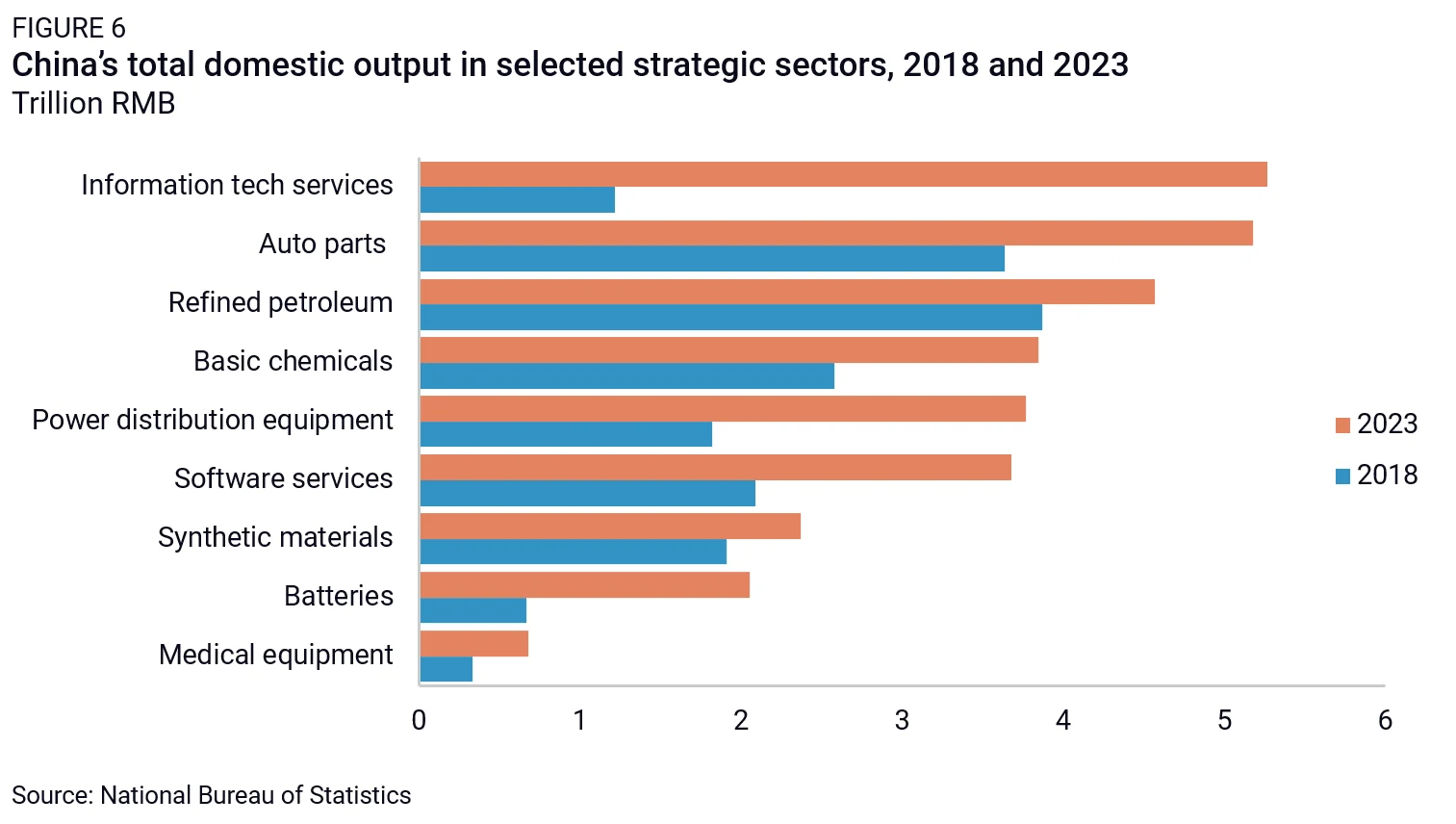
The growing policy emphasis on services is already showing up in sectoral growth patterns. According to China’s National Bureau of Statistics’ input–output tables, information technology services recorded the fastest output growth among all sectors from 2018 and 2023. Internet and related services ranked third, behind only gas production and supply (Figure 6).
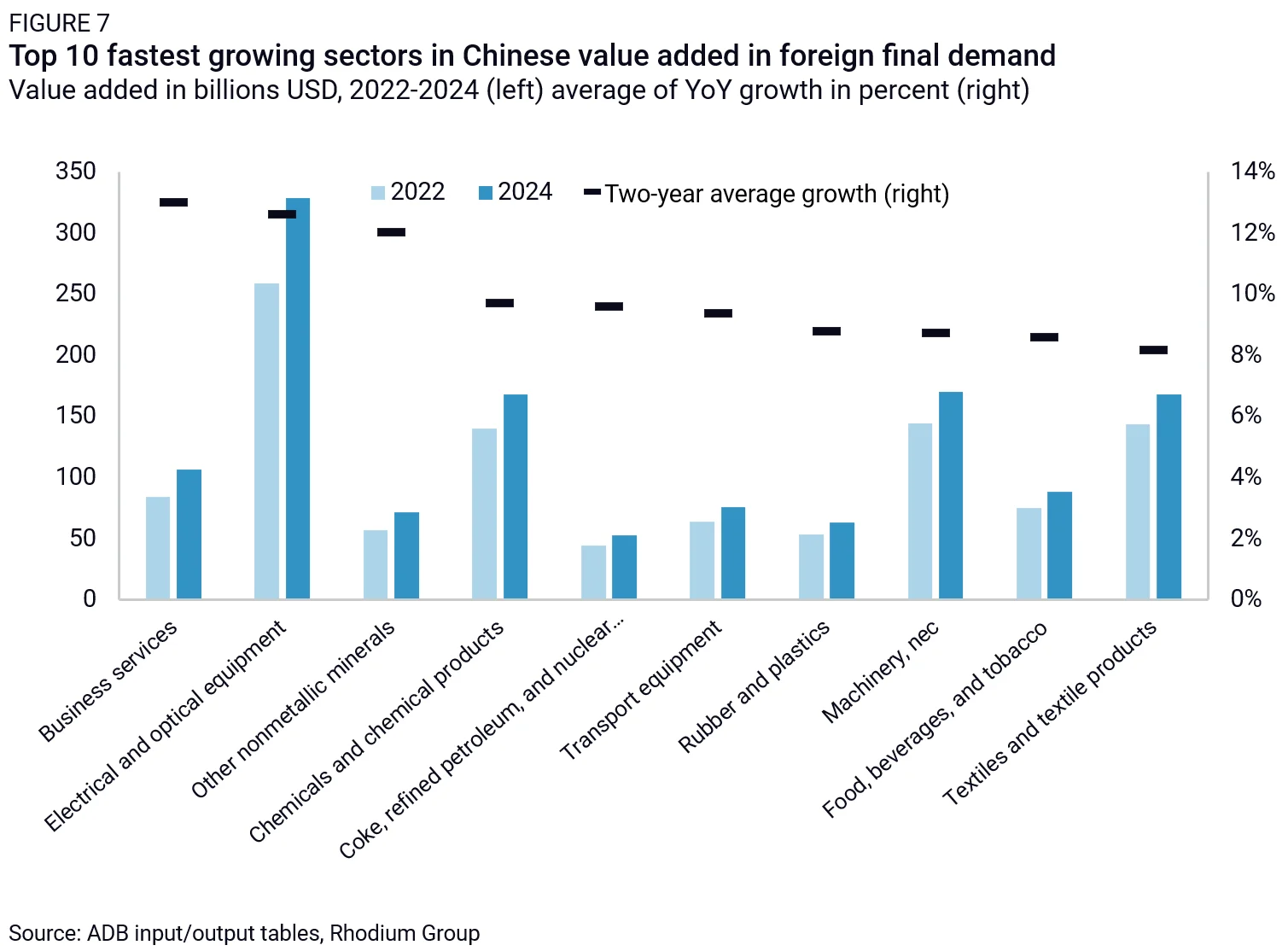
The recent growth in China’s service sector output is also visible abroad. Among all industries, the share of value-added output from China’s business services sector in other countries’ final demand grew the most from 2022 to 2024 (Figure 7), though from a low base level prior to this period.
These aggregate categories also mask an important shift within the service sector itself, where the industries showing the strongest growth are knowledge-intensive and technology-driven. Recent data show that high-tech services are expanding faster than high-tech manufacturing, growing 17.2% year-on-year in January and February 2026, compared with 14.5%, with R&D-related technical services particularly strong, posting revenue growth of 23.6% in the first two months of 2026. The biopharma sector illustrates this pattern, with rapid expansion of research and contract services supporting drug development. China’s contract research and manufacturing (CRO/CDMO) industry (companies providing outsourced R&D, testing, and manufacturing services to global life-science firms) has grown from $5.9 billion in 2018 to $11.6 billion in 2022 and is projected to more than double this size by 2027.
This shift is likely to accelerate in coming years. As manufacturing becomes more high-tech, it requires services to play a greater role. The next generation of manufacturers will likely be highly agile, networked firms that use information and analytics as skillfully as they employ talent and machinery. Moving to robotics and smart manufacturing processes highlights this change as they require servicing and software updates to be maintained. Similar to China’s downstream demand subsidies promoting upstream production, by fostering high-tech and smart manufacturing, China is creating downstream demand for a wider variety of services. Advances in AI will only drive this further.
2. Improving the industrial policy playbook
Despite Beijing’s confidence in its industrial policy playbook, its push for industrial policy and technological self-reliance comes as its traditional policy tools are weakening. Fiscal resources are increasingly constrained, credit growth is slowing, and the efficiency of capital allocation is declining. Beijing is not retreating from intervention, but is instead responding by tightening control over financial and capital markets to ensure scarce resources are concentrated on strategic sectors. The government is intervening more in equity markets, banking, and other regulatory measures in the face of tighter fiscal conditions.
Fiscal and financial pressure
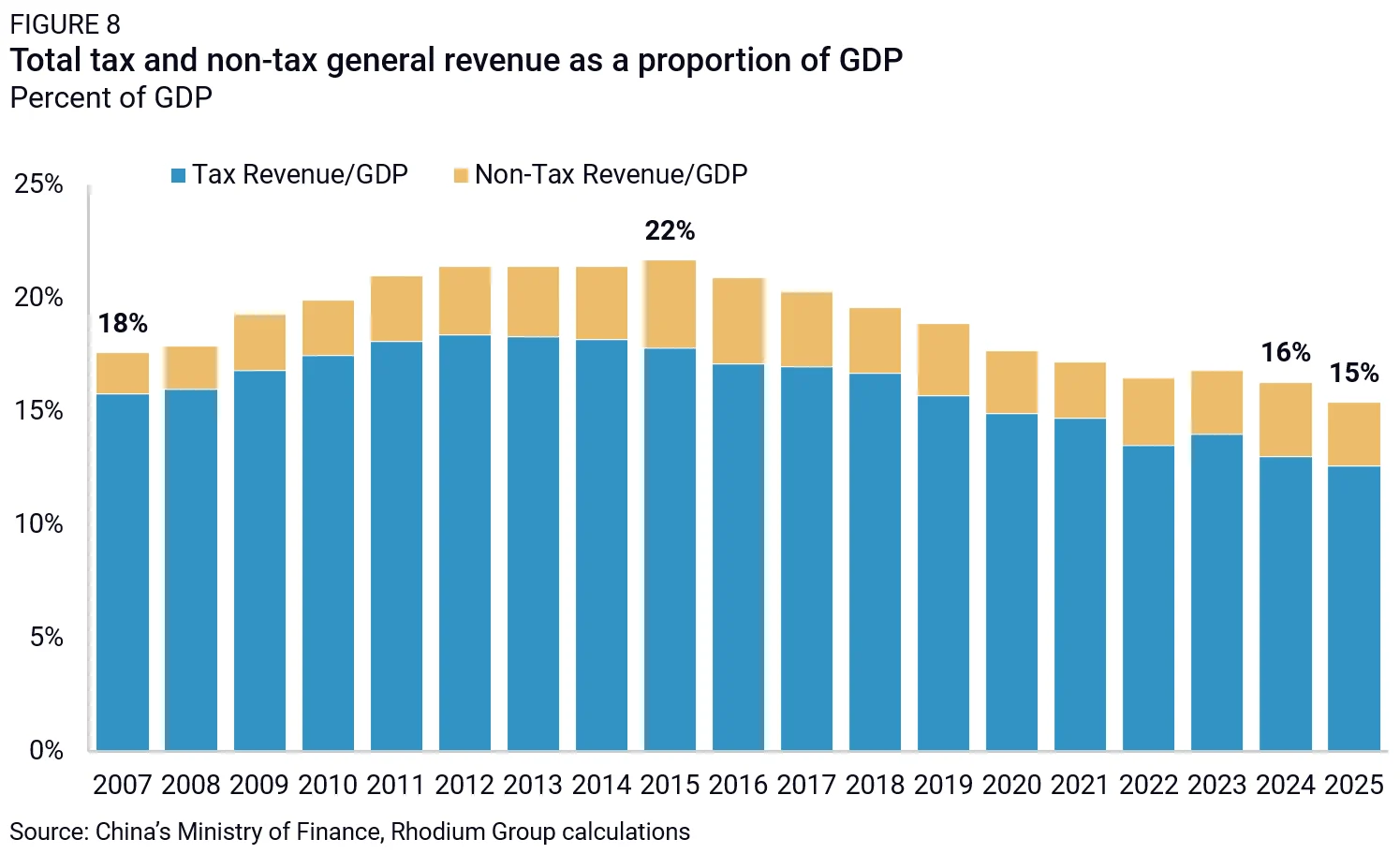
China’s fiscal capacity has weakened significantly in recent years and is increasingly tied up in sectors struggling with overcapacity. Tax and non-tax revenues fell to 15.4% of GDP in 2025, among the lowest levels across major economies and far below the OECD average of around 34% (Figure 8). As a result, the IMF estimates that the augmented fiscal deficit reached 14.3% of GDP in 2025. Faced with growing fiscal constraints, Beijing has so far adopted a conservative approach of austerity, rather than launching a stimulus by expanding fiscal deficit as a share of GDP.
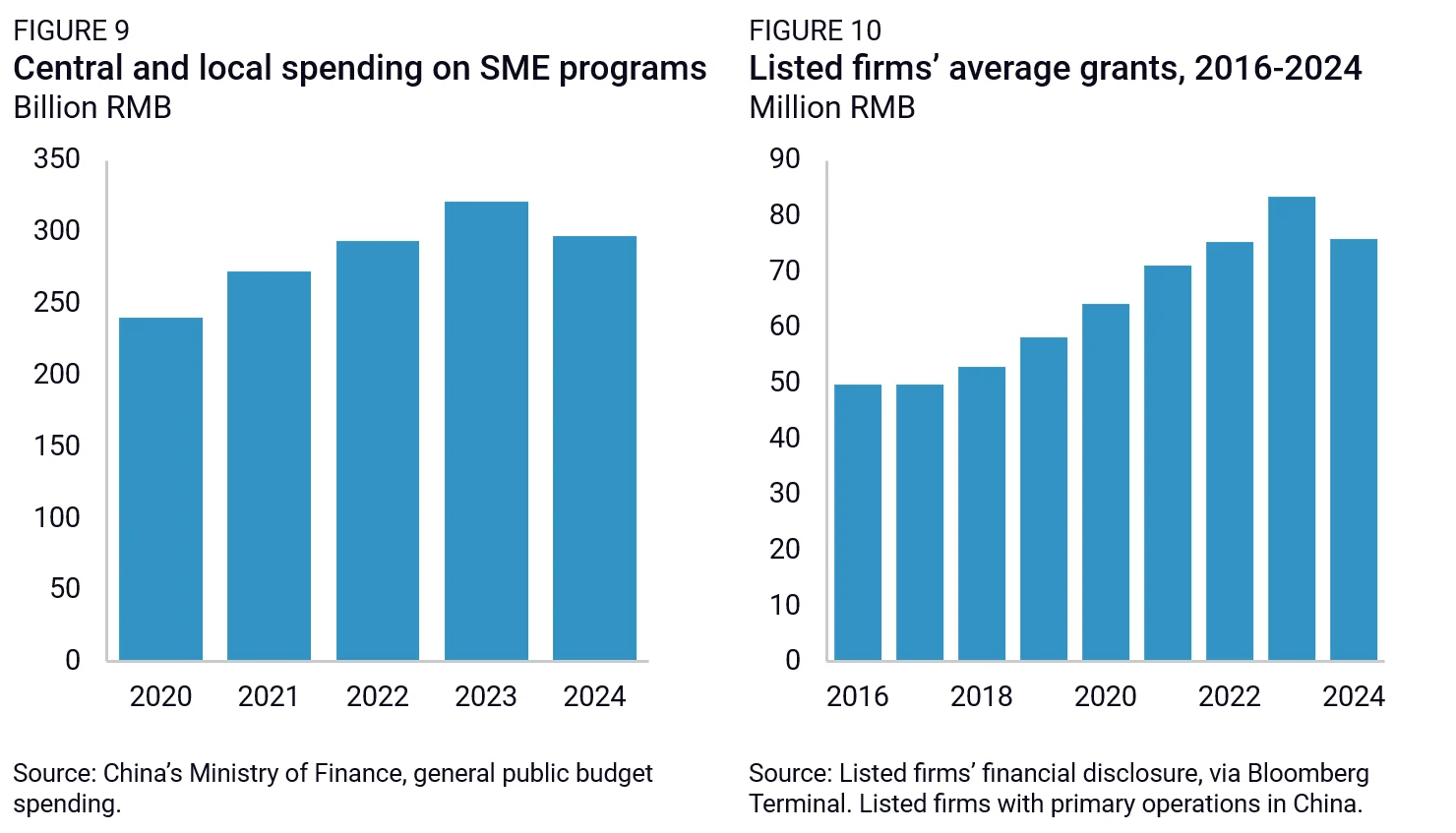
These pressures are already visible in direct subsidy programs. Government funding for SME innovation programs, which support firms designated as SSCN enterprises, Little Giants, and Individual Champions, declined slightly in 2024 (Figure 9) according to official statistics. Similarly, in 2024, average direct grants to listed firms fell to their lowest level since 2022, the first decline since at least 2016 (Figure 10) according to listed firm disclosures.
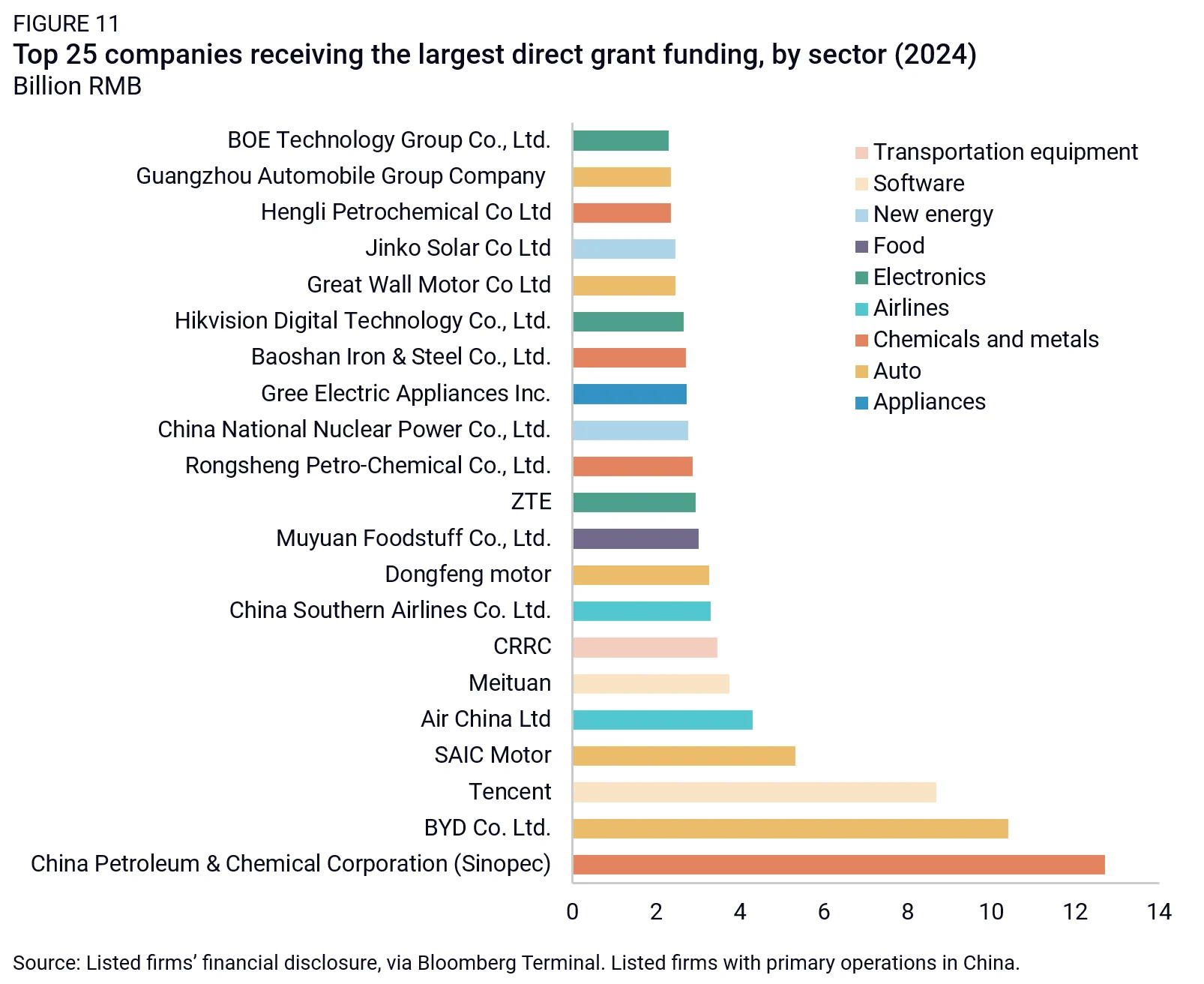
Fiscal and banking resources are also increasingly tied up supporting companies suffering from overcapacity. In the EV and battery value chain alone, manufacturing subsidies reached $17.5 billion in 2024, equivalent to 1.3% of central government revenues.12 Among the largest recipients of direct government grants in 2024 were automobile manufacturers, oil and gas producers, airlines, commodity chemical companies, new energy power producers, and steelmakers (Figure 11). Many of these industries are characterized by excess capacity and weak profitability. In recent years, authorities have also directed the banking system to extend special lending to state-owned enterprises and government financing vehicles facing financial stress, most of which are in sectors with heavy overcapacity, including to help clear overdue payments owed to small and medium-sized suppliers.
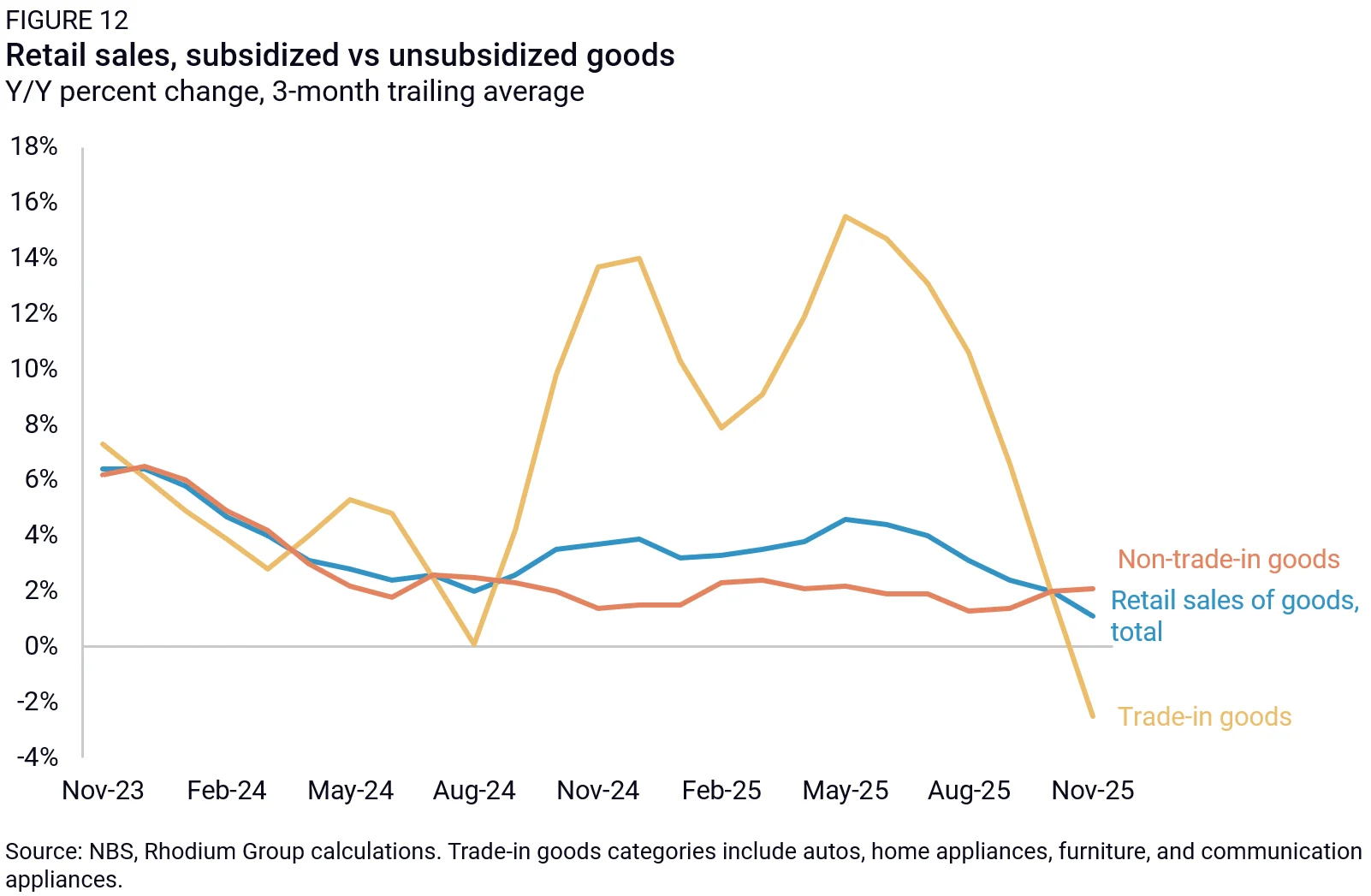
Demand-side subsidies are also under strain. Stimulating demand has long been central to China’s industrial policy, both via targeted programs for specific products (e.g., EVs) and broad-based incentives for consumption (e.g., the trade-in program). Public procurement, purchase subsidies, and infrastructure investment were critical to earlier success. Today, however, these tools are increasingly stretched, as policymakers use them to prop up sectors facing overcapacity. In 2025, the Ministry of Finance allocated roughly RMB 300 billion in trade-in subsidies, a short-term incentive scheme to encourage demand for industries under stress. Auto-related subsidies alone are estimated at a record RMB 342 billion. This includes RMB 150 billion for scrappage and trade-ins and RMB 192 billion in NEV purchase tax exemptions. Together, these incentives amount to about 3.4% of central fiscal expenditure. For 2026, another RMB 250 billion has been earmarked for trade-in support.
The scale remains modest compared to past stimulus episodes, such as the post-2008 infrastructure surge or the shantytown redevelopment program after 2015. Their effectiveness is also limited because these subsidies tend to pull demand forward rather than sustain it. The result is a costly, short-lived boost that does little to address underlying demand weakness, while constraining the state’s ability to deploy fiscal resources elsewhere (Figure 12).
Lastly, China’s financial system is also under strain. Bank asset growth averaged 18% annually between 2007 and 2016, but slowed to around 9% from 2017 to 2024, with credit growth falling further in 2025. At the same time, the efficiency of credit allocation has deteriorated. By December 2025, 58% of bank loans were issued at or below the loan prime rate (3%), more than double the share seen in 2020–2021. This likely reflects an increasing concentration of lending to SOEs and state-directed relending programs, which are better able to negotiate very low credit prices. Profitability across the banking system deteriorated in 2025 despite RMB 520 billion in capital injections into major banks. Overall, the fiscal and financial strains mean that Beijing will have to do more to support a growing set of industrial policy objectives, with less resources and less capacity to reallocate resources.
Recentralizing state resources
Faced with these growing constraints, Beijing is rationalizing resource allocation and tightening central control. Two major policy documents issued in 2025—the Guiding Opinions of Seven Departments on Financial Support for New Industrialization and the Policy Measures to Accelerate the Construction of a Science and Technology Finance System—outline a coordinated strategy to direct fiscal spending, bank lending, capital markets, and state investment funds toward technological innovation and strategic industries. Together, they formalize a whole-of-finance approach in which credit, equity markets, and state capital are explicitly tasked with supporting industrial upgrading and “new quality productive forces.”
To start with, the government is prioritizing the allocation of fiscal resources for science and technology spending. While overall fiscal expenditures grew only around 1% annually in 2024–2025, spending on science and technology increased around 5%. The 2026 budget plans nearly RMB 1.3 trillion in national S&T spending, a further 7.1% increase.
At the same time, the central government is curbing excessive local industrial policy competition in areas that are not central priorities. The 2025 Budget Report, for example, proposed standardized tax incentives and a negative list for local subsidies, prohibiting unauthorized incentives and requiring existing programs to be reviewed or abolished if they conflict with national priorities. Authorities are also considering a nationwide negative list specifying circumstances in which local governments are barred from granting fiscal subsidies. Oversight is also tightening: Following a 2024 audit findings of fraudulent subsidy claims, a late-2025 rectification report shows local governments recovered or reallocated RMB 5.975 billion in misused funds, revoked firms’ eligibility, and strengthened verification.
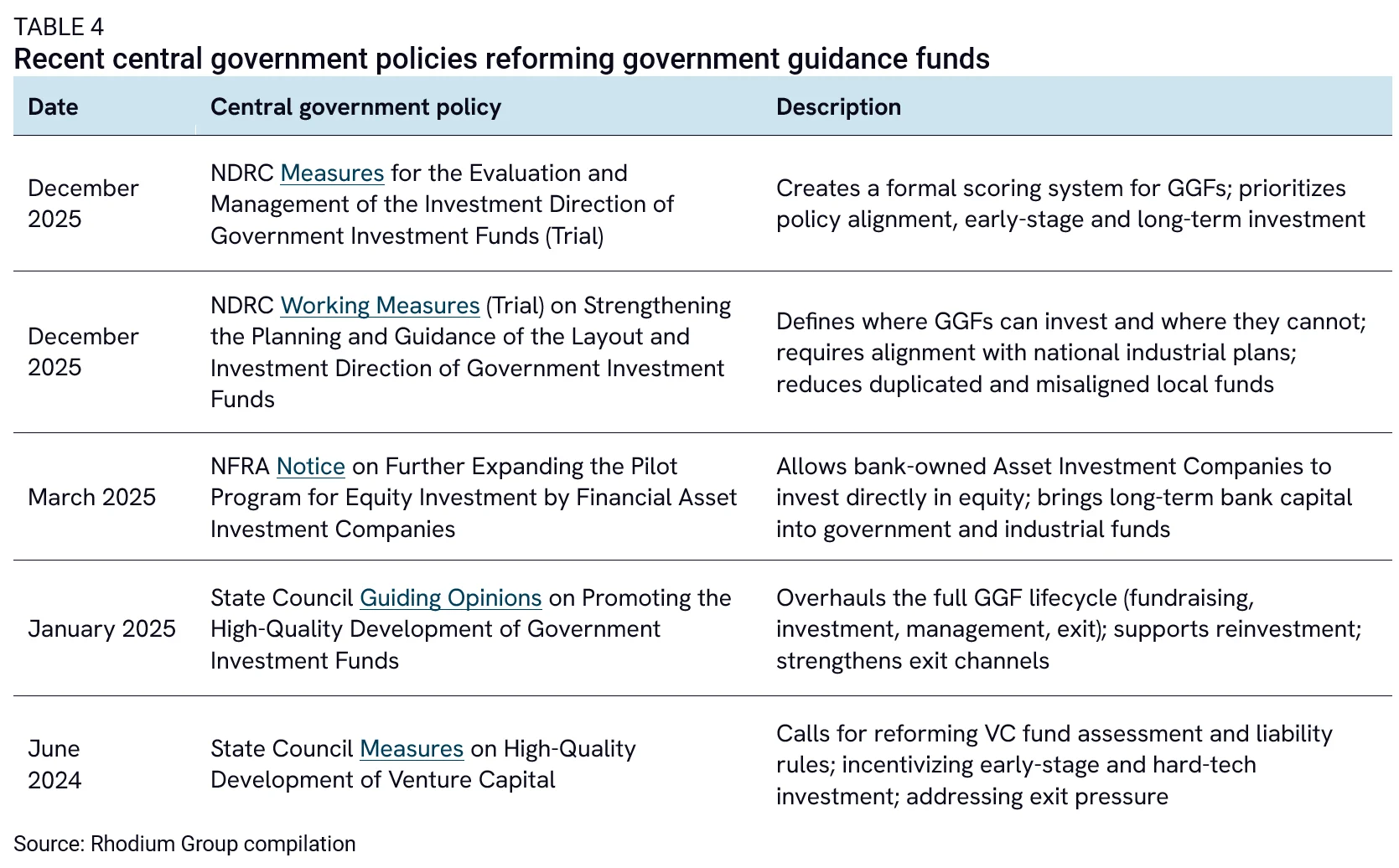
A second, and central, target of reform is the government guidance fund (GGF) system. GGFs are state-directed investment funds that combine public and private capital to support strategic industries. Over the past decade, thousands of such funds were created by local governments, often resulting in duplicated investments and inefficient capital allocation.13 Governance structures encouraged risk-averse behavior, which in many cases undercut their primary objectives: Fund managers typically operated under short performance cycles with strict audit requirements and low tolerance for losses. As a result, GGFs often favored large, politically connected firms or late-stage companies rather than early-stage technological innovation. This dynamic crowded out private capital and inflated valuations in favored sectors, but may not have aided China’s innovation goals.14
Recent policy initiatives aim to overhaul the system. New regulations introduced in 2024–2025 establish evaluation frameworks for investment direction, strengthen central guidance over fund deployment, and expand participation by financial institutions such as bank-owned asset management companies (Table 4). These reforms also emphasize longer investment horizons and greater tolerance for early-stage technological risk.
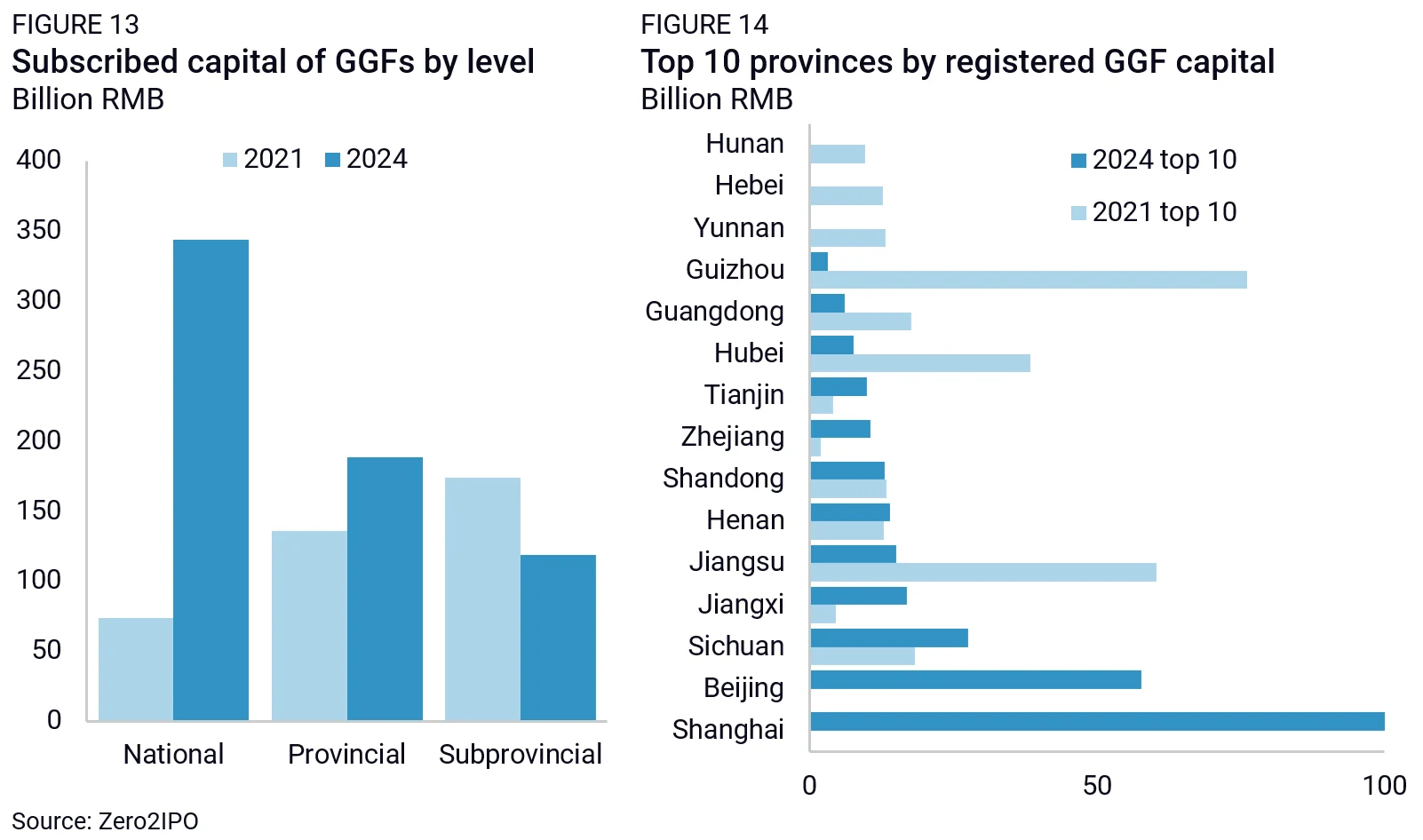
GGF activity is also becoming more centralized. Policy documents now stress coordination between central and local governments and explicitly criticize the proliferation of duplicative local funds. In practice, capital is increasingly concentrated at the national level (Figure 13) and in a smaller number of wealthy provinces with established industrial ecosystems (Figure 14).
The “Little Giants” program is undergoing rationalization, shorthand for China’s broader system of tiered SME selection and upgrading. In the lead-up to the 15th Five-Year Plan, implementation weaknesses had become increasingly evident, as local authorities prioritized quantity over quality of companies, resulting in uneven firm performance. Recent policy revisions in early 2026 introduce stricter eligibility criteria (including higher revenue thresholds), cap provincial nomination quotas based on past approval outcomes, and strengthen oversight through audits, data verification, and penalties for misreporting.
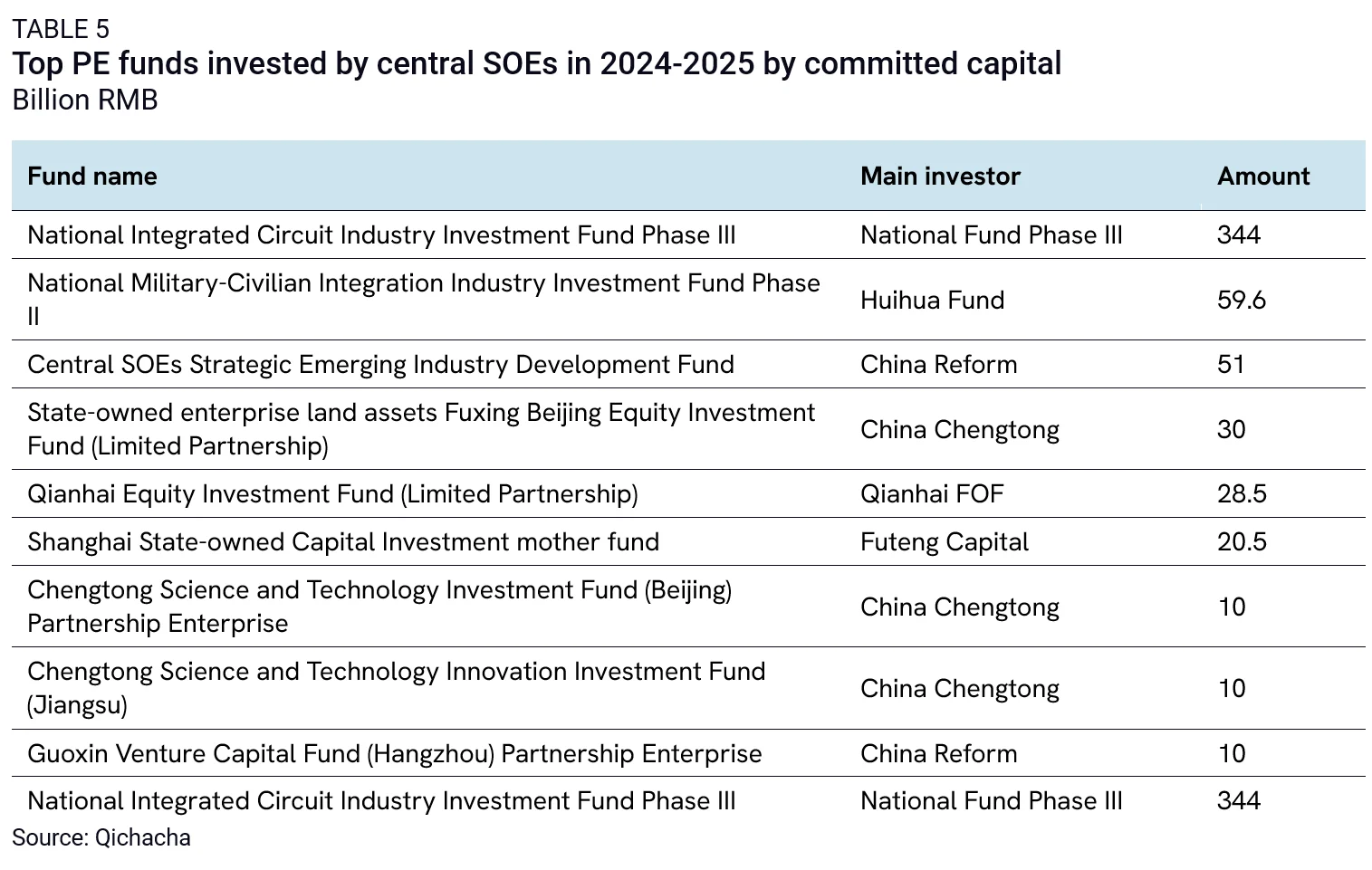
Lastly, a similar rationalization is underway among central SOEs. Over the past decade, SOEs were encouraged to establish funds and act as PE and VC investors, often with limited discipline and weak alignment with core business.10 More recently, policymakers have pushed them to refocus on strategic sectors and reduce scattered, non-core investment. In practice, after a sharp decline in SOE participation in PE funds in 2021–2023, activity rebounded in 2024–2025 in a more concentrated and professionalized form, centered on a smaller number of large, policy-aligned vehicles (Table 5). One prominent example is the Central SOEs Strategic Emerging Industry Development Fund, which became one of the largest new funds in 2025, along with the Phase II of the National Military-Civilian Integration Industry Investment Fund. Beijing recently signaled further moves to overhaul how SOEs are evaluated, emphasizing metrics tied to their contribution to strategic objectives such as economic security, technological self-reliance, and supply chain resilience, in key sectors.
Leveraging financial resources
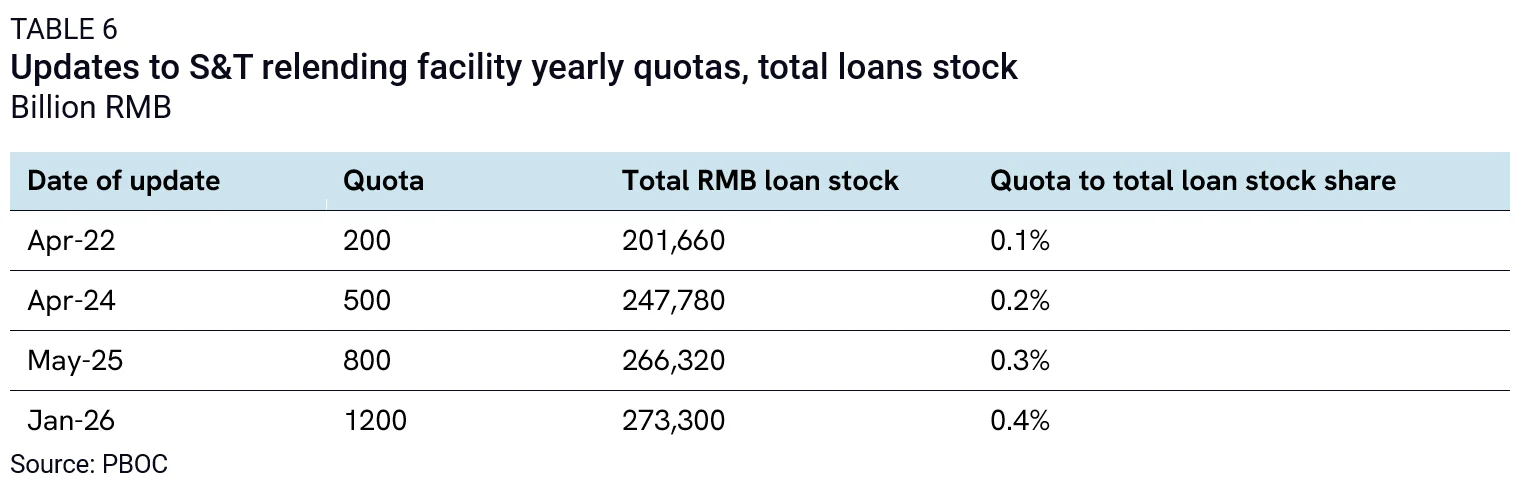
Beijing has expanded its control over bank lending decisions. Chinese authorities have long guided bank lending through a combination of regulatory tools and informal guidance, but in recent years, the People’s Bank of China (PBOC) has dramatically increased its ability to “guide” commercial bank lending to priority sectors. It has deployed a range of targeted relending facilities—low-cost central bank funding provided to banks, conditional on lending to designated sectors—as a way to incentivize and monitor banks’ support for the firms, technologies, industries, and even cities that central policymakers want to prioritize. Initially focused on rural finance and small businesses, these relending programs now channel hundreds of billions of dollars (trillions of yuan) to firms that advance science and technology, industrial upgrading, and strategic emerging industry objectives. The quota for the science and technology innovation relending facility increased from RMB 200 billion in 2022 to RMB 1.2 trillion by early 2026, equivalent to 0.4% of total RMB loan stock, and roughly 8% of new corporate lending (Table 6).
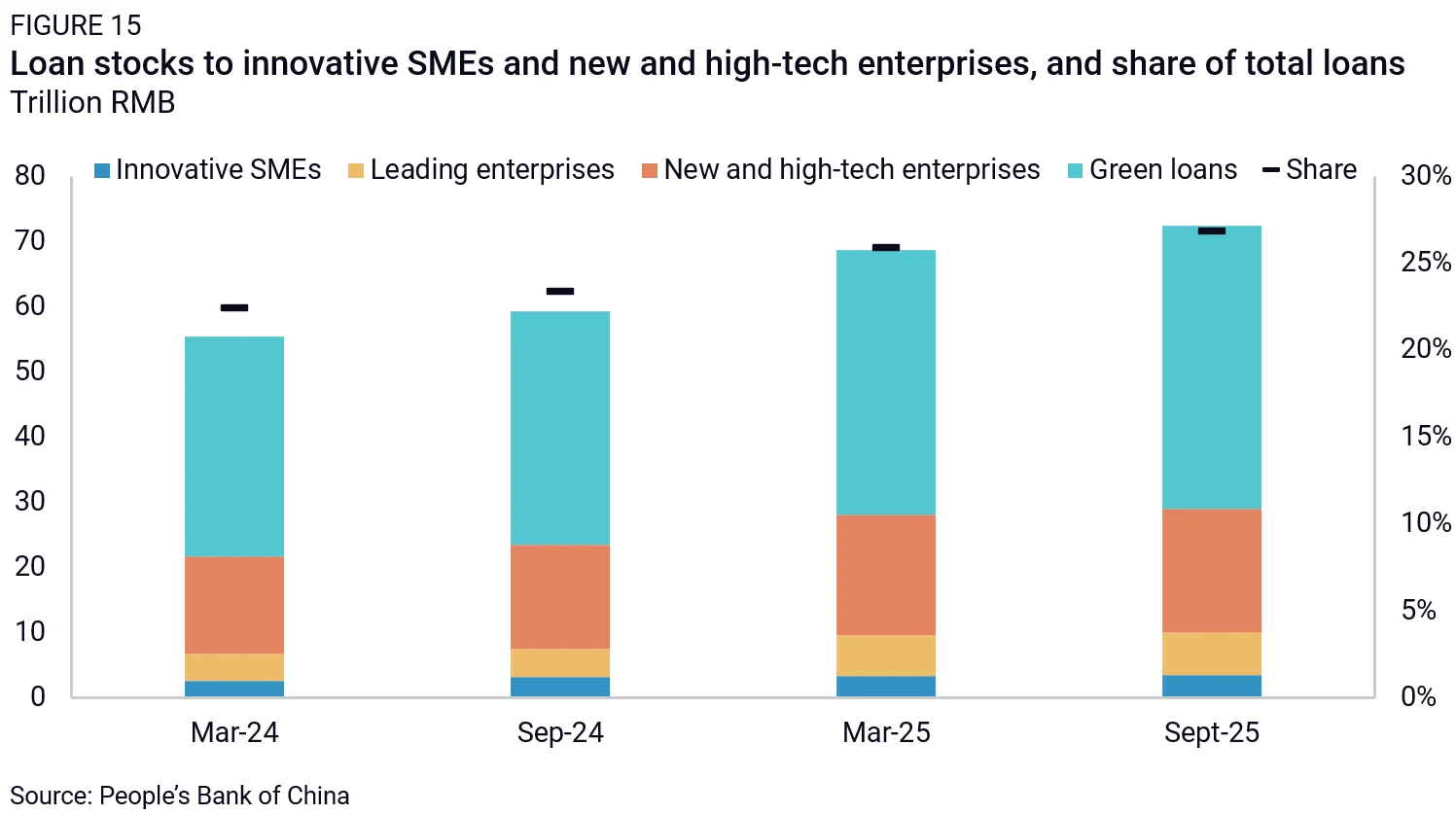
State-guided credit appears to be shifting toward innovative firms, including innovative SMEs, “new and high-tech enterprises,” and “leading enterprises,” categories that reflect different classification frameworks, all tied to technological capabilities, as determined by industrial planners. Together with loans to green loans, their share of total loan stock has increased from 22% to 27% over the past two years (Figure 15).
Lastly, China’s capital markets are also being reshaped to support industrial policy. After authorities tightened IPO approvals in 2023–2024 in a bid to stabilize equity markets, listing activity collapsed. Only about 100 companies completed A-share IPOs in 2024 (compared to 313 the previous year), raising RMB 675 billion, the lowest level in a decade. Beginning in 2025, regulators gradually reopened listing channels, but they did so selectively to prioritize strategic sectors. During the 14th Five-Year Plan period, the Shenzhen Stock Exchange added 649 new listed companies, of which high-tech enterprises and private enterprises each accounted for over 80%, and the proportion of specialized and innovative enterprises increased from 38% to 46%, with nearly half of the companies belonging to strategic emerging industries. Reforms to the STAR Market in 2025 aimed to further prioritize innovative and strategic companies. Upcoming reforms of ChiNext board have similar objectives.
Hong Kong is being repositioned as a complementary offshore financing channel, allowing capital to continue flowing to priority sectors under looser constraints. Investment from mainland investors into Hong Kong-listed equities has surged, from HKD 13.1 billion in 2014 to HKD 807.9 billion in 2024, reaching HKD 1,072.9 billion by September 2025. It is increasingly concentrated in sectors such as technology and healthcare. In parallel, Hong Kong’s IPO market has rebounded sharply after years of stagnation, with fundraising up over 220% year-on-year in 2025. Targeted regulatory reforms, including lower listing thresholds and fast-track channels for “innovative” firms, have supported this shift, effectively extending China’s industrial policy toolkit offshore.
The trade-offs of China’s industrial policy strategy
In the long term, the strategy Beijing is pursuing is likely to compound wasteful spending and inefficiency in the economy, even if it helps advance industrial goals in the short-term. By leaning on banks and capital markets to serve as a major policy instrument—for regional and other economic objectives, in addition to science and technology—the leadership is inserting non-market considerations into the DNA of its most important institutions. In the long-run, this will reduce resource efficiency, as capital and credit chase after policy priorities not profits. In the short run, it is also creating new pressures on bank profitability due to the strain of lending to SMEs and other low-return or high-risk endeavors. In capital markets, trying to do an industrial policy of everything also risks making the system less effective. The lack of clear prioritization may create more confusion for local governments and financial institutions tasked with implementation, and lead to capital being spread thinly rather than concentrated in strategic sectors and technologies.
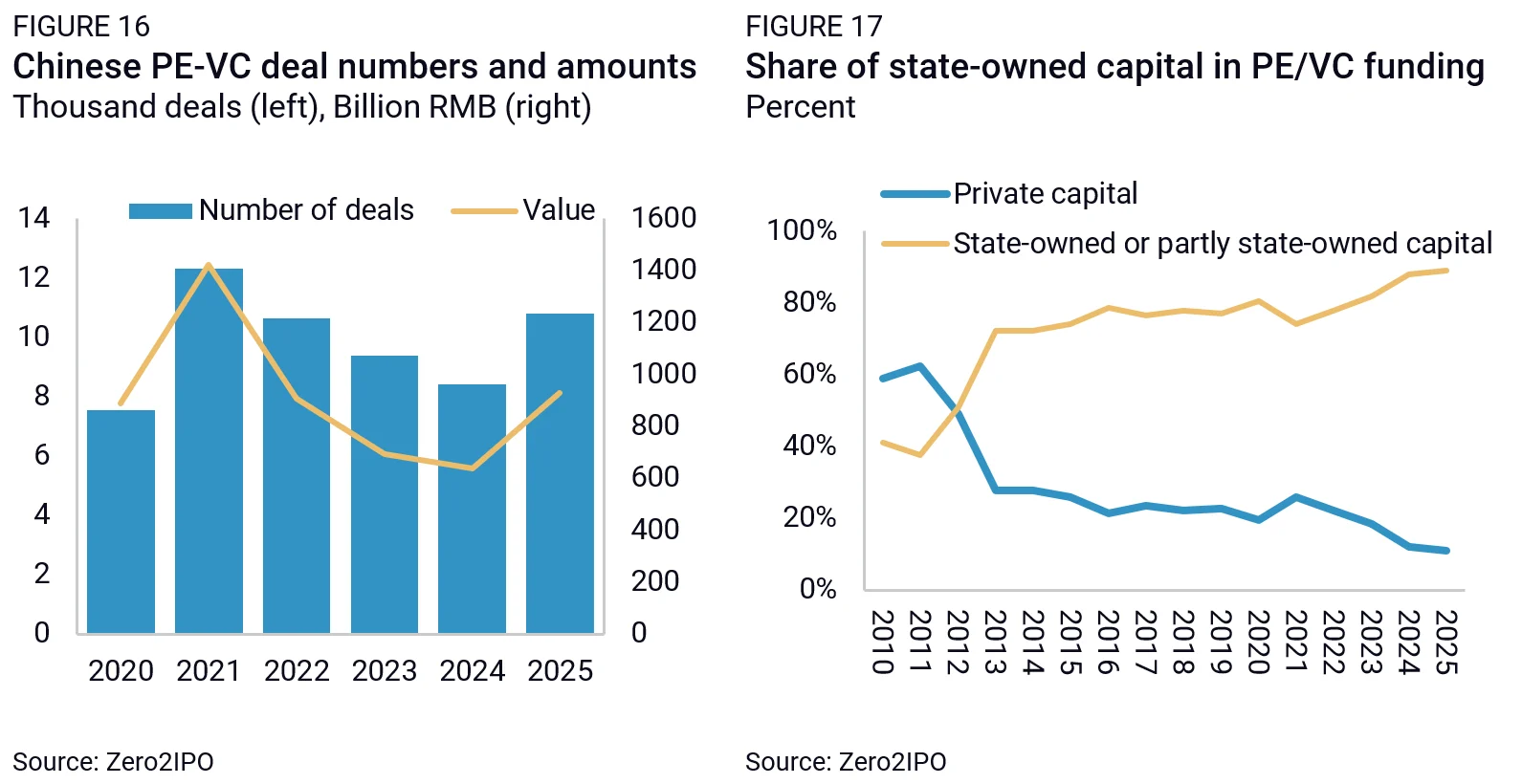
There are already clear signs of strain that will constrain the effectiveness of China’s industrial policy in the short term. Private equity and venture capital activity remains well below its 2021 peak (Figure 16)—partly because public capital crowded out private investors. Government-led funds contributed 81% of fund capital as limited partners in 2025, up from 65% in 2019, when accounting for investments made by SOEs (Figure 17).
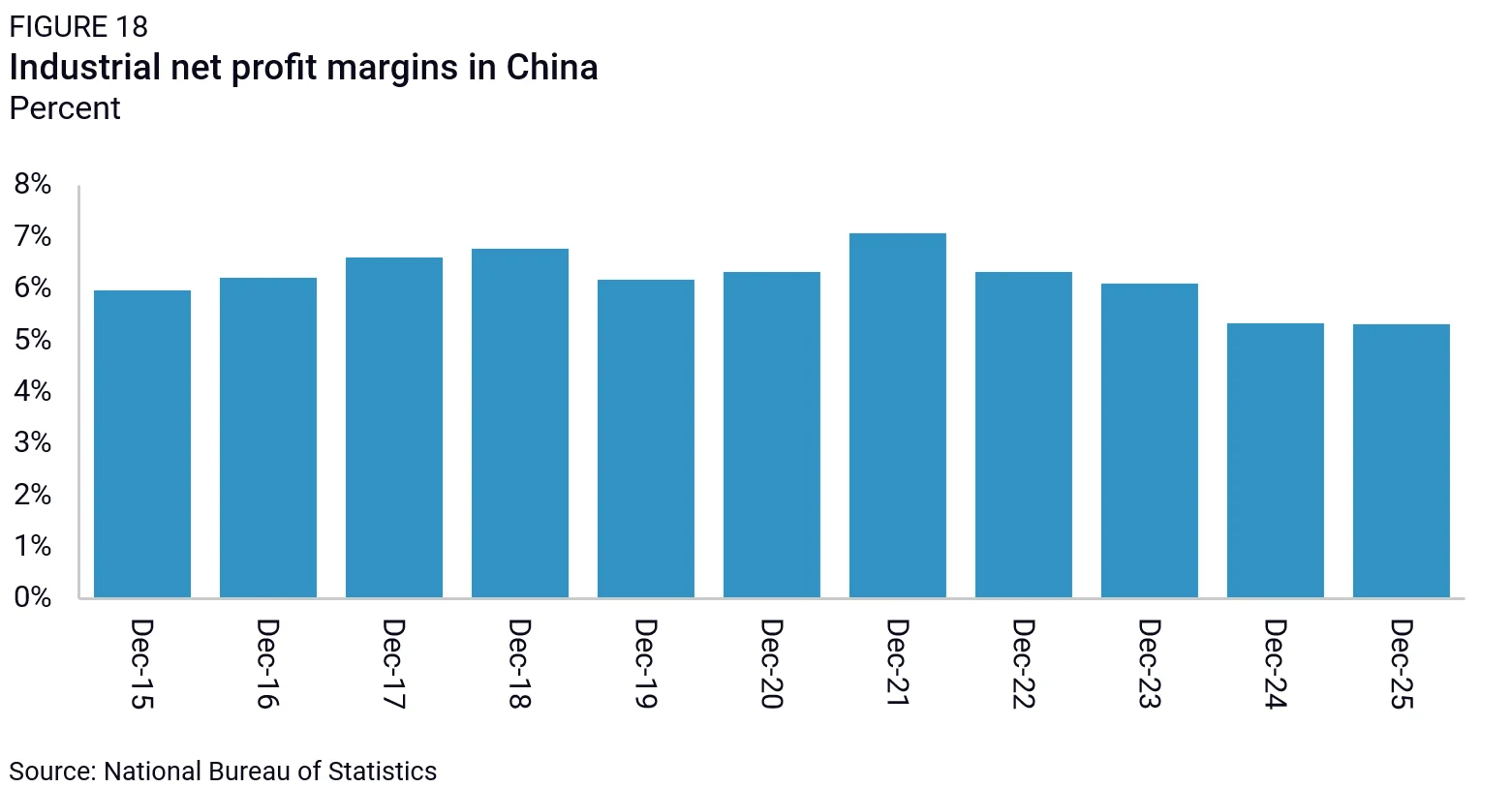
Corporate profitability in industrial sectors is at its lowest level in at least a decade (Figure 18). For many industries, from metals to automotive and ICT equipment, aggregate corporate profits have fallen in recent years.15 This means they have less ability to invest in Beijing’s industrial policy agenda.
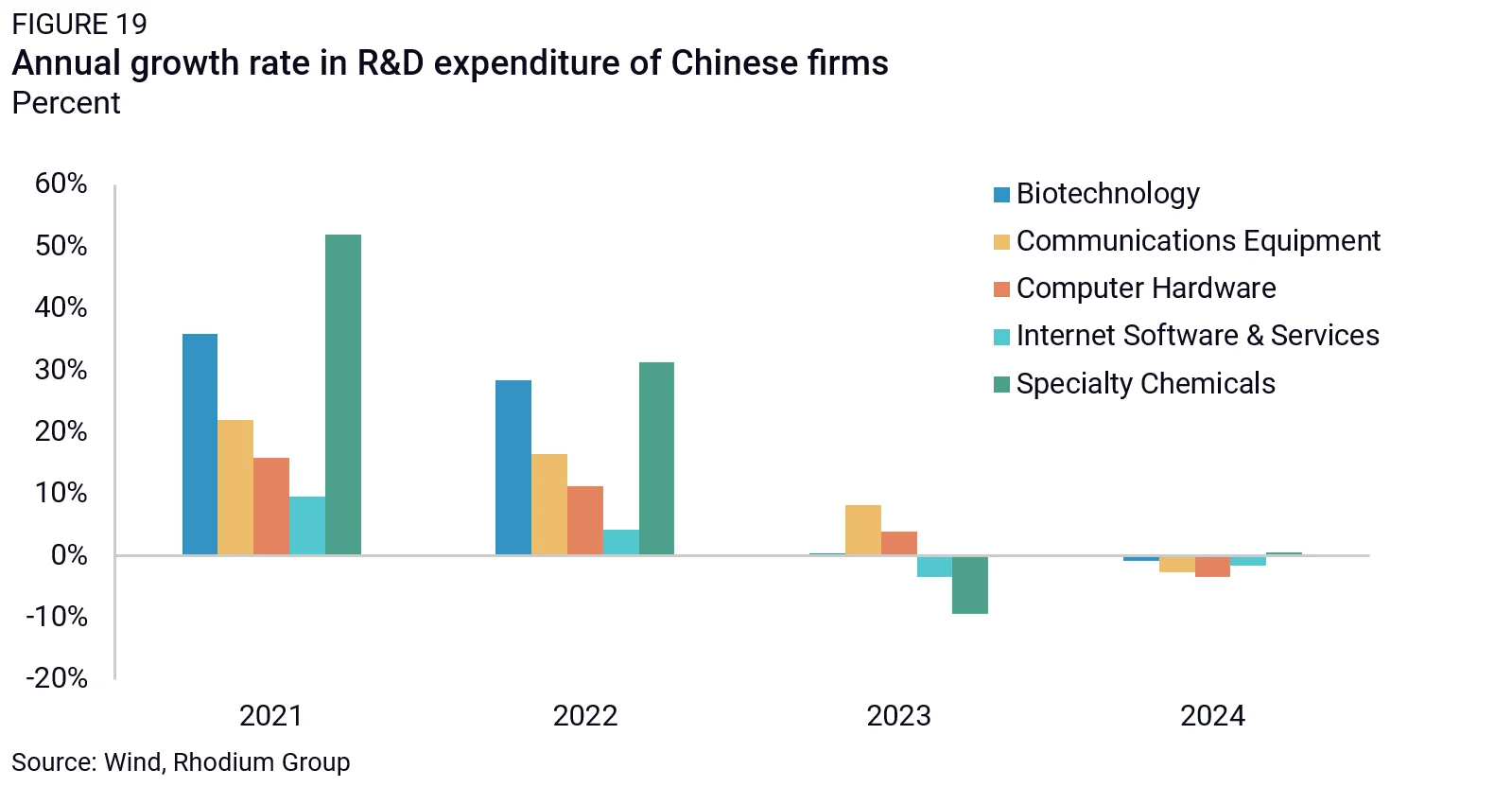
More concerning still, firms are starting to pull back on R&D spending, including in key sectors such as biotech, software, specialty chemicals, and computer hardware (Figure 19). This is not due to a lack of strategic importance, but a lack of financial capacity: Without sufficient profits, firms cannot sustain high levels of innovation investment. Absent meaningful reforms to boost demand or address structural overcapacity, this is likely to persist.
Lastly, at its core, the push to recentralize decision-making and refine industrial policy is at odds with Beijing’s stated ambition to support virtually all industrial sectors. One possibility is that headline ambitions mask a more selective prioritization of projects and key firms within target industries. Pressure will likely grow for this to happen over time, and it appears to be happening in some sectors, like semiconductors. But overall, available evidence suggests the opposite: Support is becoming more diffuse, including toward legacy and struggling sectors. The most likely outcome is that that overall industrial policy funding will become increasingly dispersed, even if fiscal and financial constraints mean that the pace of overall funding increase will slow.
Even if that proves to be the case, Beijing still commands vast resources across the economy, from banks and SOEs to public and private investors, and can sustain levels of industrial policy funding far beyond what most other countries can afford – at least for the next five years. More importantly, while sectoral prioritization remains unclear, Beijing has made clear that it will prioritize production overconsumption, and the growing scope of its industrial policy will only compound the economy’s bias toward industry.
This systemic bias within the Chinese economy, similar to what the IMF has termed “macro industrial policy,” is a central driver of structural imbalances. As we have documented in previous reports, political and financial incentives systematically direct fiscal and financial resources away from households and toward firms, especially in capital-intensive industries. Public spending is heavily skewed toward industrial infrastructure rather than public services, while widespread implicit guarantees encourage banks to extend large volumes of low-cost credit to companies to fund investments. At the same time, discrimination against foreign products and informal market access restrictions act as broad-based trade protection. On the demand side, consumption remains constrained by low household income and a highly unequal distribution of income.
Foreign exchange dynamics exacerbate these imbalances. The RMB is widely considered undervalued, based on models of what levels might balance the current account. While the IMF conservatively estimated in February 2026 this undervaluation at about 16%, other analysts have estimated it at around 25%.
As the emphasis on industrial policy intensifies and efforts to boost domestic consumption remain limited, these dynamics are likely to strengthen. The result will be continued gains in manufacturing capacity, global market share, and China’s trade surplus. A return to a more state-directed economic model will further entrench these imbalances, making them difficult to unwind. Meaningful adjustment would require a fundamental restructuring of the economy, including fiscal reforms and a redistribution of income toward households.
Chapter 2: The global impacts of China’s industrial policy
China’s industrial and economic policy has translated into a rapid expansion of China’s manufacturing trade surplus and trade dominance—a “China Shock 2.0,” where rising Chinese exports threaten industrial ecosystems in third countries. This expansion is concentrated in advanced manufacturing, with an acceleration in chemicals and machinery, deepening global dependencies at the upstream and midstream stages of production. The scale of this shift is larger than conventional trade data suggests. Standard trade statistics understate China’s market share gains because persistent producer-price deflation is compressing the nominal value of exports even as volumes surge. Dependence on China is also becoming more indirect and therefore less visible, as Chinese inputs, machinery, and components are increasingly embedded in goods produced and exported by third countries.
Chinese outbound investment is reinforcing this trend. Chinese firms are becoming true multinationals with operations spanning multiple countries around the world. The value of OFDI transactions announced by Chinese firms increased almost 20% year on year in 2025, more than double the value in 2020. Yet this fast expansion does not necessarily bring deep localization. Chinese firms often retain high-value activities, inputs, and technology within China, while Beijing is increasingly focused on preventing the kind of know-how diffusion that once helped China benefit from foreign direct investment.
Beijing is actively reinforcing this position and has expanded its toolkit to do so, through price suppression to displace competitors, control over inputs and technologies to restrict entry, the growing use of economic coercion to deter diversification, and strengthened control over companies’ activities overseas, including not only through technology controls but also travel restrictions on essential personnel, so that their investment footprint serves China’s domestic manufacturing dominance.
This chapter examines how that process is unfolding. The first section analyzes the rapid expansion of China’s trade dominance, including the rise in upstream and midstream dependencies and the growing importance of indirect exposure through third countries. It also highlights Beijing policies to entrench China’s manufacturing dominance and prevent other countries from de-risking. The second section turns to the rise of Chinese multinational firms, showing that, in many cases, their overseas expansion reinforces rather than reduces reliance on Chinese manufacturing.
1. Growing Chinese trade dominance
Since 2019, China’s industrial policy—both at the sectoral level and through macro-economic distortions—has combined with weak domestic demand to produce a rapid expansion of China’s manufacturing trade surplus. Advanced economies have framed this dynamic as a “China Shock 2.0” where rising Chinese exports threaten industrial ecosystems in third countries. But standard trade data understate the scale of the shift, because deflation in China is masking the true pace of global market share gains. Adjusted for price effects, China’s share of global exports has been increasing at nearly double the nominal pace between 2022 and 2024 (by 1.6 percentage points, rather than 0.6 percentage points in nominal terms).
This expansion is concentrated in advanced manufacturing, with an acceleration in chemicals and machinery, deepening global dependencies at the upstream and midstream stages of production. Chinese value added is also increasingly embedded in third-country exports, creating indirect dependencies that standard trade statistics fail to capture. These trends are reinforced by policy tools such as export controls that allow China to maintain and extend its dominance.
Growing trade surplus concentrated in advanced manufacturing
In the past few years, Chinese companies across a wide range of sectors have expanded production capacity far faster than domestic demand can absorb. While these imbalances are not new, they have reached unprecedented levels since the pandemic: China’s overall trade surplus has nearly tripled over the past six years. The manufacturing trade surplus is even larger, doubling from roughly $1 trillion in 2019 to about $2 trillion—an increase equivalent to the entire GDP of Switzerland. As a share of GDP, the surplus is now over 6%, a 15-year high.
This growing trade surplus reflects both rising exports and success in substituting them away from imports. On the export side, Chinese manufacturing exports grew by around 11% between 2021 and 2025, with much of the increase directed toward Asia. Countries such as Vietnam (up 45%, or $58 billion), India, Russia, and Thailand have been key recipients. At the same time, imports have weakened, particularly affecting major manufacturing economies. German exports to China fell by 25% between 2021 and 2025, a loss of nearly €31 billion, equivalent to about 2% of Germany’s total exports in 2021. China dropped from Germany’s second-largest export market to sixth. Japan experienced a similar decline, with exports to China also down 25% ($38 billion), representing more than 5% of its 2021 exports. Other economies, including Malaysia, have also been affected: Its exports to China fell by 5% over the same period, with China slipping from its largest to third-largest export destination. Overall, the European Union and ASEAN have been the most affected by China’s growing trade surplus, each accounting for roughly one-third of this increase, with the remaining third spread across other markets.
The aggregate growth in Chinese exports masks two important shifts: They are increasingly concentrated upstream in global value chains, and they are increasingly high-tech. China’s exports of intermediate inputs was up 26% between 2021 and 2024, while its exports of capital goods was up 32%. Meanwhile, exports of consumption goods have remained broadly flat. China is becoming further embedded in global production systems by shifting its exports away from final consumption goods and toward manufactured products that are used by firms in the manufacturing of other goods, such as chips or machines. This evolution is consistent with its long-running import substitution strategy, which has progressively localized entire value chains after initially relying on imported components for assembly. This shift up the supply chain is receiving greater recognition and has earned China the nickname “factory for factories” rather than the previous “factory of the world.”16 As a result, China’s export profile is converging with that of advanced manufacturing economies, where trade is dominated by intermediate and capital goods rather than final consumption products.
Chinese exports are also increasingly high-tech. One useful way to capture this shift is the Product Complexity Index (PCI) developed by researchers at Harvard’s Growth Lab. The PCI assigns higher scores to products that are exported by relatively few countries but are associated with diversified and advanced economies (such as precision machinery or advanced electronics). Between 2019 and 2024, China’s export mix shifted modestly up the complexity ladder: China’s global export share of the highest-complexity goods category (PCI 2 to 5) increased from 5% to 6%. The largest gains were in medium-to-high complexity goods (0 to 2), which increased by about 4 percentage points. Conversely, China’s global share of low-complexity export goods (-5 to -1.5) stayed flat or had modest declines. Overall, this points to gradual upgrading at the high end of the product spectrum and continued strength in basic manufacturing (Figure 20).
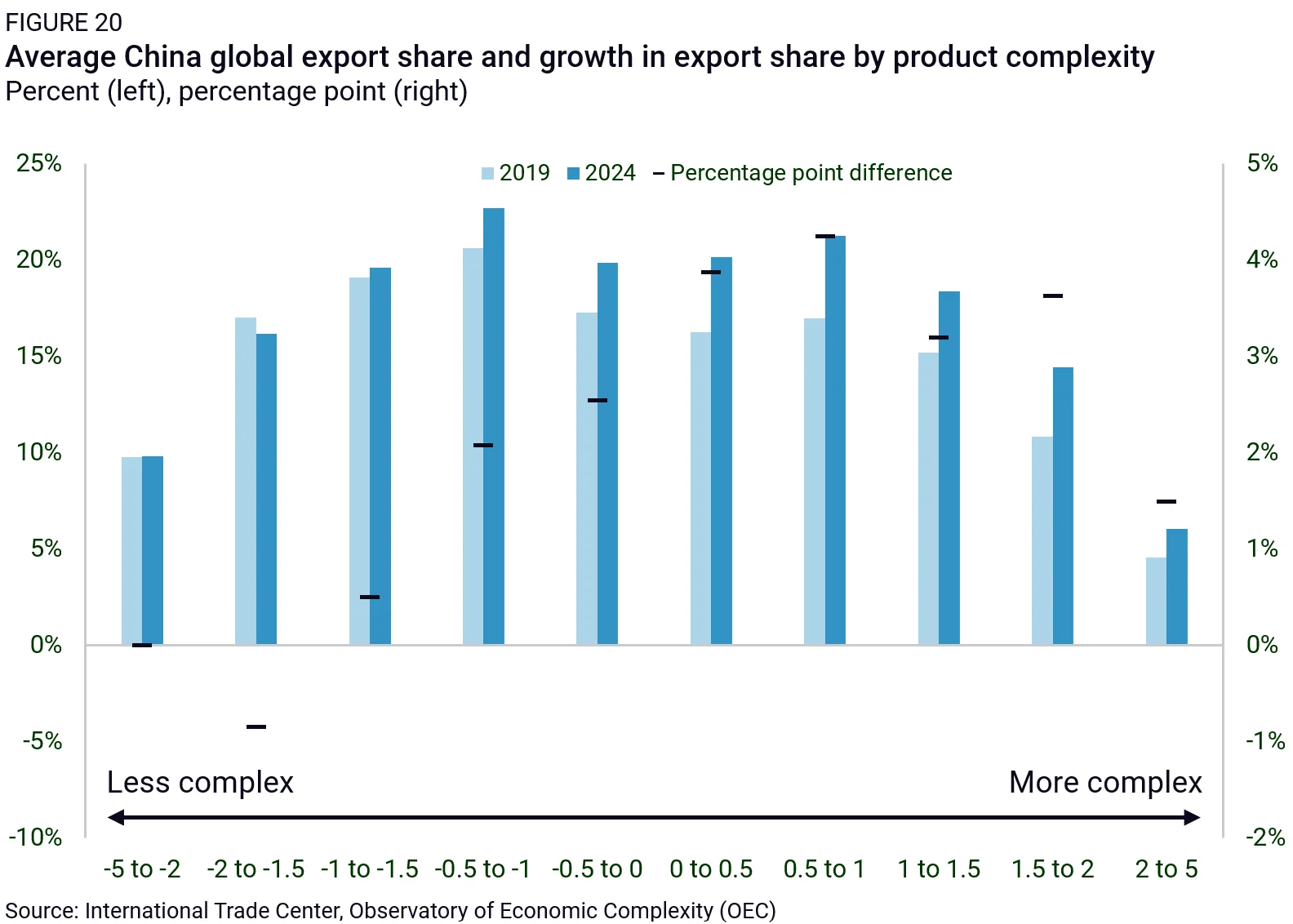
The rise in complexity of Chinese manufactured goods exports is reflected in products that composed the Made in China 2025 strategy. China’s trade balance in MIC25 sectors has risen from a $128 billion deficit in 2015 to a $179 billion surplus in 2025 (Figure 21). Sectoral surpluses have largely aligned with the findings of our evaluation of MIC25’s success: Power generation, autos, and ships are driving most of the surplus gains, while China continues to run a deficit in aerospace and health products, where it is still largely dependent on certain imports, though these deficits have been shrinking. Chinese imports of semiconductors and semiconductor manufacturing equipment, needed to support AI, EVs, and other advanced electronic manufacturing, also continue to drive deficits for the electronics industry broadly.
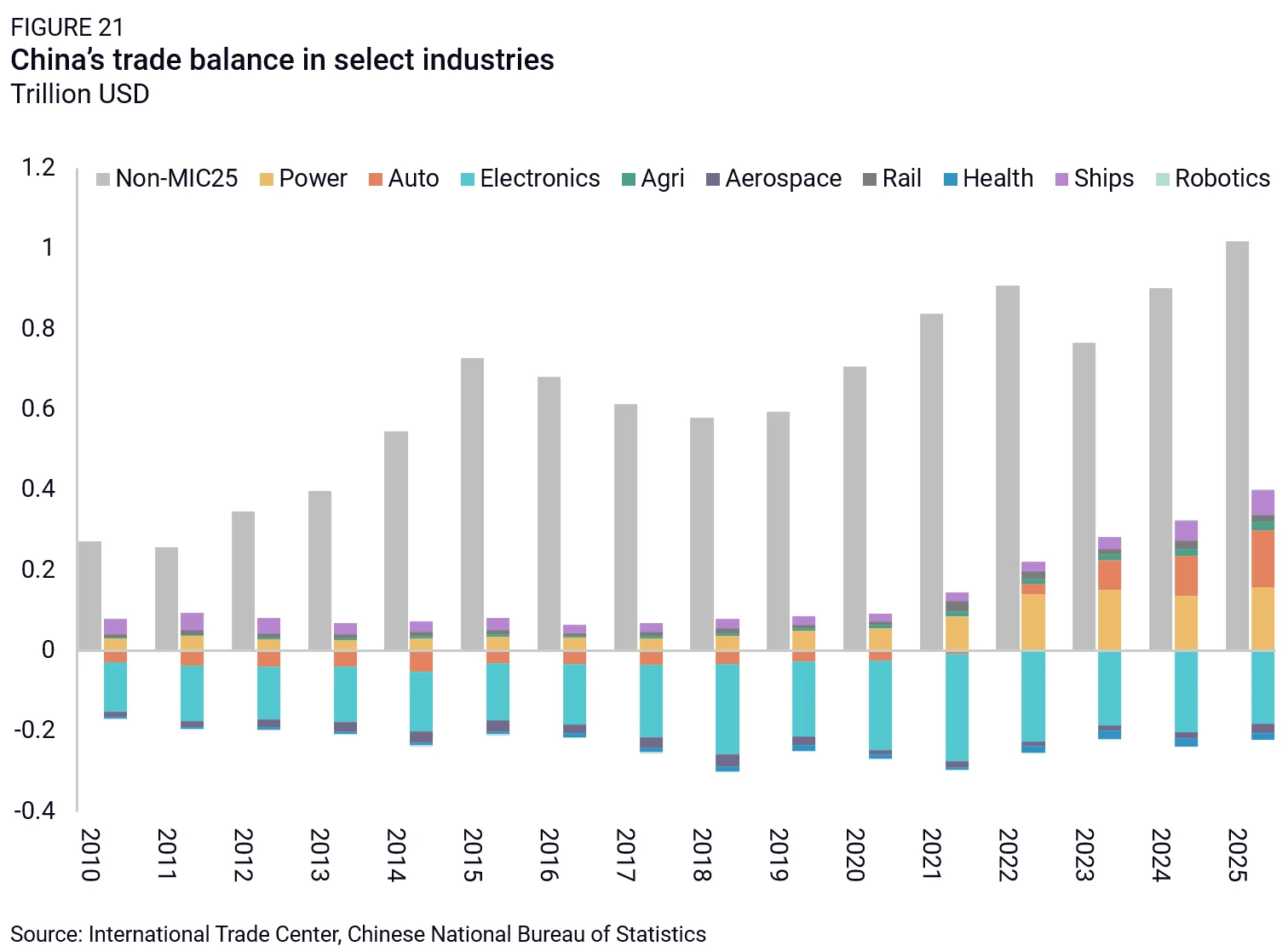
In almost all Made in China 2025 categories except electronics, aerospace, and medtech, Chinese export market share gains have accelerated since 2019 (Figure 22). In that timeframe, automotive and power equipment made relatively early gains, while robotics, machinery, and ships have seen particularly rapid growth in the past two years (Figure 23).
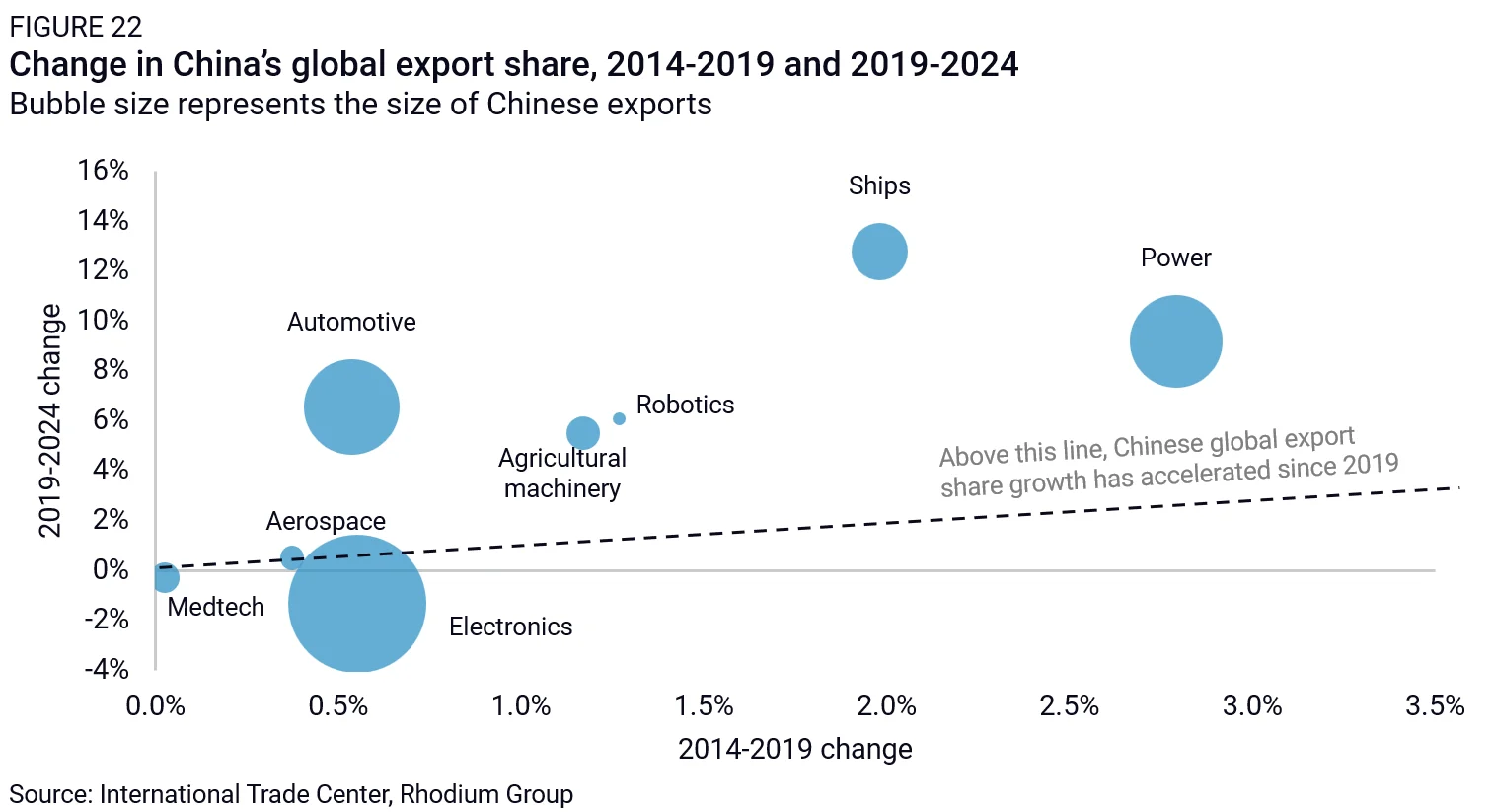
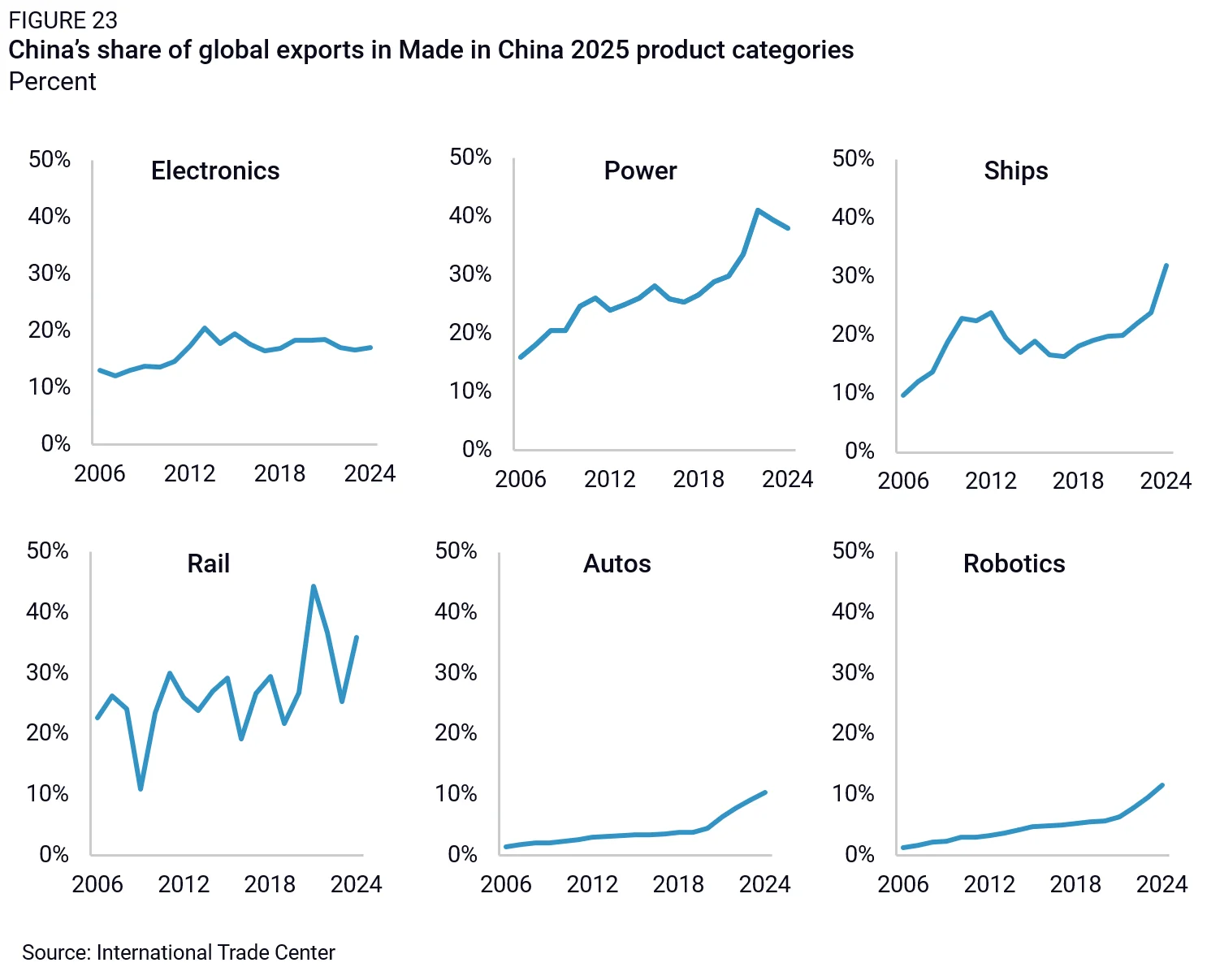
In practice, this has translated into rapid increases in Chinese exports across a strikingly diverse set of products, from industrial chemicals like O-xylene and tetrachloroethylene (key inputs for plastics, textiles, and dry cleaning), to heavy machinery such as track-laying tractors and numerically controlled metal-boring machines that underpin construction and advanced manufacturing. The surge also extends to hybrid passenger vehicles, central to the global energy transition, and nitrogen-based fertilizers, which are critical for agricultural productivity and food security (Figure 24).
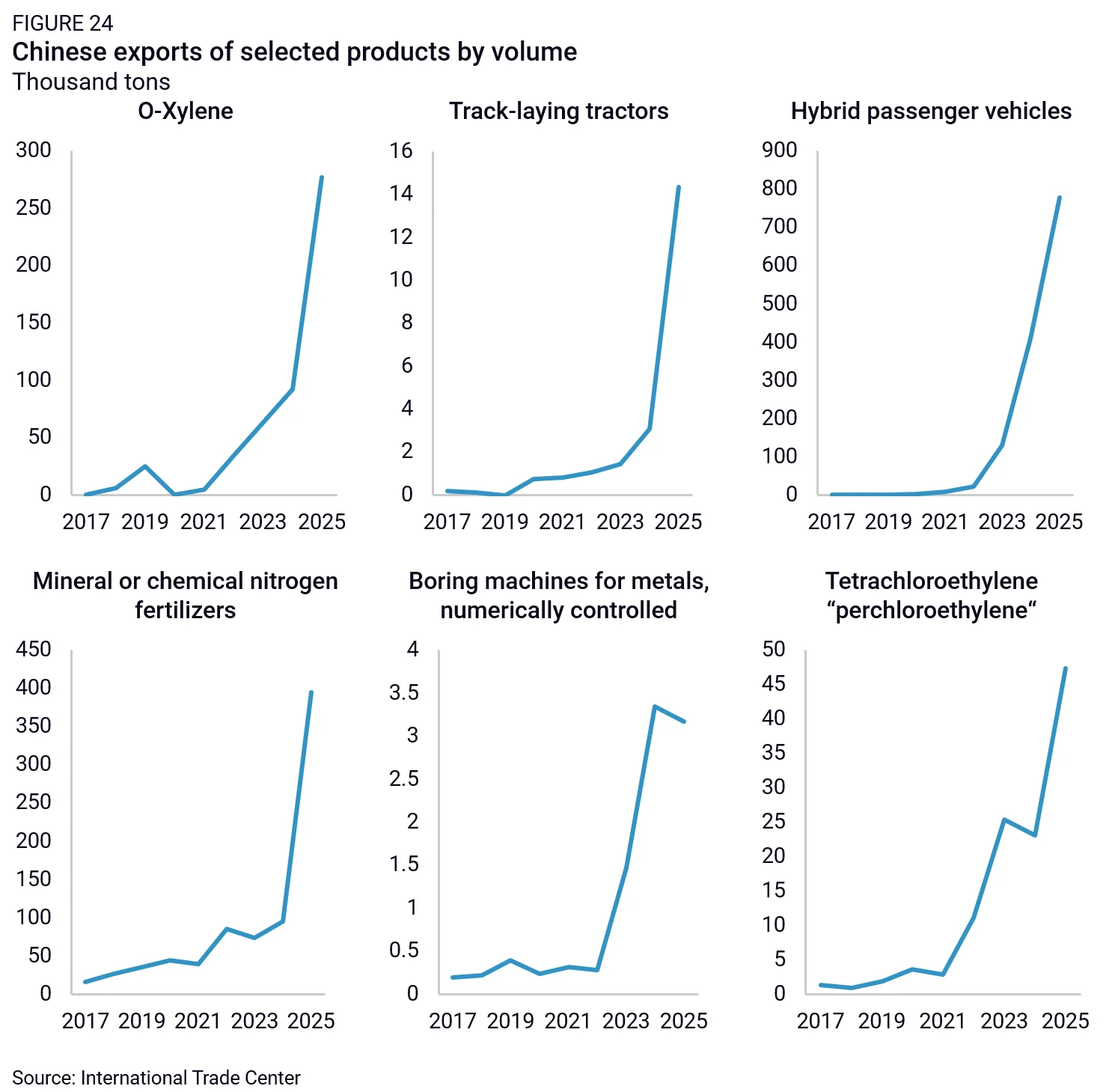
China’s market share is growing much faster than traditional trade data shows
Measuring China’s export share gains by value alone presents an incomplete picture. Export share gains when measured by volume are even more stark, as Chinese production and export prices have consistently declined in recent years. China’s producer price index, which measures changes in the prices received by producers for their goods, has contracted every month from September 2022 to February 2026. Chinese producer prices are now 5.4% lower than they were in January 2022 (Figure 25). Downward price pressures have persisted due to rising excess industrial capacity, persistent imbalances between production and domestic demand, and intensifying domestic competition (“involution”) among producers.
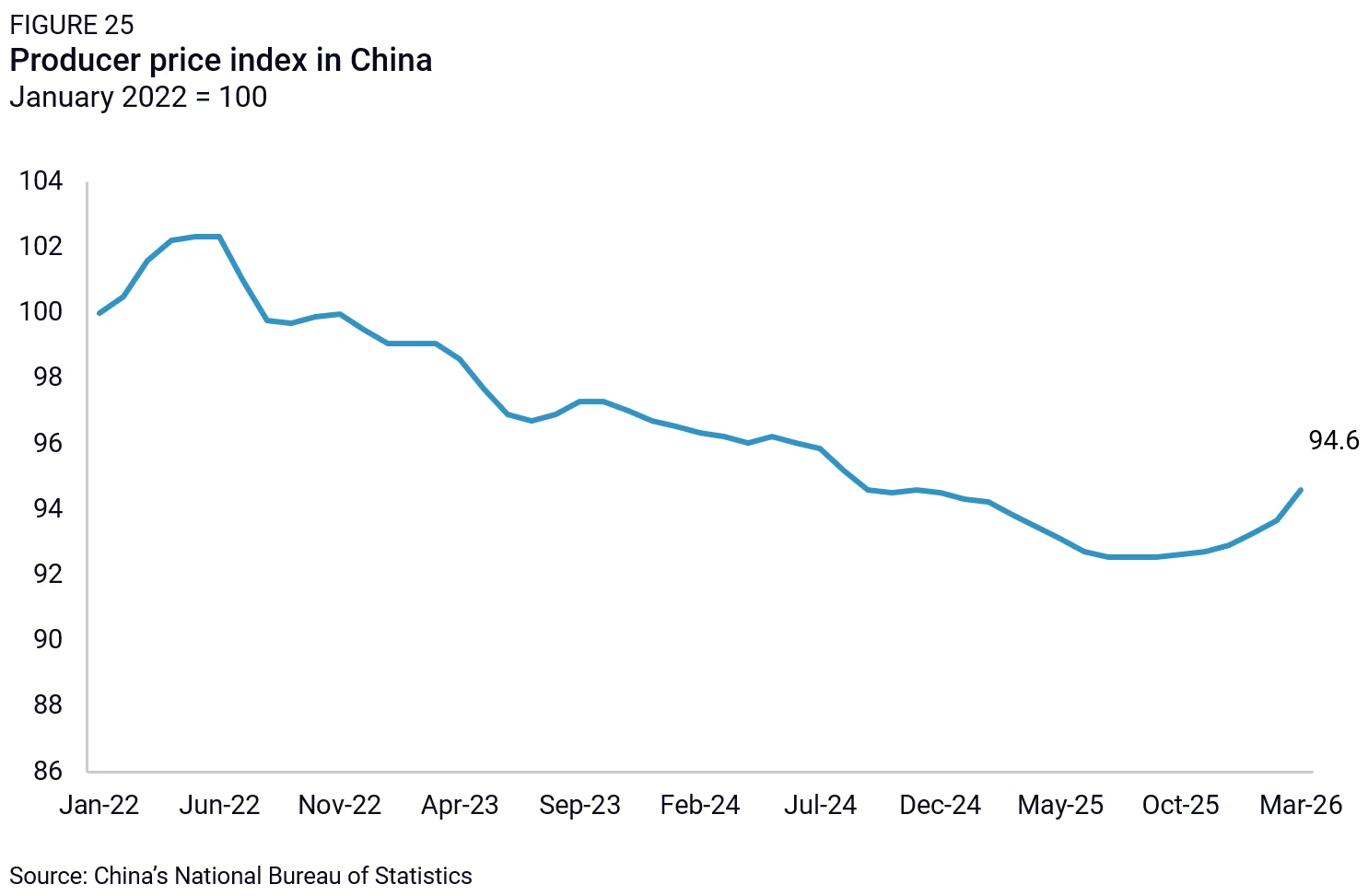
Deflationary pressures in China have coincided with a weakening currency, driving a sharp decline in the real exchange rate against a broad basket of currencies (Figure 26). The adjustment has been particularly pronounced against the euro, with the renminbi depreciating by 8.2% in nominal terms and even more in real terms once inflation differentials are taken into account.
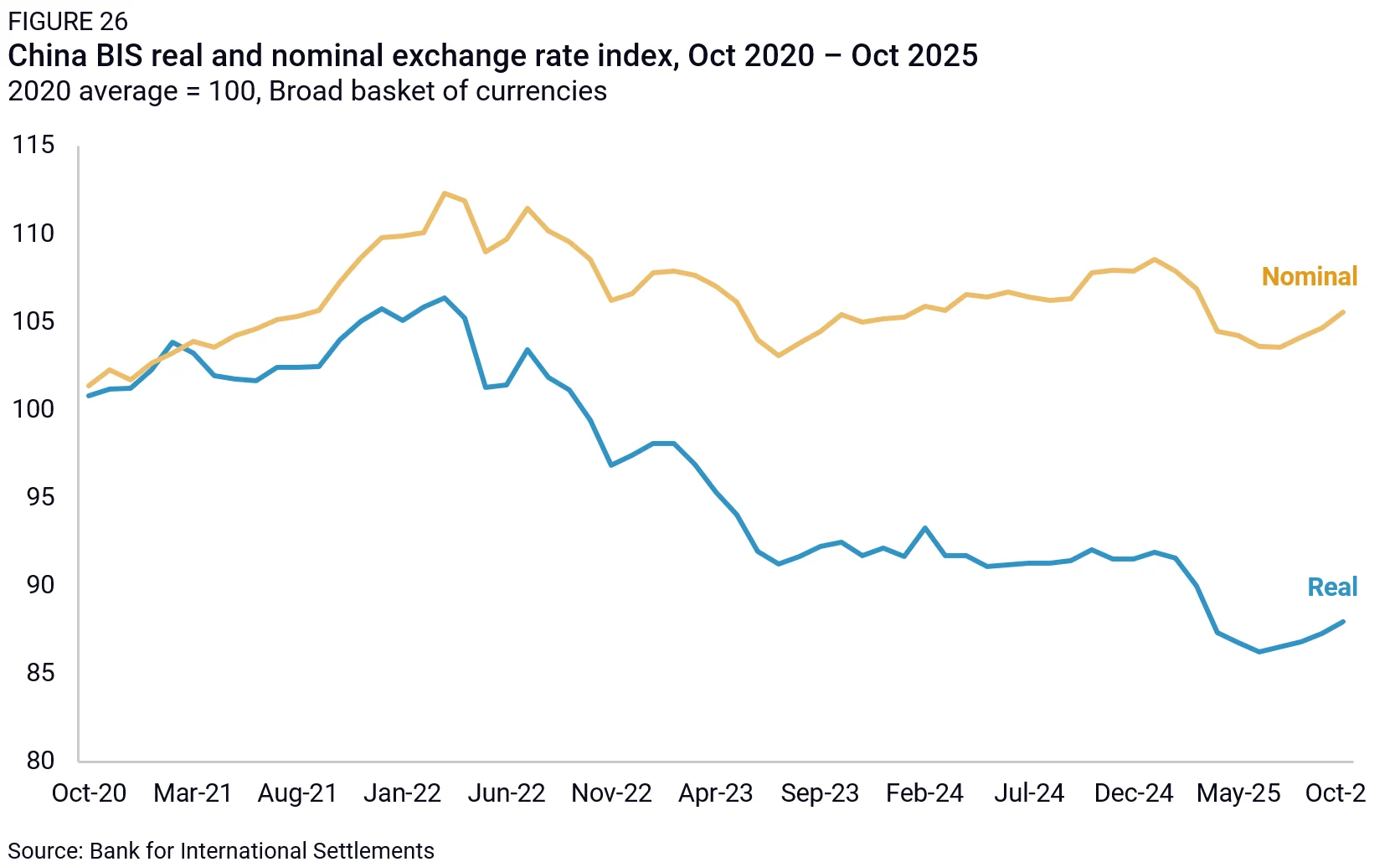
Deflation and a weakening RMB have driven a sustained decline in export prices, even as prices in other regions have risen over the same period. This has created a pronounced divergence in import prices in both the United States and Europe, with goods sourced from China becoming significantly cheaper relative to those from other suppliers (Figure 27).
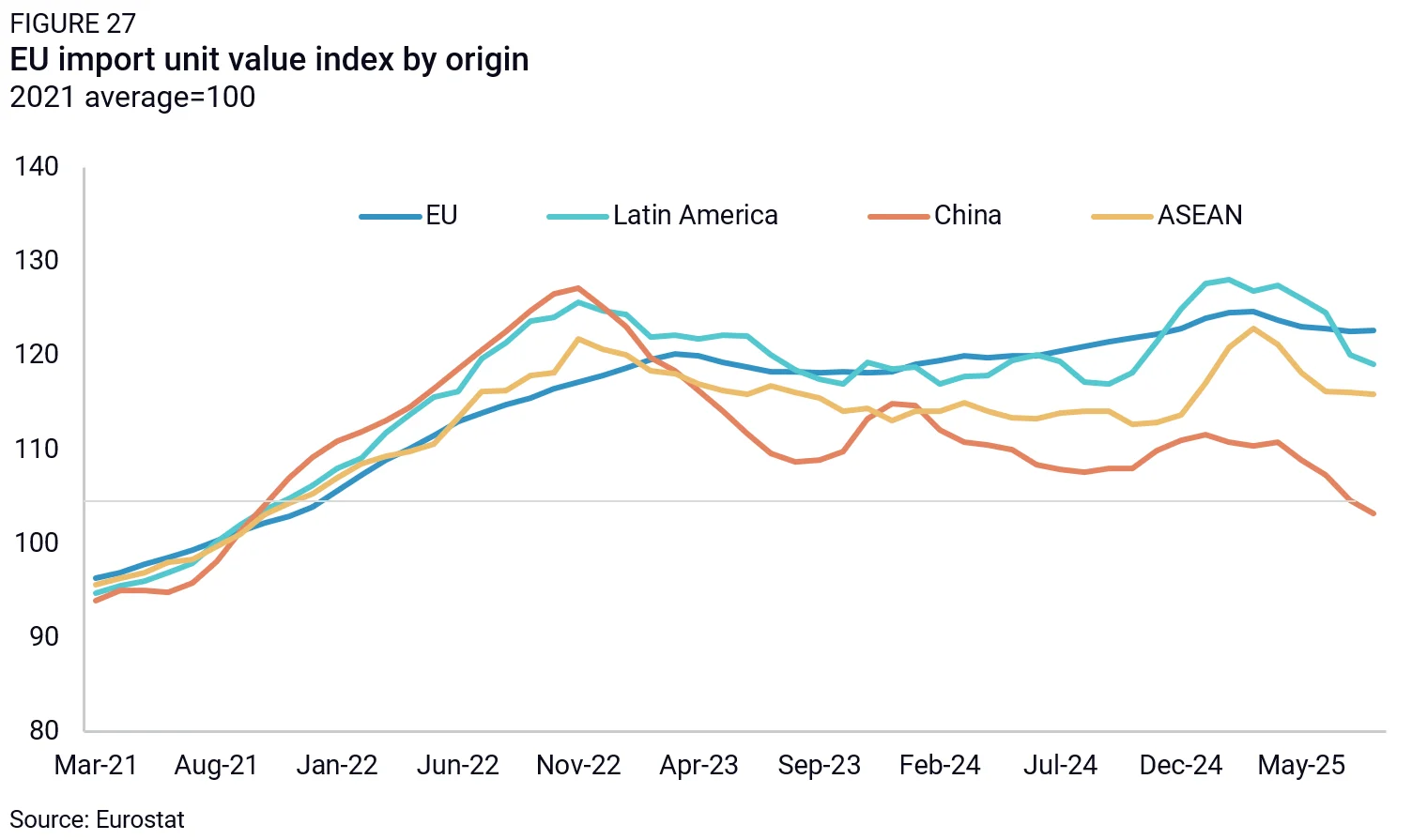
Because export volumes have grown much faster than export values, China’s share of global exports has grown at more than double the pace that value data shows: By 1.6 percentage points between 2022 and 2024, rather than 0.6 percentage points in nominal terms (Figure 28). Comparing export value and volume for products where data is available shows a similar picture: China increased its global market share by roughly 5 percentage points in volume terms between 2019 and 2024, compared to just 2 percentage points in value terms (Figure 29). Together, these measures suggest that China’s competitive expansion in global markets is significantly understated in nominal trade data.
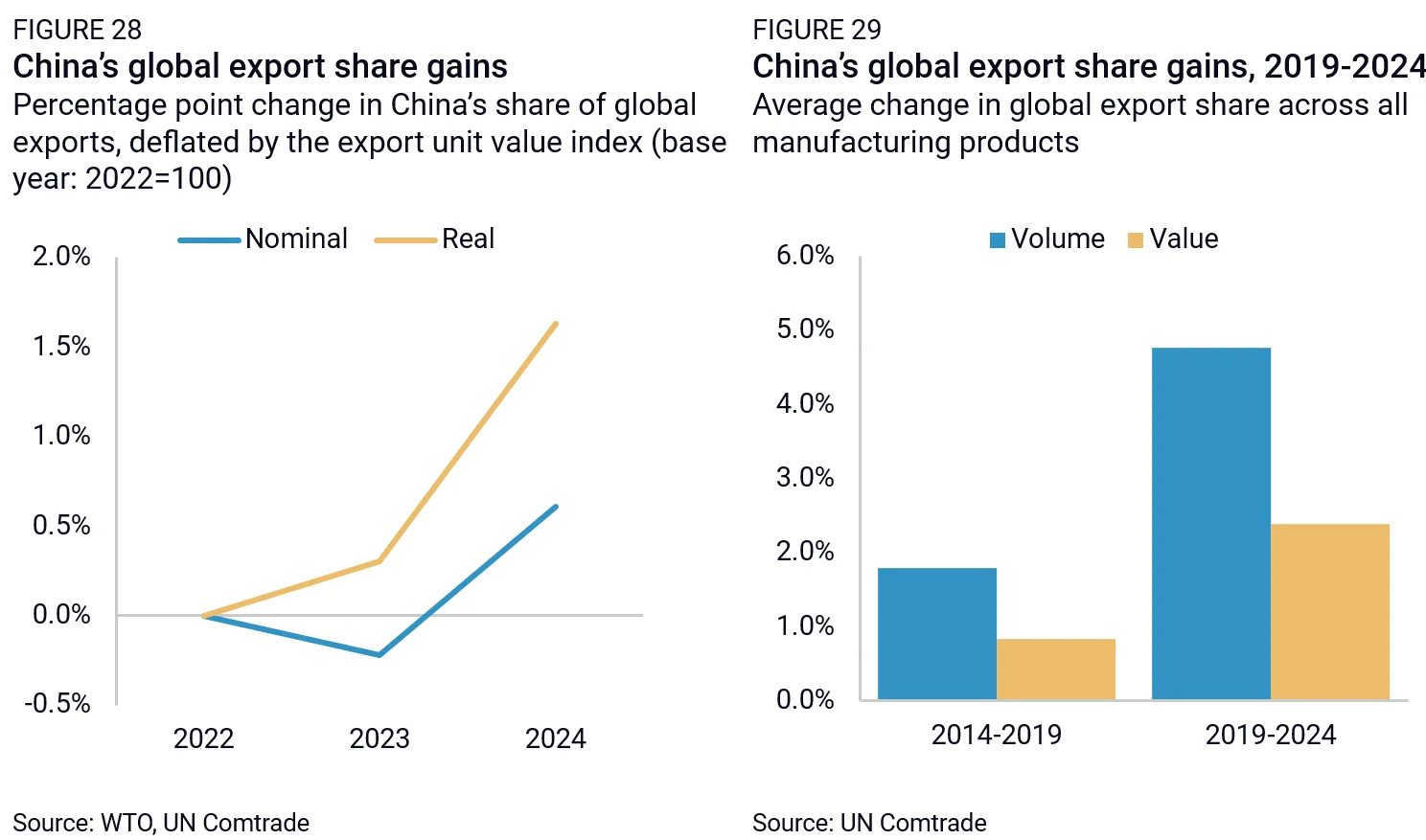
In practice, this means that China’s share of global exports has risen rapidly across a range of products embedded in critical value chains. In mono-alkyl ethers of ethylene glycol—key industrial solvents used in coatings, electronics, and pharmaceuticals (Figure 30)—China’s share of global exports has reached around 16% by volume and 12% by value, up from effectively zero in 2018. A similar pattern is visible in other products, including diethylene glycol derivatives (used in resins and plastics) and flat-rolled iron or non-alloy steel (a core input for construction and manufacturing), where China’s export share has climbed to roughly 45% by volume and 40% by value, again from negligible levels as recently as 2019.
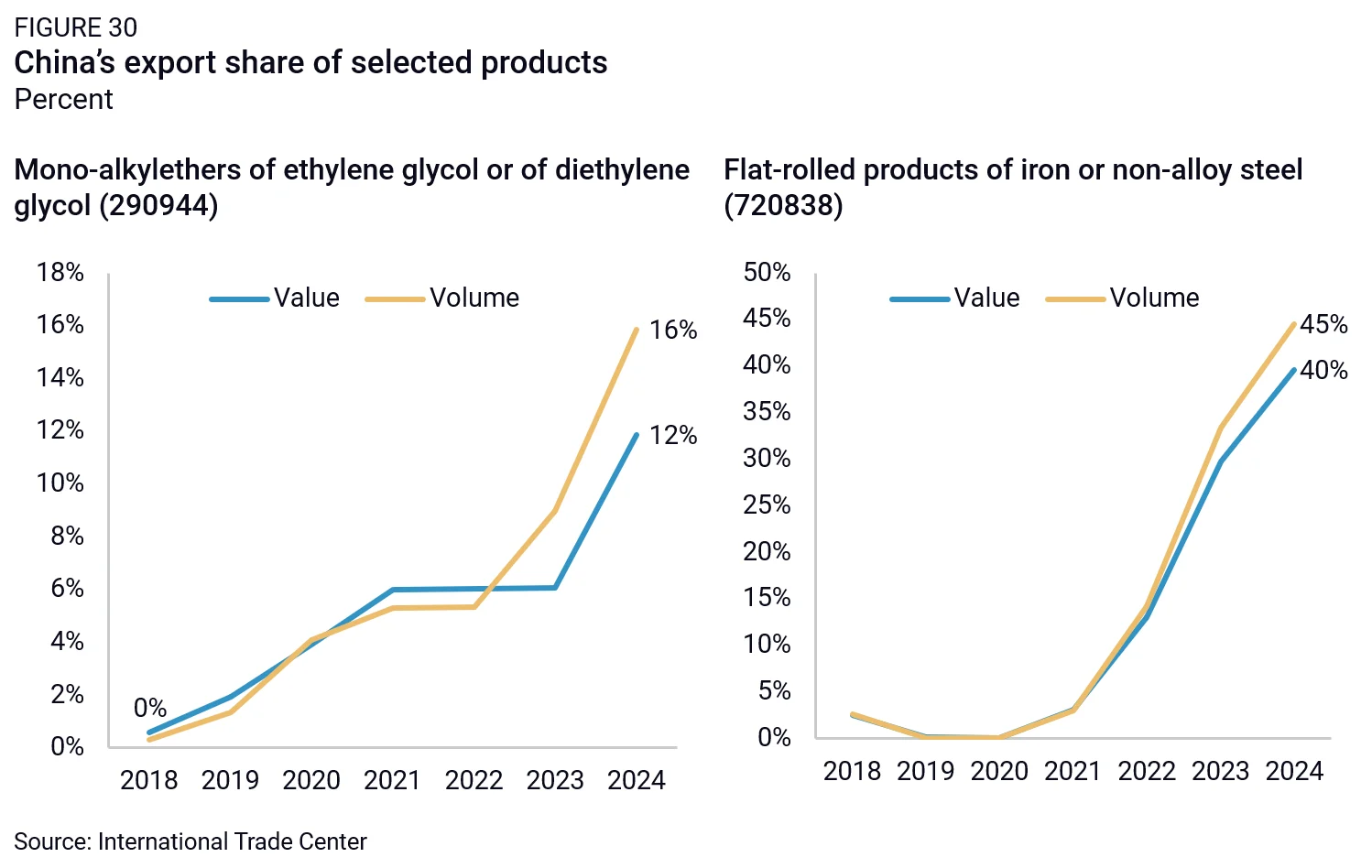
Growing global dependencies on Chinese inputs and machines
Rising Chinese exports have also sharply increased Chinese companies’ market power. This makes other countries vulnerable to monopolistic practices such as withholding supply or colluding to raise prices, as well as to market disruptions, pandemic-like external shocks, and potential economic coercion. Given China’s longstanding weight in the global goods trade, these risks are not novel. Risks of market distortions and Chinese firms leveraging overcapacity to obtain market share was highlighted in both the 2009 and 2016 EU Chamber of Commerce reports.17
Consider the number of products where China has a quasi-monopoly (>90% global export shares), is highly globally dominant (>70% global export shares), and is dominant (>50% global export share).
- Using this definition, the number of products where China is quasi-monopolist, in volume terms, doubled from 12 to 23 between 2021 and 2024. In value terms, that trend is blunted by price declines, but the number still increased from 12 to 15 (Figure 31).
- The number of products where China is highly dominant rose from 192 to 315 in volume terms.
- The number of products where China is dominant also almost doubled, from 67 to 116. In value terms, that number increased by 19%. While a 50% share may appear relatively modest compared to higher thresholds, it matters because is already sufficient to exert significant influence over pricing, supply conditions, and market dynamics.
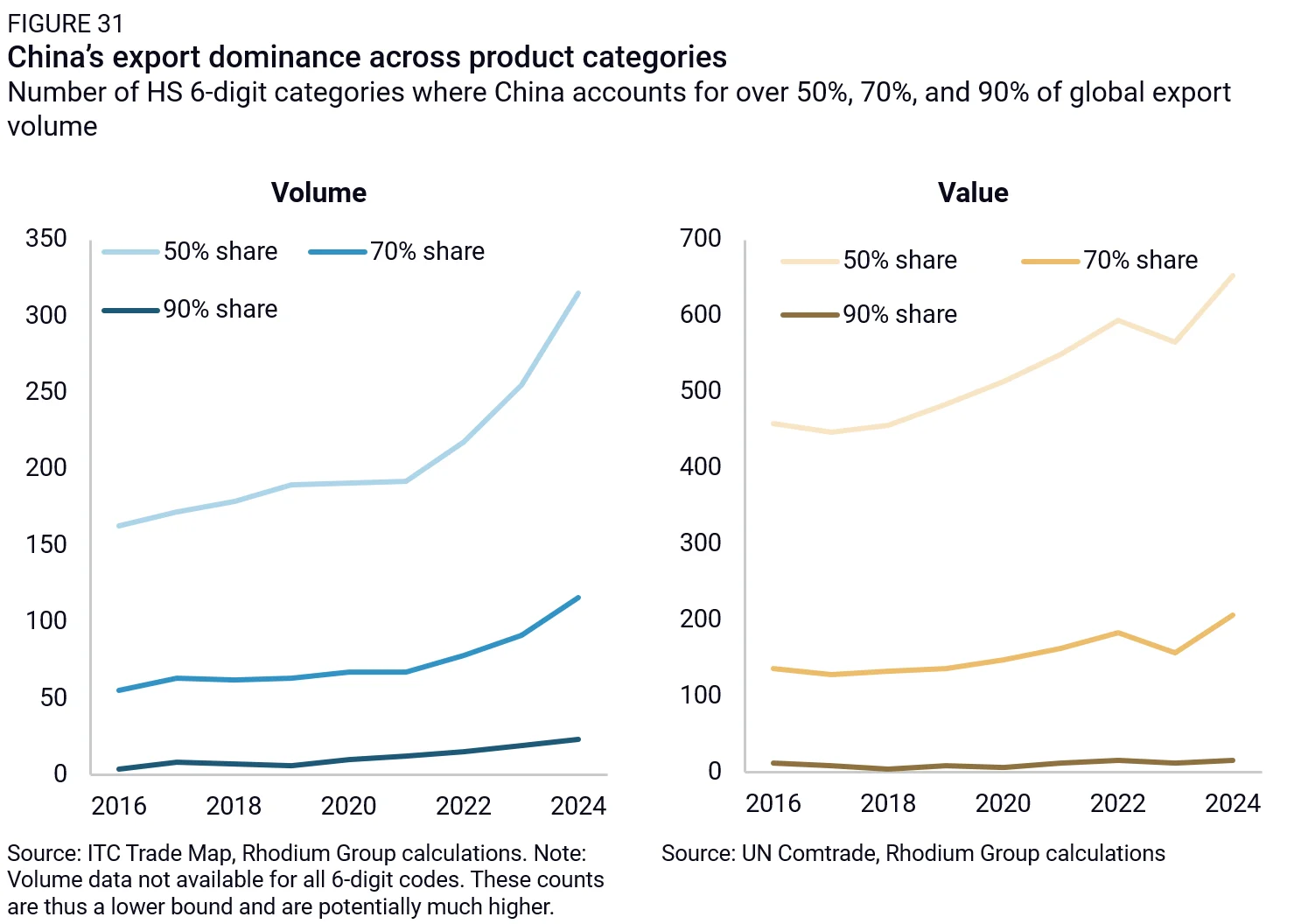
While volume data provides the clearest picture of physical market dominance, it is not consistently available across all sectors, particularly in more high-value industries such as machinery. To complement this view with the sectoral distribution of emerging dependencies, we examine export shares using nominal value data. These offer a broader and more complete cross-sectoral perspective, even though they under-state recent Chinese dominance.
- “Established dependencies,” where Chinese global export share has exceeded 50% before 2021, is the largest category, with 445 products.
- “Emerging dependencies,” where Chinese global export share has exceeded 50% since 2021, groups 122 products.
- We define “future dependencies” as products where China’s current global market share was between 35% and 50% in 2024, and where that share has increased by more than 7 percentage points between 2022 and 2024. This threshold approximates the growth trajectory needed to exceed a 50% share by 2030, identifying products that are rapidly approaching dominant market positions. There are currently 83 such products—although because this measure is based on nominal value data, the true number is likely higher.
As with broader export trends, these dependencies are increasingly concentrated in upstream inputs and, even more so, in capital goods, rather than consumption goods (Figure 32).
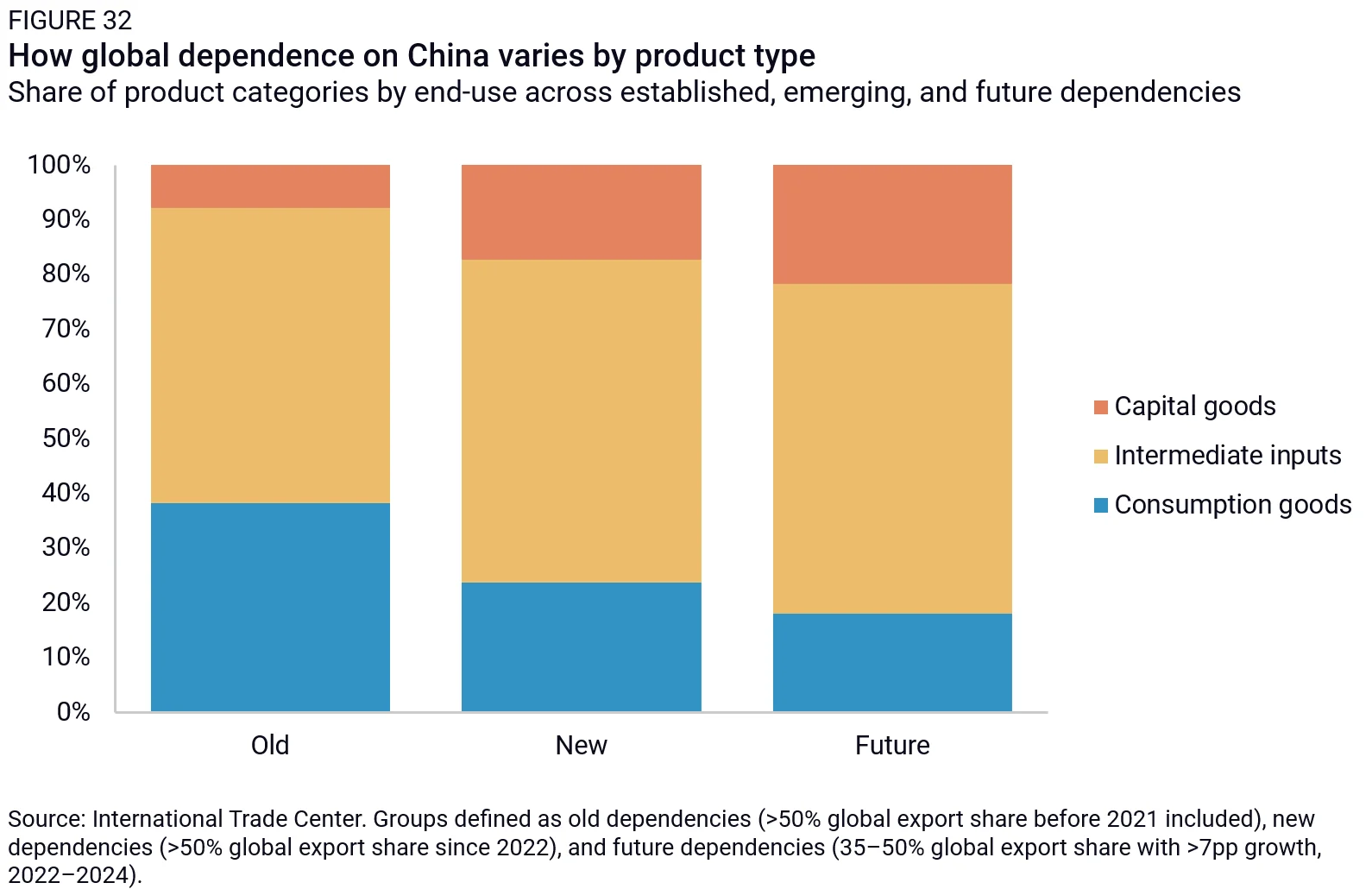
The most prominent categories within these future dependencies are organic chemicals and machinery—sectors that sit upstream in critical industrial value chains. These are categories where China has gained market share primarily at the expense of a small group of advanced industrial economies, particularly Germany, Japan, South Korea, and the United States. These economies are among the most exposed to China’s industrial strategy—focused on scaling up and upgrading advanced manufacturing—given their high concentration of value added in technology-intensive sectors, as illustrated by MERICS. The shift is especially striking relative to Germany: Chinese exports of key machinery and industrial inputs have grown rapidly since 2020, often doubling or tripling relative to German exports in the same product categories. This is particularly the case in critical machinery products that underpin industrial production throughout the world (Figure 33).
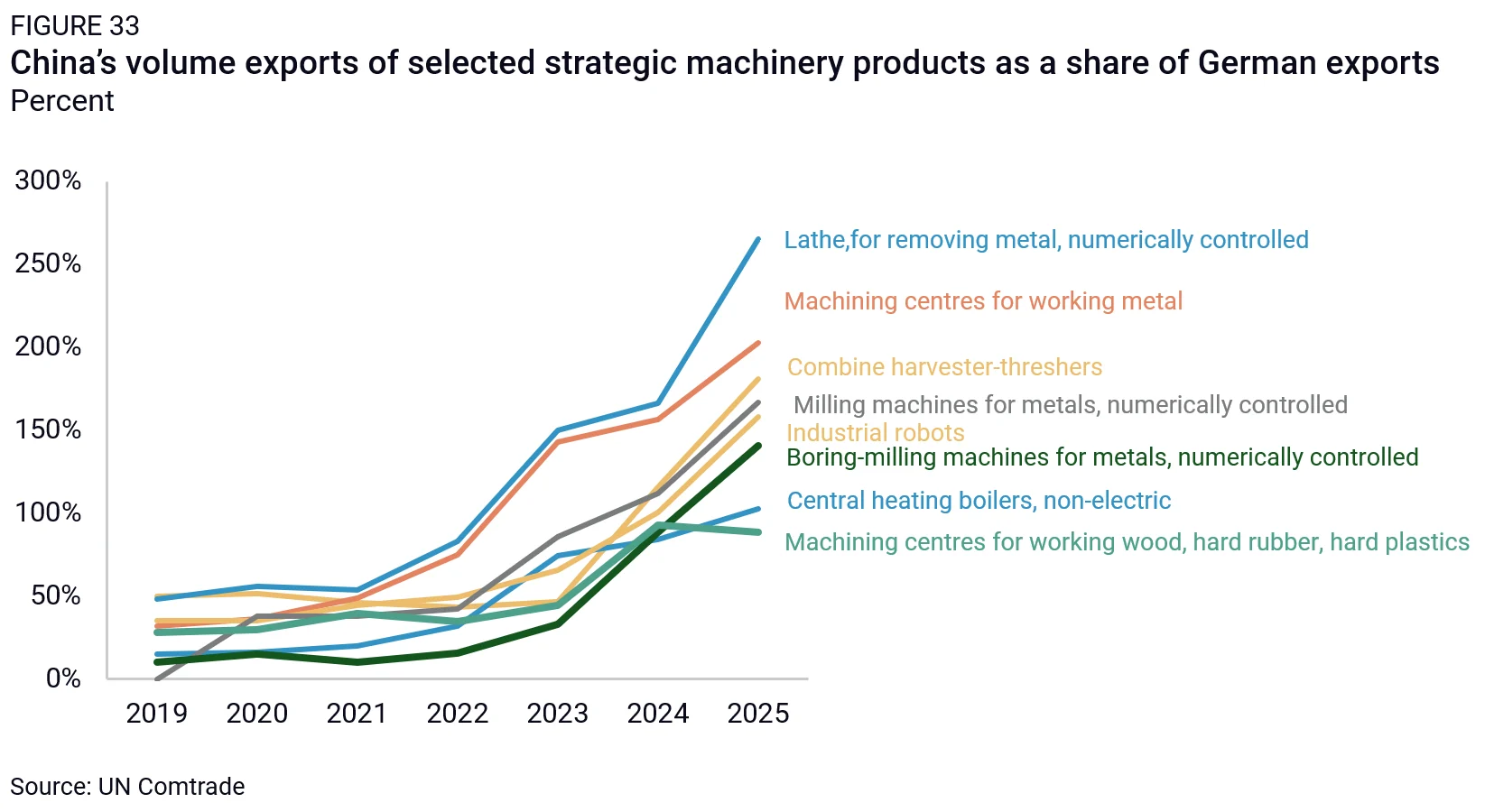
Indirect dependencies: China’s rise in global value chains
As Chinese firms move up the value chain into higher-tech, higher-value segments, they are capturing a larger share of the value embedded in goods consumed around the world. But this influence is also becoming less visible: Increasingly, Chinese inputs reach global markets indirectly, routed through third countries or embedded deep within complex supply chains, making exposure harder to track and manage.
Chinese value added in global final demand—that is, how much of what the world buys and uses ultimately originates from Chinese production—has risen fast in the past five years. That growth was particularly rapid in emerging economies. China’s value added in ASEAN’s final demand grew by 60% between 2021 and 2024, with Cambodia, the Philippines, and Vietnam recording the largest increases. Chinese value added in these countries’ final demand rose by 119%, 89%, and 78%, respectively, between 2019 and 2024. China’s value added in India’s final demand grew by 78% in the same period, far outpacing other regions (Figure 34). In absolute terms, ASEAN and the EU remain the largest destinations, although growth in the EU has been more modest (around 17%). As a share of global final demand, China’s value added increased from 14% to 16% between 2019 and 2024. Much of this shift occurred in 2020, when pandemic-related disruptions reduced production elsewhere, a gap that has only partially reversed since. The acceleration of this trend in 2025 and 2026 suggests that China’s share of value added may have increased further.
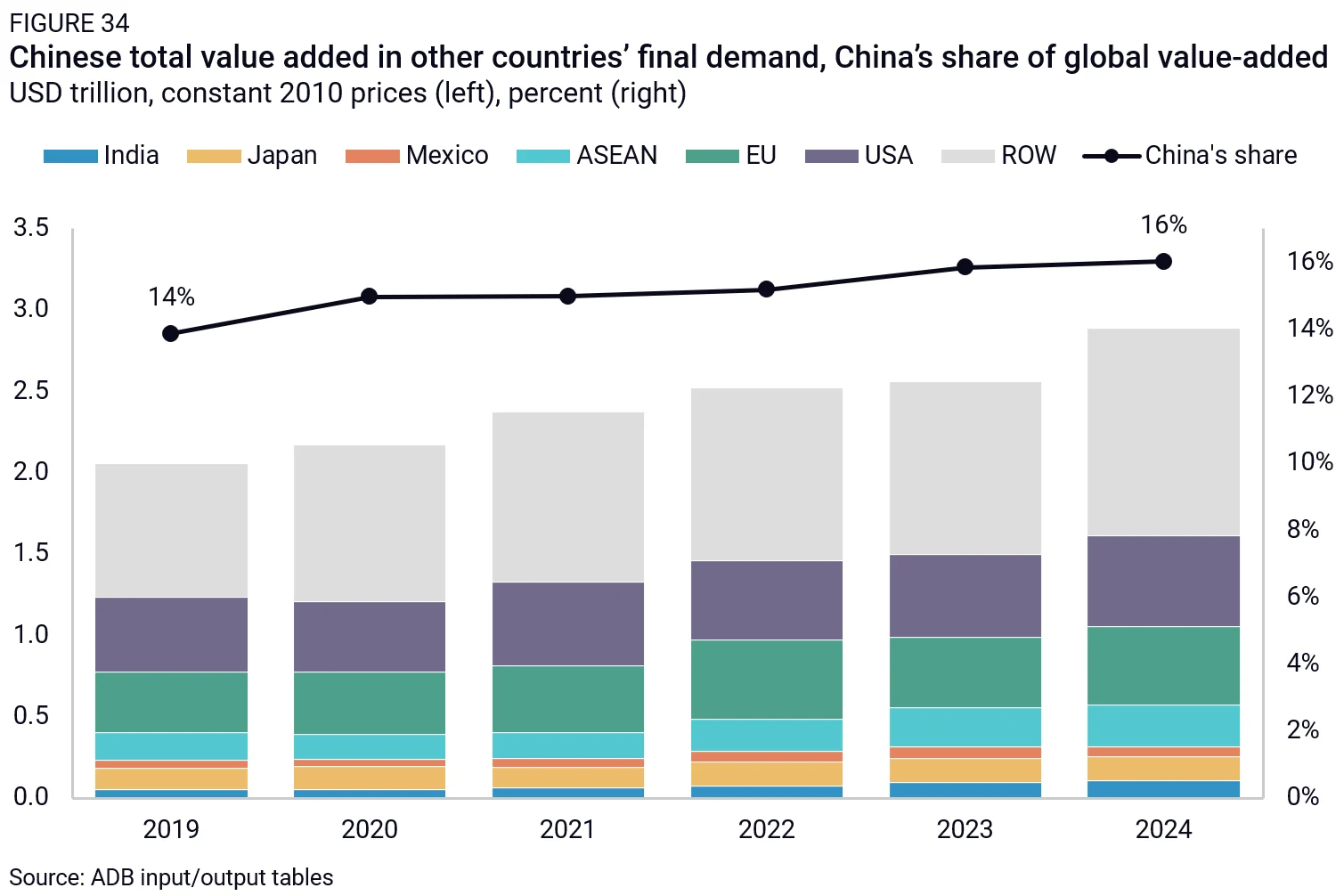
In recent years, a rising share of Chinese value-added reaches end markets indirectly via third countries rather than through direct exports. The share of China’s value added reaching foreign final demand indirectly rose from 39% in 2020 to 44% in 2024.18 This means Chinese content is increasingly embedded in goods that are assembled, processed, or re-exported elsewhere before reaching final consumers. In practical terms, this means that even when countries appear to be sourcing less directly from China, they are often still consuming Chinese value. For example, a smartphone assembled in Vietnam or a car component manufactured in Mexico may still rely heavily on Chinese-made inputs or machinery.
The United States provides a clear illustration of both dynamics. While China’s share of US imports fell from 22% in 2017 to 14% in 2024, its share of value added in US final demand proved more resilient, declining only from 17% to 16% over the same period (Figure 35). In absolute terms, while US direct imports from China declined by 2%, US imports of Chinese value added increased by 22%. A growing portion of this value added is also through “indirect imports,” from third countries (Figure 36). This divergence reflects the growing role of “connector economies” such as Vietnam, Mexico, and Taiwan, which import intermediate goods and capital equipment from China, incorporate them into finished products, and export those products to the United States. This trend has continued to accelerate into 2025–2026, suggesting current exposure is understated in these estimates.
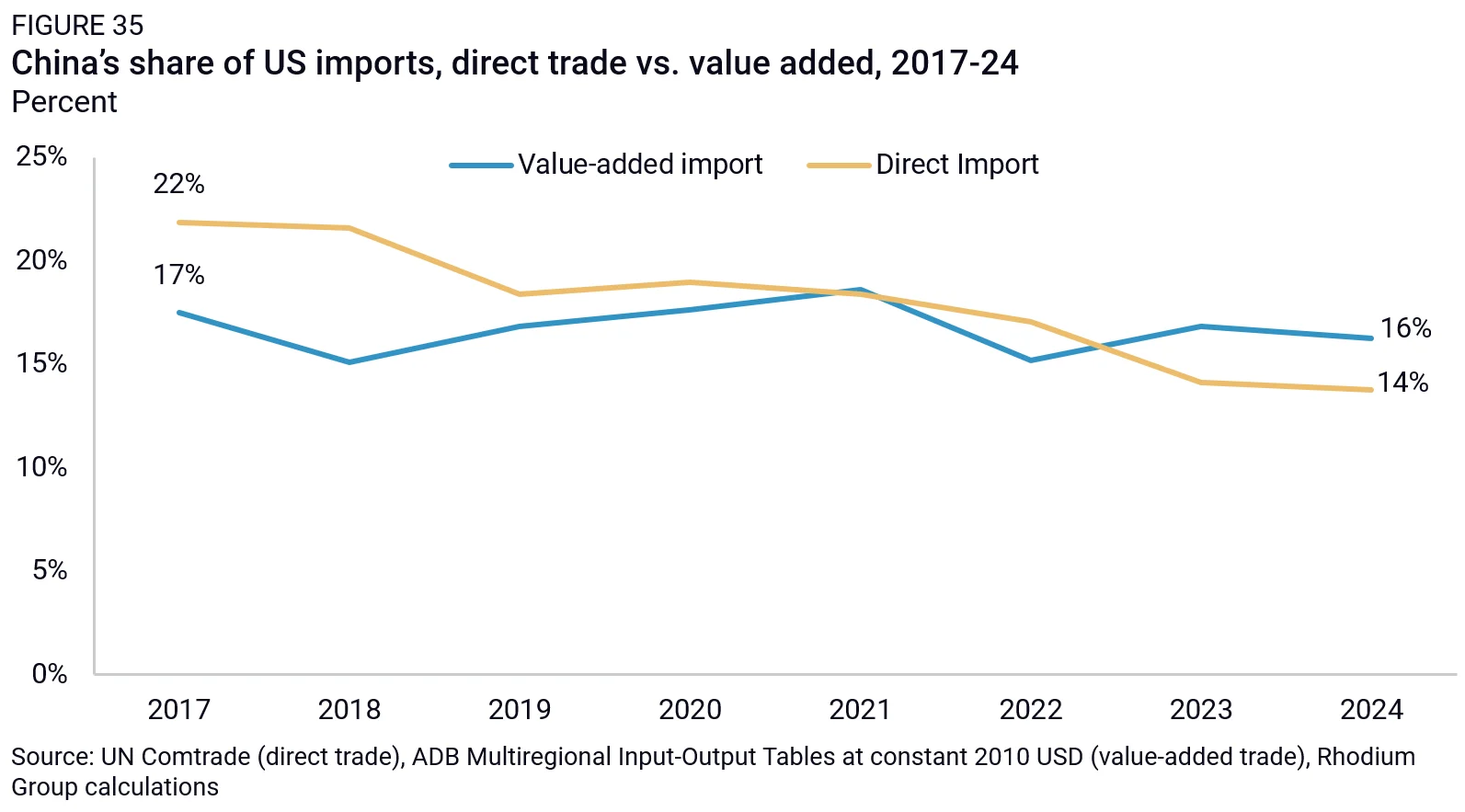
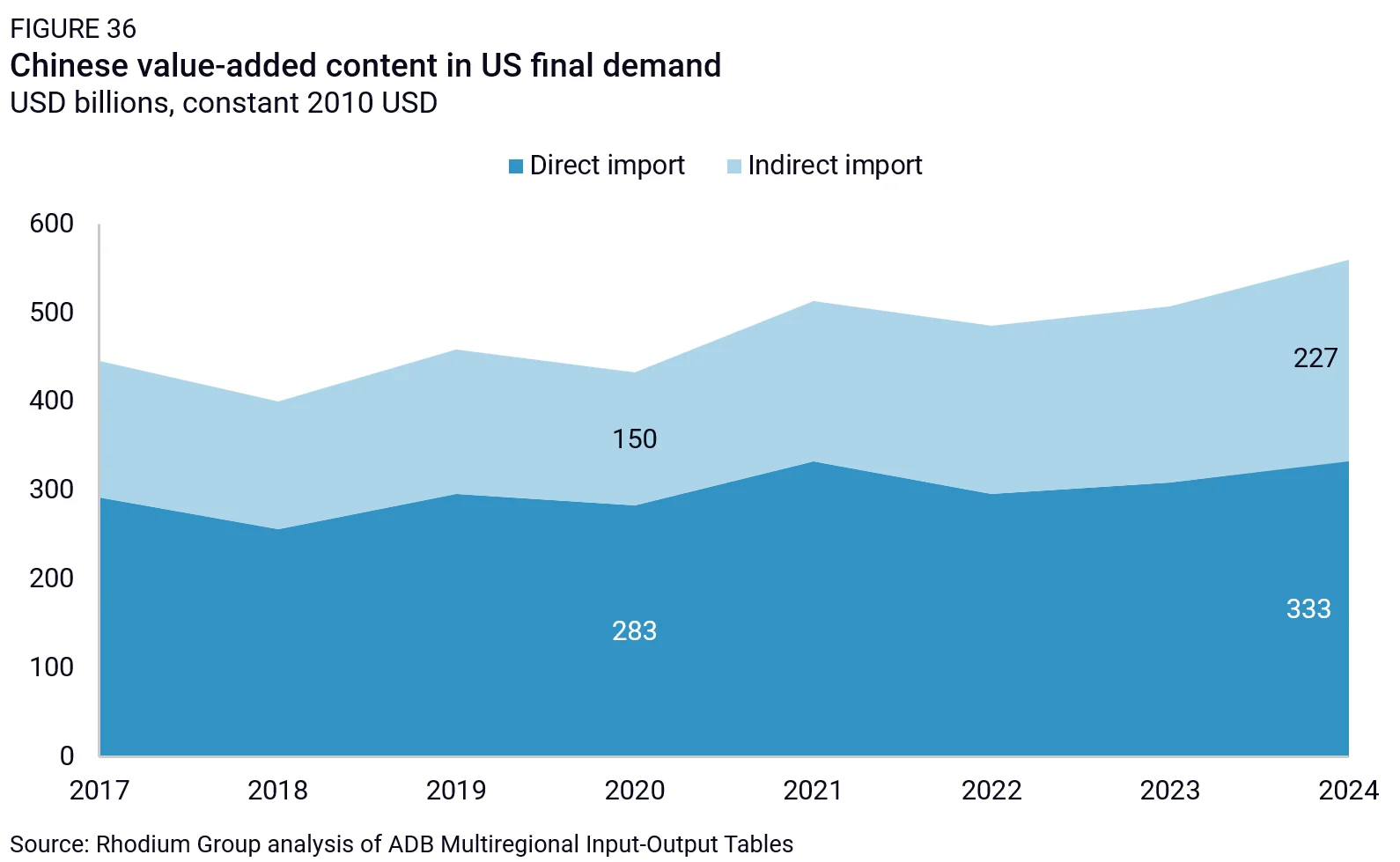
ASEAN in particular has emerged as a key hub, absorbing Chinese inputs and re-exporting them to global markets (Figure 37). Sector-wise, these indirect flows are heavily concentrated in electrical and optical equipment, though other sectors, including metals, rubber and plastics, and (to a lesser extent) textiles, are also contributing (Figure 38). This reflects the fact that, by shifting the location of final assembly to Vietnam, manufacturers of Chinese electronics inputs were able to avoid higher US tariffs. Further decomposing the value-added origin of US electronics imports from Vietnam reveals that Vietnam’s electronics exports have become more “Chinese” on a proportionate basis.
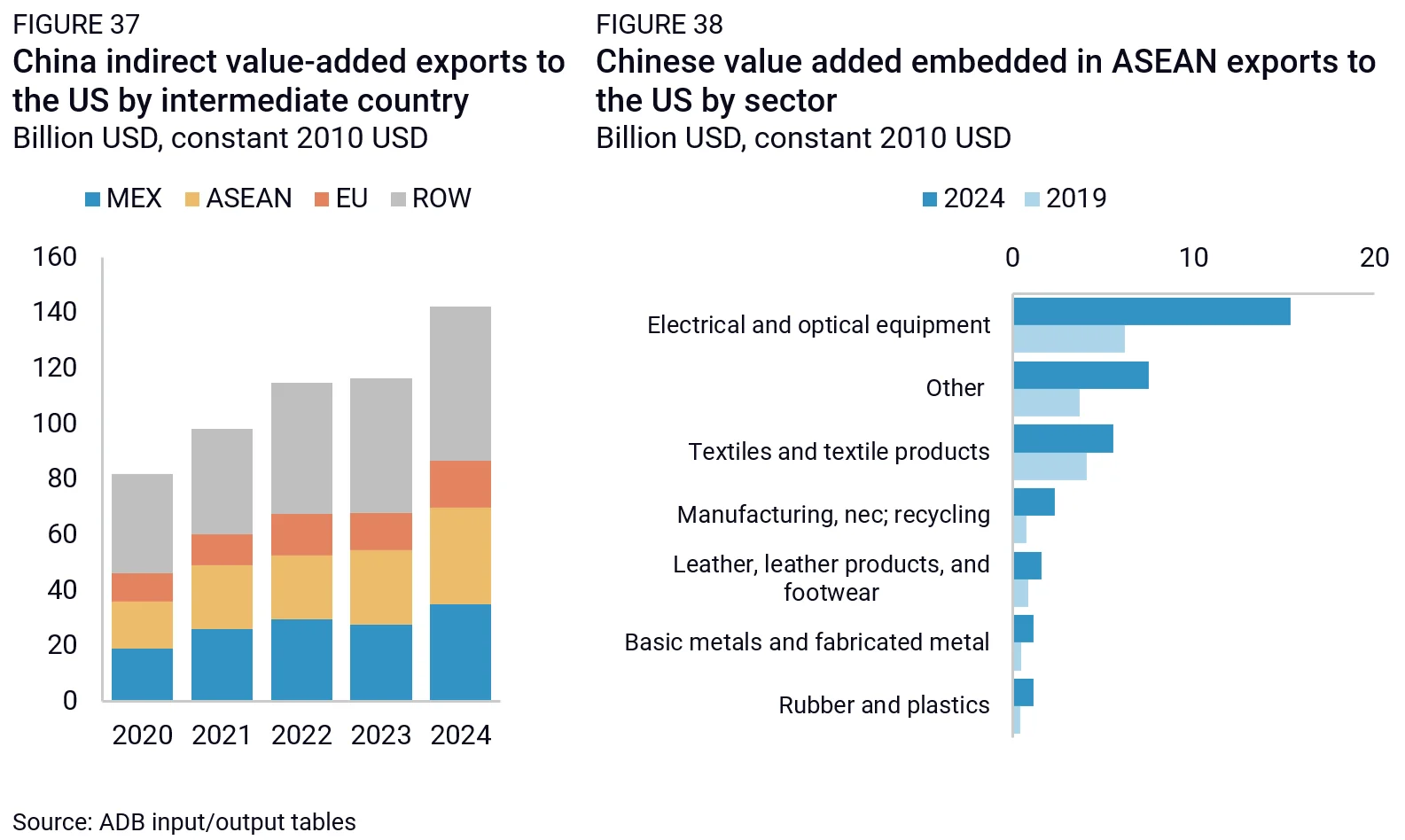
China’s growing toolkit to prevent diversification
China’s dominance across critical value chains has reached a scale where it is increasingly self-reinforcing. Control across upstream, midstream, and downstream segments creates powerful ecosystem effects which make diversification costly and difficult. Strength in one segment can also be used to shape outcomes in others: Upstream dominance can restrict access to critical inputs for downstream competitors, while large-scale demand can influence global pricing and investment decisions upstream. As its exposure to external trade defense measures increases, Beijing is also deploying an expanding set of policy measures to pre-empt future restrictions and leverage its dominance across critical value chains, effectively moving toward a more offensive use of economic statecraft.19
This growing policy toolkit follows a strategy Xi Jinping and the senior Party leadership have articulated for years: China should use legal and economic tools as an instrument of “international struggle,” national security, and industrial-policy projection. Xi has repeatedly called for China to strengthen its “foreign-related rule of law” capacity,20 including the extraterritorial application of Chinese law and the training of politically reliable legal personnel able to defend China’s interests abroad.21 Chen Yixin, head of the Central Political and Legal Affairs Commission, similarly called for enriching China’s “legal toolbox” to counter foreign sanctions, prevent perceived “interference” in China’s internal affairs, and to extend Chinese judicial oversight to PRC citizens abroad.22 Chen also emphasized the importance of influencing international rules and regulations that infringe on China’s interests.
First, Chinese firms reinforce their dominant position by sustaining long periods of below-market prices and then raising prices or controlling supply when they achieve market dominance. Chinese firms benefit from scale, state support, and coordinated industrial policy, allowing them to operate at extremely low or even negative margins for extended periods. This creates a competitive environment that foreign producers cannot survive in. Over time, these dynamics force exit of non-Chinese companies and consolidate China’s market position. The rise of China in the global vitamin C market illustrates this pattern: After a wave of Chinese capacity expansion drove global prices down and pushed incumbents out of the market, Chinese producers moved to coordinate supply and raise prices, leading to US antitrust litigation beginning in 2005.
The gallium supply chain provides another, more recent example of this mechanism. A rapid expansion of Chinese production in the early 2010s led to persistent global oversupply and depressed prices. Supported by state backing, Chinese producers continued operating despite losses, while competitors in Europe and Central Asia exited the market. Within a few years, China had become the sole large-scale supplier. Once this position was secured, China moved to formalize control over supply. In July 2023, it introduced export licensing requirements for gallium, followed by tighter end-use scrutiny and targeted restrictions in 2024, including measures aimed at US buyers.
Beijing has deployed a range of policy tools that both deepen China’s dominance and constrain the ability of others to diversify. Export controls have become a central tool in this strategy (Table 7). Since the late 2010s, China has transformed what was once an ad hoc system into a comprehensive, rules-based regime anchored in the 2020 Export Control Law and subsequent regulations, including the 2024 Regulations on Export Control of Dual-Use Items. The toolkit now spans formal export controls (dual-use lists, technology catalogs), entity-based sanctions (Unreliable Entity List), and counter-sanctions authorities (Anti-Foreign Sanctions Law), broadly mirroring the scope of advanced regimes such as the United States.
China has ramped up the use of export controls since 2023 to deter other countries from pursuing de-risking or trade defense agendas. For example, China imposed export licensing requirements on gallium and germanium in August 2023 shortly after the United States tightened semiconductor export controls in October 2022. It expanded graphite controls in December 2023 following further US chip restrictions, and in February 2025 introduced controls on tungsten, tellurium, bismuth, molybdenum, and indium just days after new US tariffs took effect. The April 2025 expansion of rare earth elements (REE) export controls came in the wake of a broader US trade escalation, signaling China’s willingness to leverage its dominance in critical inputs in direct response to external pressure. Most recently, the restriction of REE exports to Japan in early 2026 was openly acknowledged as a response to remarks made by the Japanese prime minister.
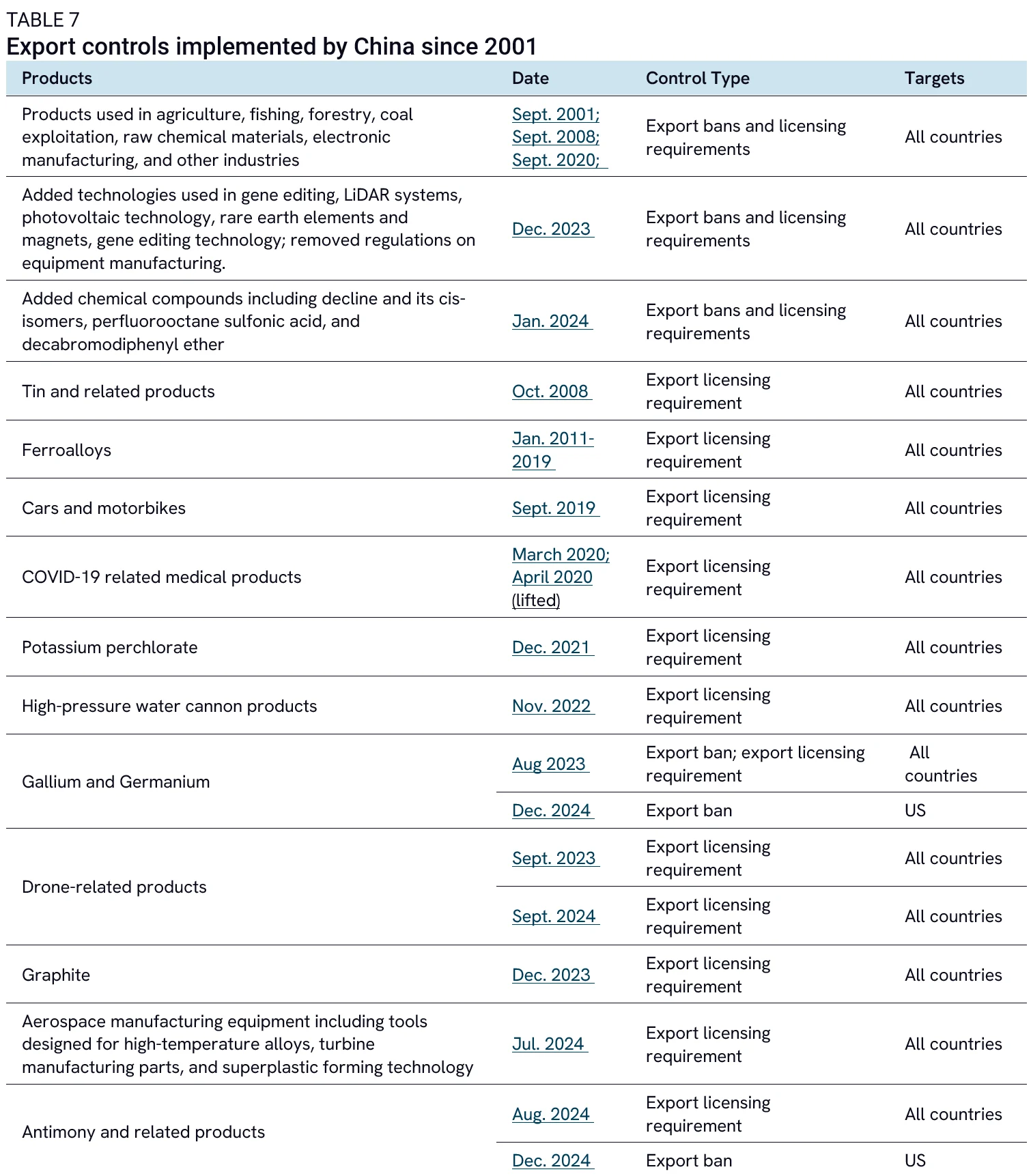
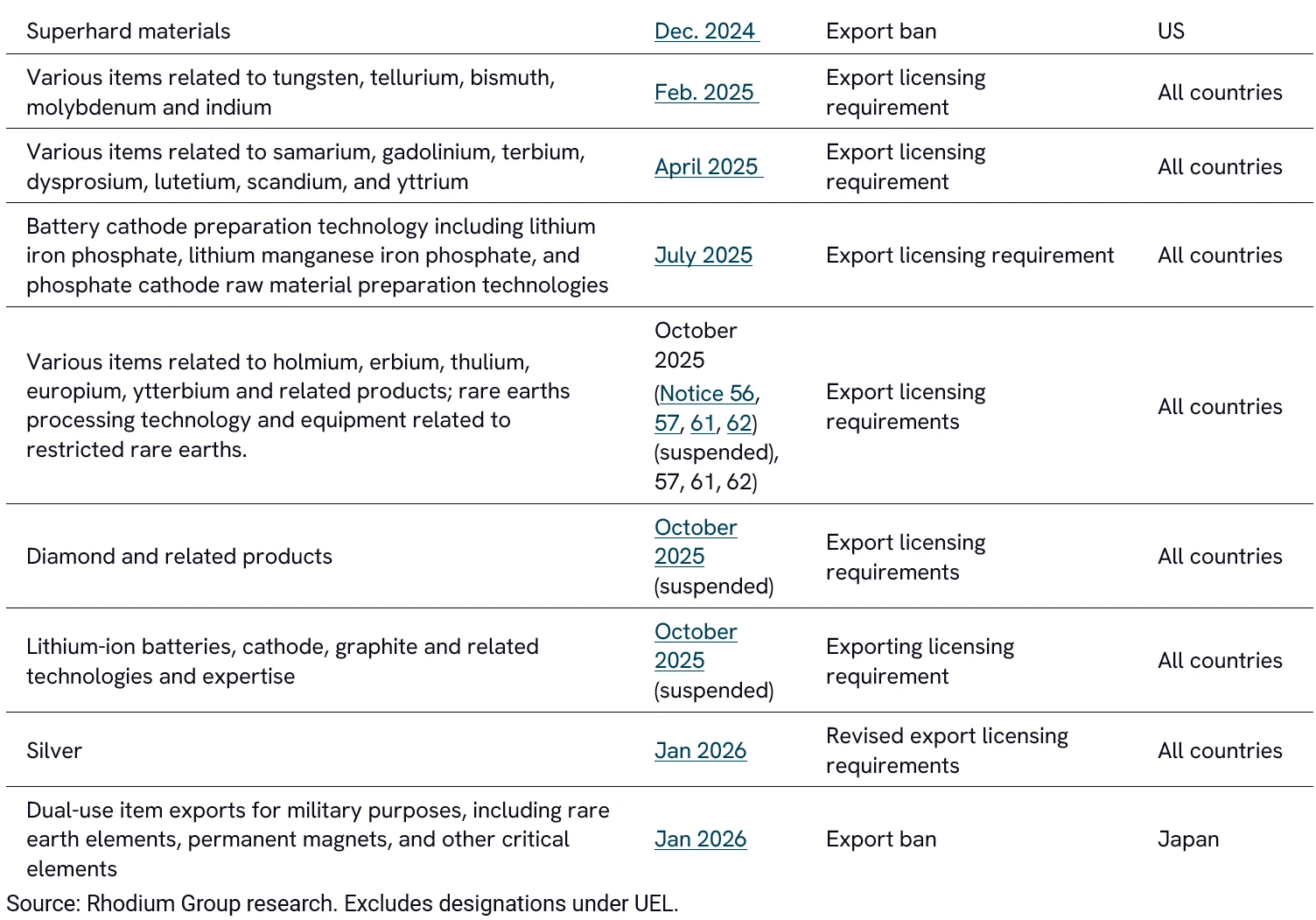
Export controls have been used to prevent diversification by denying access to critical inputs and technology. In the battery and critical minerals sectors, for example, China has progressively tightened restrictions not only on raw materials, but also on the know-how and equipment required to process them. For example, in July 2025, China’s Ministry of Commerce expanded its catalog of technologies subject to export controls to include a range of lithium processing technologies for advanced battery manufacturing. The proposed measures cover technologies for refining lithium from spodumene into battery-grade carbonate and hydroxide, direct lithium extraction from brines, and the production of metallic lithium and lithium alloys. They also extend to key battery manufacturing capabilities, including producing advanced lithium iron phosphate (LFP) cathodes, particularly high-compaction-density (HCD) variants that fall under the latest generation of HCD LFP material. These restrictions constrain the ability of countries such as Argentina to license Chinese technology to build domestic refining and battery production capacity, preserving Chinese firms’ lead in upstream processing.
Although they were postponed for a year, the October 9, 2025 export controls introduced a much more expansive and extraterritorial regime. The controls expanded the scope from heavy and medium REEs to a broader set of REEs, lithium-ion battery technology, superhard materials, and equipment needed for the mining and processing of REEs and magnets. They also marked the first time China has applied a foreign direct product rule to regulate downstream products. The new licensing framework will apply to foreign-produced rare earth magnets, as well as parts, components, and assemblies containing at least 0.1 percent heavy rare earth elements sourced from China. China is also ramping up its capacity to implement and enforce these tools. Enforcement efforts are becoming more sophisticated, with crackdowns on smuggling, the introduction of traceability systems (notably in rare earths), and enhanced inter-agency coordination. Licensing regimes generate detailed information on global supply chains and firm-level dependencies, enhancing China’s ability to calibrate future measures.
Export controls are embedded within a broader economic coercion toolkit designed to impose asymmetric costs and deter diversification. Rather than pursuing symmetric retaliation, Beijing targets supply chain chokepoints where foreign dependence is highest. Alongside export controls, China has increasingly deployed trade and sanctions instruments in response to foreign measures. Following the EU’s tariffs on Chinese electric vehicles, Beijing imposed duties on European brandy, pork, and dairy—measures that target politically sensitive sectors in key member states such as France, Spain, and Denmark. “Anti-discrimination investigations” under the Foreign Trade Law also enable retaliatory tariffs: In the first-ever application of the law, China imposed tariffs on Canadian rapeseed, pork, and other products in response to Canada’s 100% tariffs on Chinese EVs and 25% tariffs on steel and aluminum in March 2025.
China can also escalate through entity-based sanctions under the Unreliable Entity List (UEL) and Anti-Foreign Sanctions Law (AFSL). The number of firms on the AFSL list increased from just eight in Q1 2023 to 103 in Q1 2024. Increasingly, these lists are being used to counter companies’ diversification efforts or lobbying for restrictions on Chinese competitors. The listings of PVH and Illumina in February 2025 are instructive. MOFCOM argued that PVH’s compliance with the Uyghur Forced Labor Prevention Act “discriminated” against Xinjiang suppliers and disrupted “normal market transactions,” with even internal compliance discussions drawing scrutiny. Illumina, meanwhile, was targeted following its lobbying support for the US BIOSECURE Act.
Two recent regulations mark a clear escalation in China’s efforts to deter diversification and de-risking by governments and firms globally. On April 7, China’s State Council issued the Provisions on Industrial and Supply Chain Security, which explicitly enable countermeasures against actors engaged in “investigations and other information collection activities” related to China’s supply chains and outlines retaliation against companies that suspend “normal transactions” with Chinese firms, apply discriminatory measures, or otherwise “cause or threaten substantive harm” to China’s industries or supply chains. In practice, this creates legal exposure for firms supporting de-risking measures and shifting supply chains away from China, with the goal to raise the cost of both public advocacy and internal corporate de-risking decisions.
A second policy, the Regulations on Countering the Improper Extraterritorial Application of Foreign Laws and Measures, issued on April 13, reinforces this approach by directly targeting foreign legal influence. The regulations stipulate that entities must not implement or support foreign “long-arm” jurisdiction, where deemed improper by Chinese authorities, formalizing Beijing’s ability to penalize alignment with external regulatory regimes.
These regulations follow a revision of China’s Foreign Trade Law, effective in March 2026, which allows Beijing to take countermeasures against countries that adopt policies deemed discriminatory against China. In addition, the revisions permit China to take broad trade measures outside the framework of the WTO when it is deemed that the treaty dispute settlement mechanism cannot work properly. Taken together, these recent regulatory developments signal a shift from reactive to proactive, future-looking economic coercion strategies. They represent the predictable execution of a strategy that Xi and senior Party leadership have articulated over several years: To build a comprehensive toolkit capable of shaping global supply chains, deterring diversification, and extending China’s regulatory reach beyond its borders. China is preparing for a more contested global environment by both strengthening domestic resilience and expanding its capacity to shape firm behavior beyond its borders. The objective is not only to defend existing market positions, but to actively deter diversification and preserve China’s central role in global supply chains.
2. The expansion of Chinese multinationals abroad
China’s expanding trade surplus and growing reliance on external demand are also reshaping how its firms compete globally. As production capacity continues to outpace weak domestic demand, Chinese companies are increasingly dependent on foreign markets for growth. The scale of China’s export expansion is also triggering tariffs, trade defense measures, and broader efforts to reduce dependence on Chinese supply chains in major markets. In response, Chinese firms are entering a new phase of internationalization through overseas investment, partnerships, and localized production.
Yet this expansion may not necessarily bring deep localization and associated local economic benefits. Unlike other emerging multinationals in previous generations, Chinese companies are much more heavily exposed to policy guidance through domestic industrial policy and an outbound FDI regime that gives Beijing an opportunity to intervene if investment projects are not in line with national development and economic security priorities. As a result, although many governments hope Chinese investment will bring capital, technology, and industrial upgrading, its positive spillovers are likely to be limited. Instead, investment may deepen reliance on Chinese inputs and machinery, extending China’s market dominance through channels that are more indirect, more entrenched, and more difficult to observe.
Chinese firms are growing competitors in overseas markets
As Chinese firms capture a growing share of global markets, they are becoming more reliant on overseas revenues. Weak domestic demand, combined with persistent overcapacity and intense competition at home, has compressed margins and pushed firms to seek expansion outside of China. This expansion reflects rising exports, but also the increasing ability of Chinese firms to provide local service and after-sales support, particularly in higher value-added sectors.
This shift is clearly visible in firm-level financials. In 2024, Chinese firms’ domestic revenues fell by around 2%, while overseas revenues grew by around 10% (Figure 39). The share of total revenue that Chinese listed firms derive from overseas markets rose from around 10% in 2015 to roughly 15% in 2024. The trend is even more pronounced among the largest firms: For the top 500 Chinese companies, the overseas share of total revenue rose from 44% to 47% between 2022 and 2024. That level is now comparable with their American peers, where the top 500 US firms were dependent on overseas markets for 45% of their revenues in 2024.
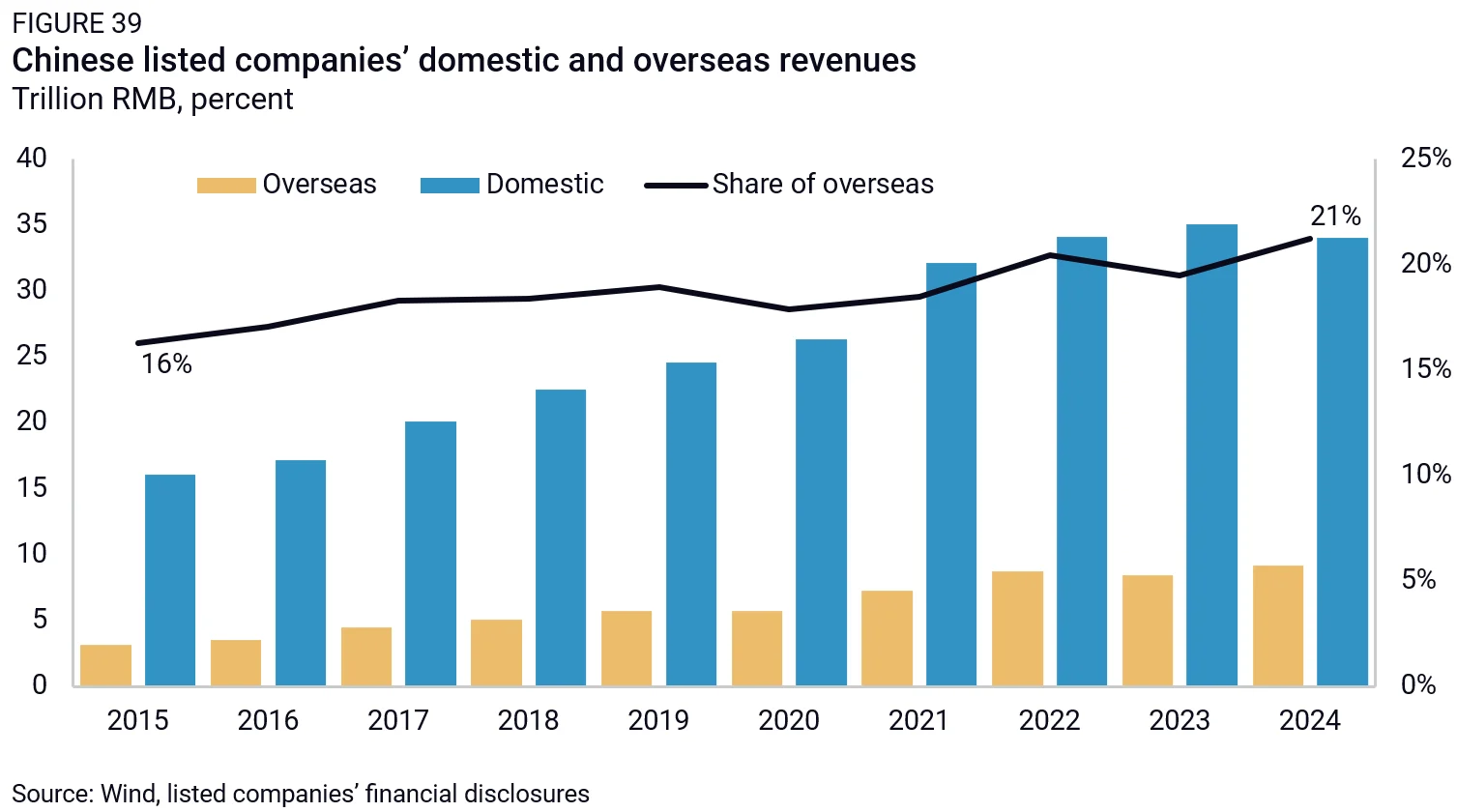
The overseas market is becoming increasingly important for many Chinese firms, particularly those in mature, consumer-facing sectors. Industries such as motorcycles, computers, housewares, tires, consumer electronics, and household products derive well over 40% of revenue from overseas markets, and that dependence is still increasing. This dynamic is also reflected at the firm level. Companies such as BYD and Zhejiang Geely have drastically increased the share of their revenues originating overseas over the past decade (Figure 40).
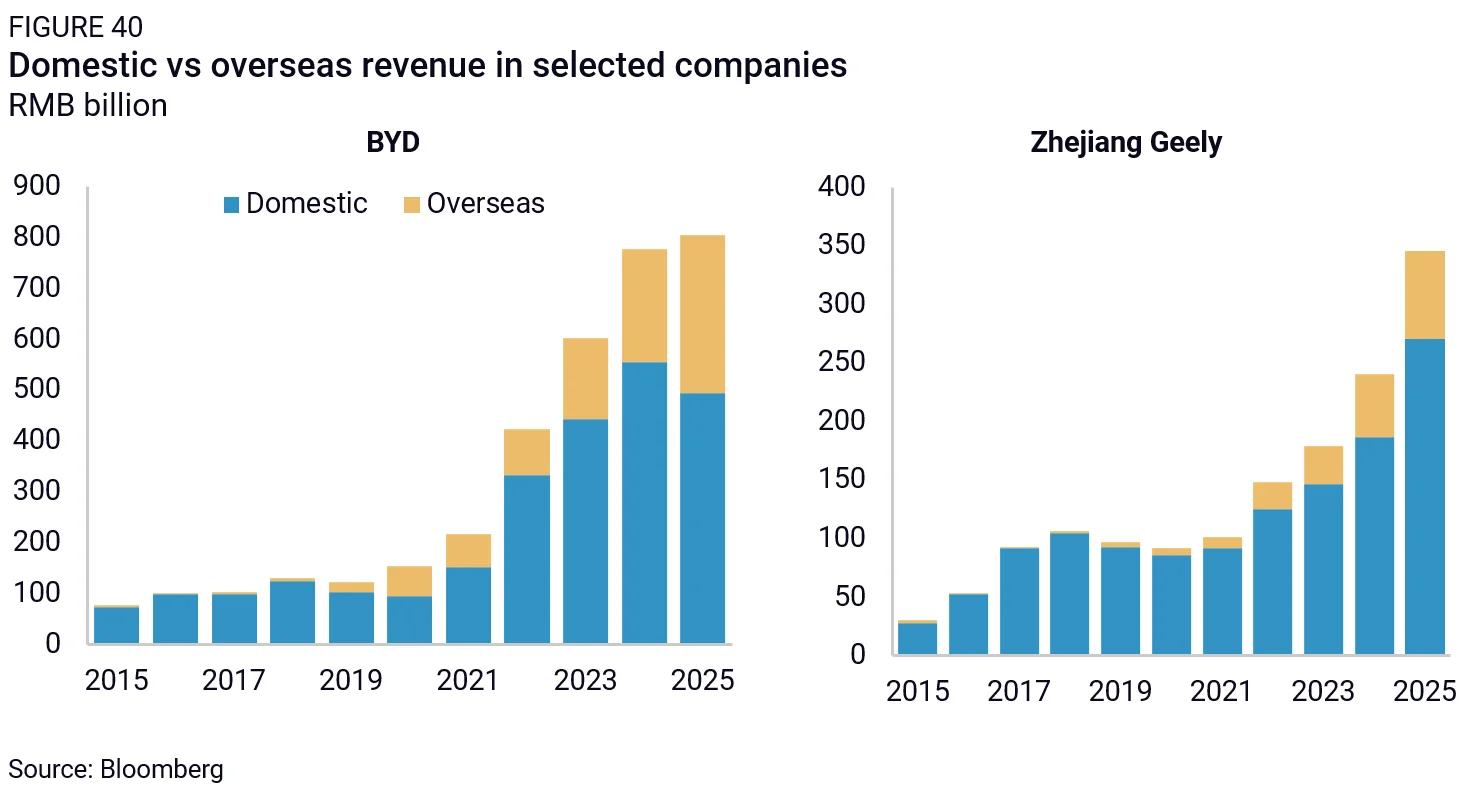
Rapid increases in overseas revenues indicate that Chinese firms are becoming robust global competitors in both established and emerging industries. Companies in traditional industries such as Haier, Wanhua Chemical, and Weichai have roughly doubled their non-China revenues between 2021 and 2025, as have firms in emerging and new technology industries like BYD, CATL, and Luxshare (Figure 41).
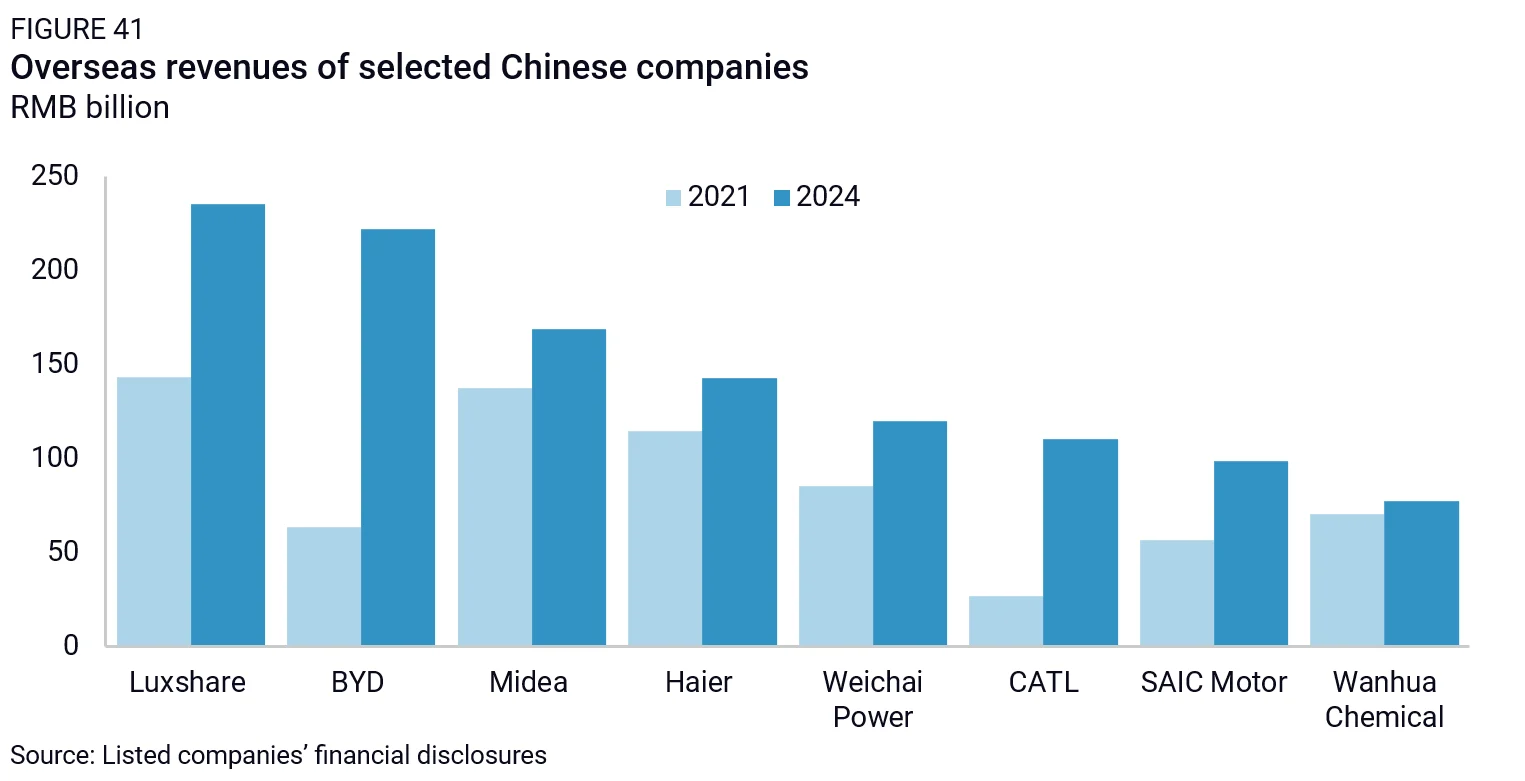
At the industry level, Chinese automakers illustrate growing success overseas clearly. In ASEAN, the EU, and Latin America, they have gained market share very quickly—from 2% of the market in 2019 to 12% in 2025 in ASEAN, from 2% to 6% in the EU, and from 2% to 11% in Latin America (Figure 42). In certain economies, this shift is even more pronounced. In Thailand, Chinese firms like BYD, SAIC, and Great Wall now account for nine out of ten of the top ten selling models.
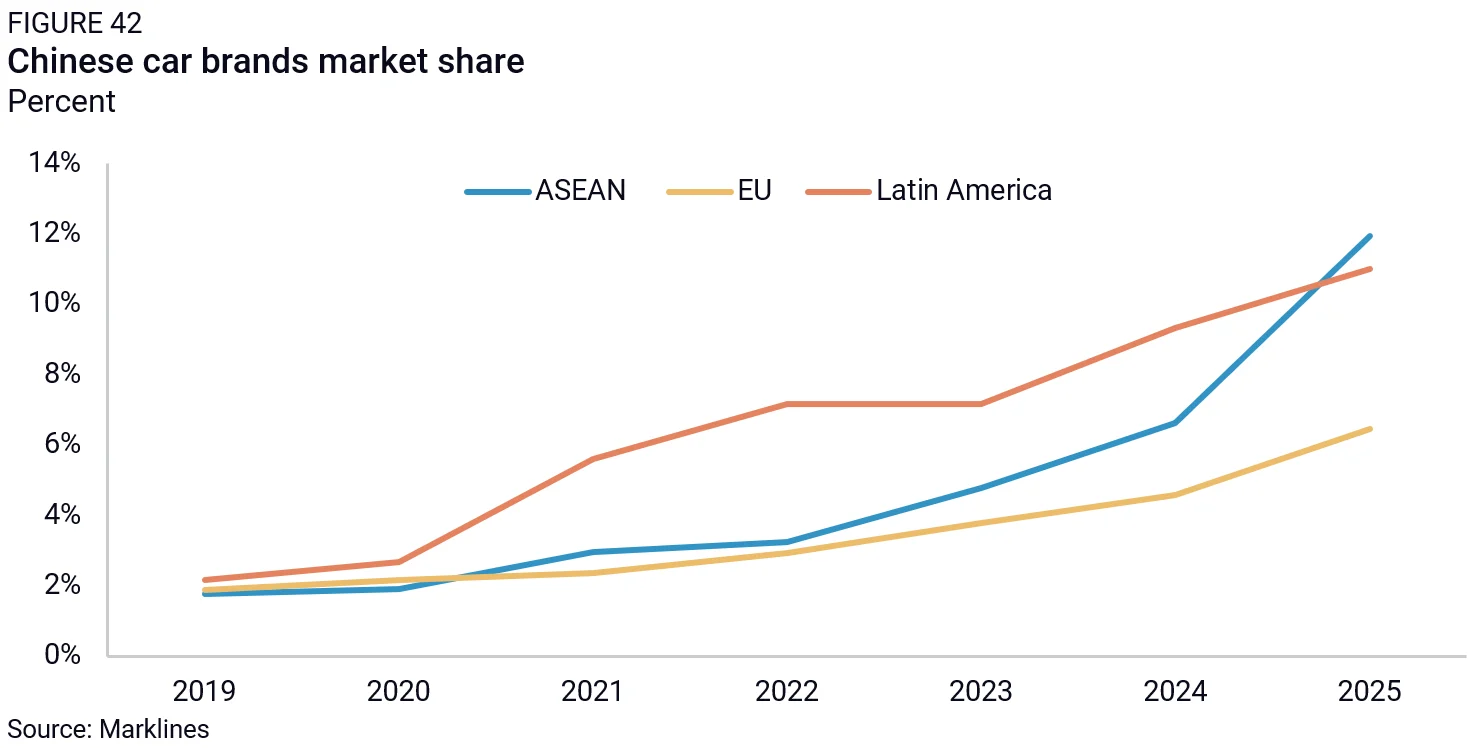
The speed of Chinese automakers’ gains is also noteworthy and drastically outpaces Japanese and Korean automakers’ yearly expansion (Figure 43). For example, within five years of entering the UK and EU markets, Chinese firms have reached nearly a 5% market share, compared to around 2% for Korean automakers at a similar stage.
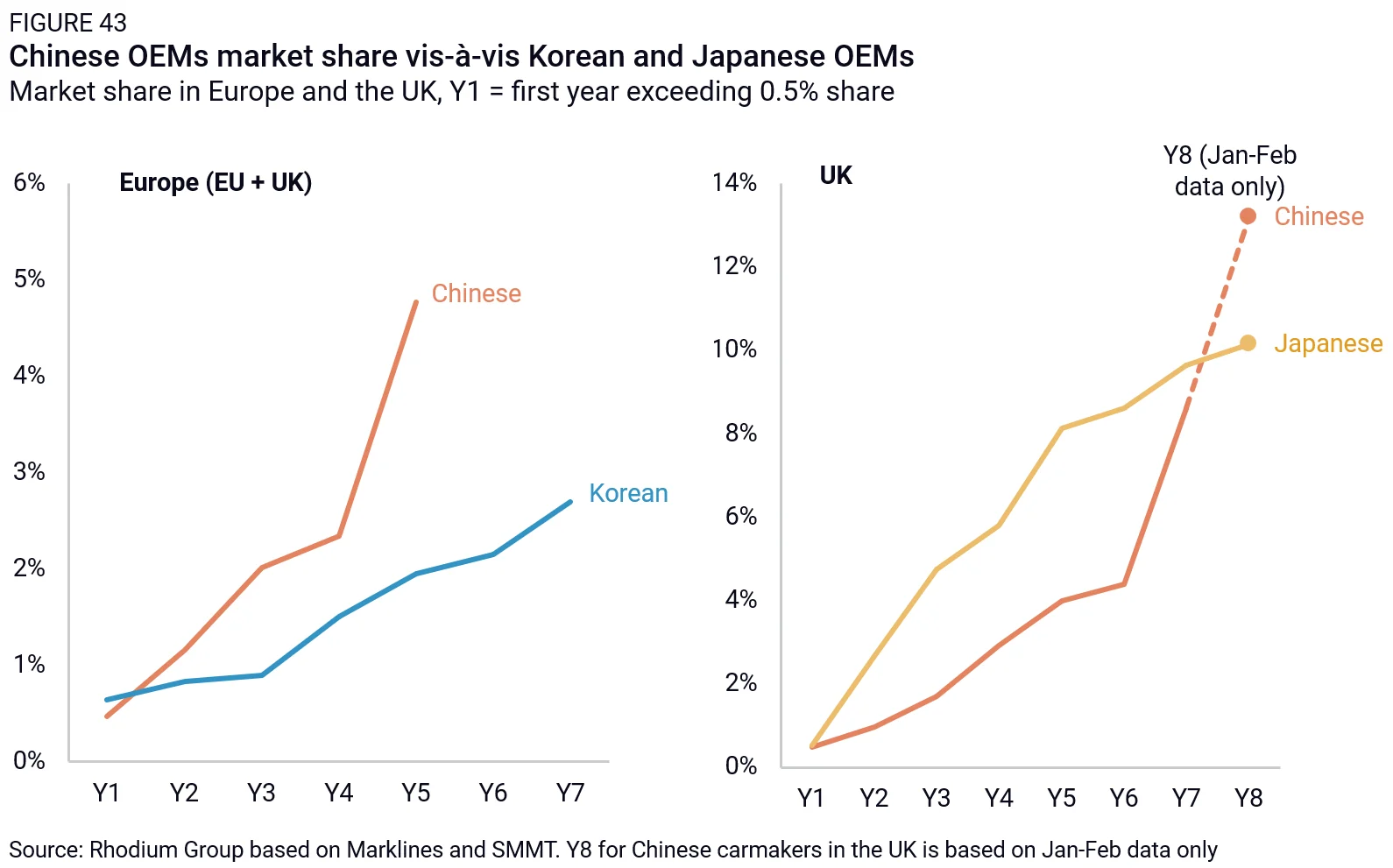
Similarly, heavy equipment manufacturers like Sany and XCMG now derive a substantial share of their overall revenue from overseas. In 2024, 64% of Sany’s total revenue originated overseas, while XCMG generated nearly 45% of its revenue abroad from operations in over 190 countries (up from 10% in 2020).23 These firms now compete directly with traditional global leaders like Caterpillar, Komatsu, Deere, and Hitachi. As in autos, revenue growth has been especially robust in non-Western markets. Sany, for example, currently holds a 30% market share in the Thai construction equipment industry.
This outward push is also increasingly visible in consumer electronics. In Southeast Asia Samsung led the smartphone market with an 18% market share in 2025, but other Chinese companies (Xiaomi, Transsion, Oppo, and Vivo) ranked second through fifth at 17%, 16%, 15% and 13%, respectively. This highlights another emerging dynamic: Chinese firms are not only competing against established non-Chinese players, but increasingly against one another in third markets.
FDI Is rebounding, but not enough to slow down the rise of China’s domestic manufacturing dominance
Chinese companies are also increasingly investing abroad. The value of OFDI transactions announced by Chinese firms increased almost 20% year on year in 2025, reaching $124 billion (Figure 44), more than double the value in 2020 ($55 billion), according to Rhodium Group’s China Cross-Border Monitor. This marks the highest level of new investment since 2018, though it remains well below the 2016 high.
That rise in Chinese outbound FDI is heavily concentrated in a few sectors: basic materials and clean technology, which account for around 70% of FDI between 2022 and 2025. Investment in metals and minerals has consistently been a major investment target as Chinese firms sought to maintain access to resources such as iron ore needed to fuel their manufacturing sector. Investment in the sector has risen in recent years, as securing resources has become even more important in the context of worsening geopolitical tensions. Clean technology investments have risen fast since 2021, in part because of rising trade tensions and market barriers to imports. By moving production abroad and embedding themselves in global supply chains, Chinese firms are able to keep markets open.
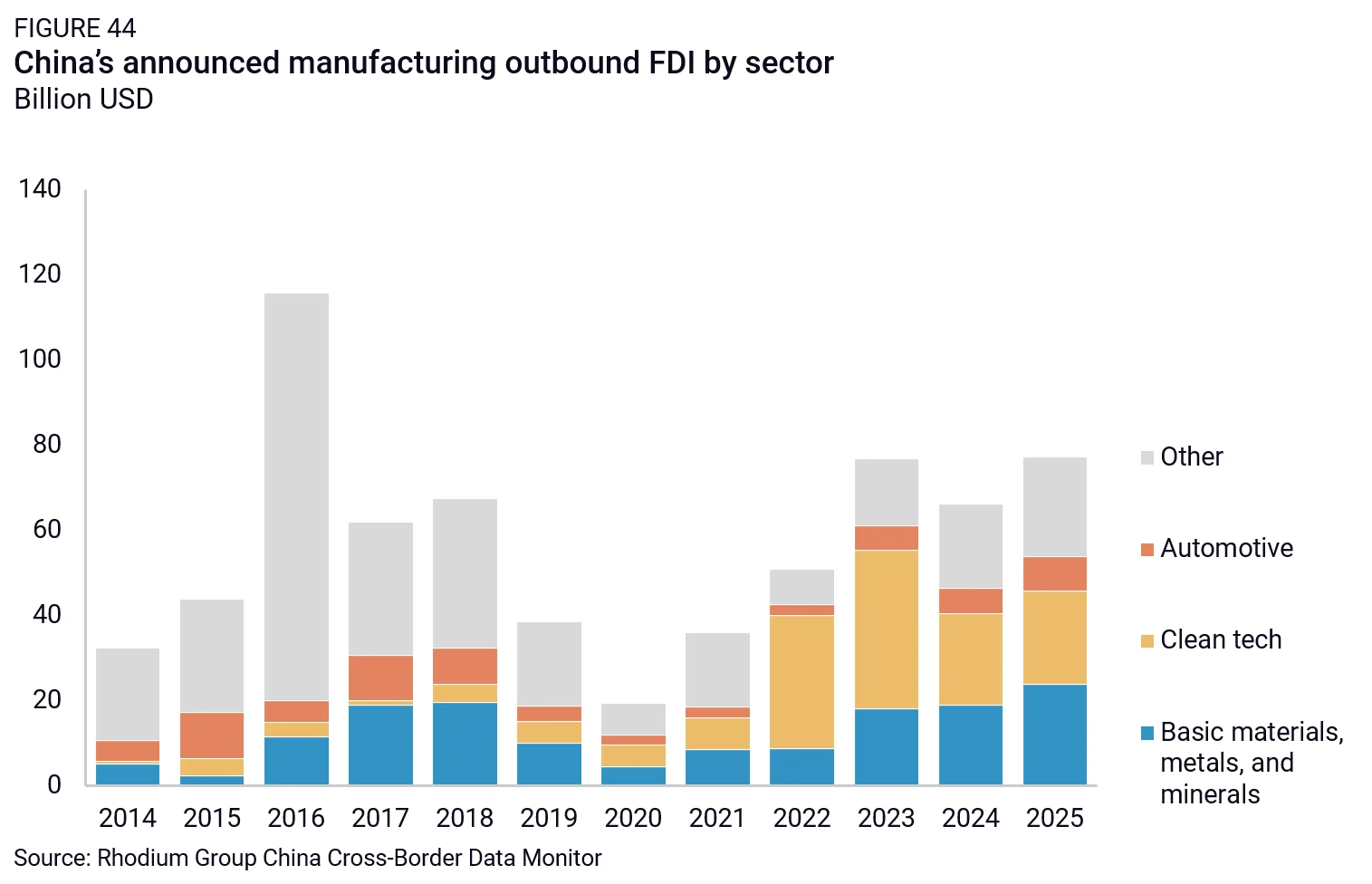
China’s OFDI is now driven by the organic expansion of Chinese firms, rather than strategic asset purchases. While M&A accounted for 66% of announced OFDI value from 2004 to 2017, greenfield FDI accounted for 80% of new investment in 2025, spurred by Chinese firms’ growing competitiveness in higher value-added industries, increasing trade barriers, and greater restrictiveness toward acquisitions in Europe and the United States. Chinese FDI is also increasingly flowing into manufacturing, accounting for 55% in 2024 versus 29% in 2016. Chinese outbound FDI has also shifted from high-income economies in Europe and North America toward middle income and emerging economies (Figure 45), in large measure reflecting Beijing’s goal not only of reaching new customers, but of preserving access, albeit indirectly, to high-demand markets in the United States and Europe. Asia has become the top investment destination over the past five years, with strong growth in Africa and the Middle East. ASEAN countries, in particular, saw rapid increases in Chinese manufacturing OFDI, with average annual investment hitting around $12 billion during 2022–2024, more than double the $5.5 billion average of 2017–2021.
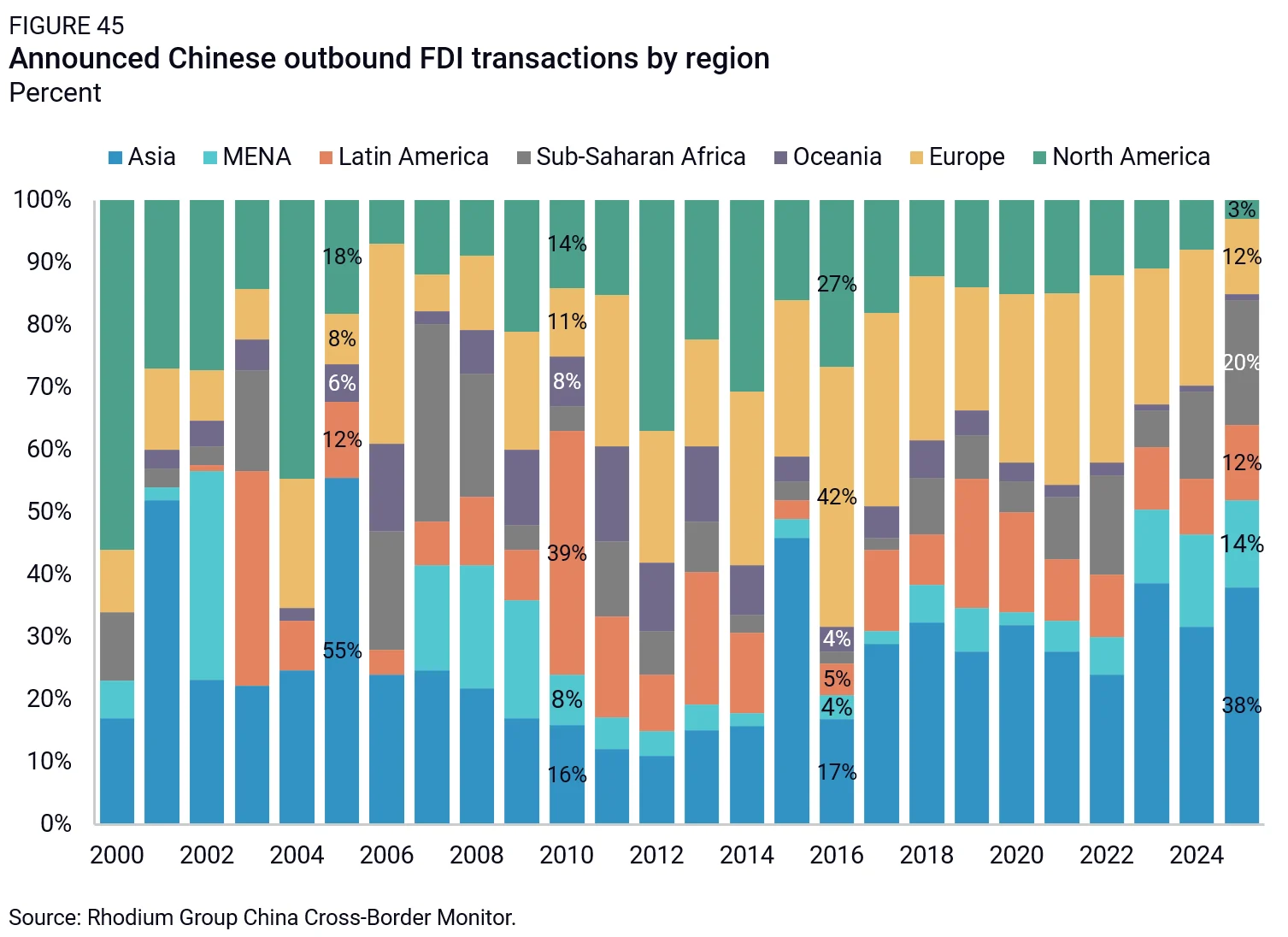
Chinese firms looking to expand overseas markets are also increasingly using other vectors of collaborations, rather than relying only on wholly-owned subsidiaries abroad. Chinese companies are increasingly embedding themselves in global markets through joint ventures, licensing agreements, contract manufacturing, R&D collaboration, and platform-based alliances. This shift is especially pronounced in high-tech and regulated sectors. In healthcare, for instance, Chinese firms are expanding in Europe less through direct market entry and more via research services, manufacturing partnerships, and licensing deals.
BYD and Mindray exemplify this model. BYD has ramped up its global partnership footprint, evolving from a handful of regional partnerships in 2015 to a dense, multi-region network by 2024, with Asia and Europe as key hubs (Figure 46). Similarly, the medical device company Mindray has developed a dense network of global partnerships, including involvements in public procurement frameworks, clinical and laboratory collaborations, the establishment of training and competency centers facilitating certification and product uptake, and commercially oriented integration efforts, such as its 2024 collaboration with Inpeco.
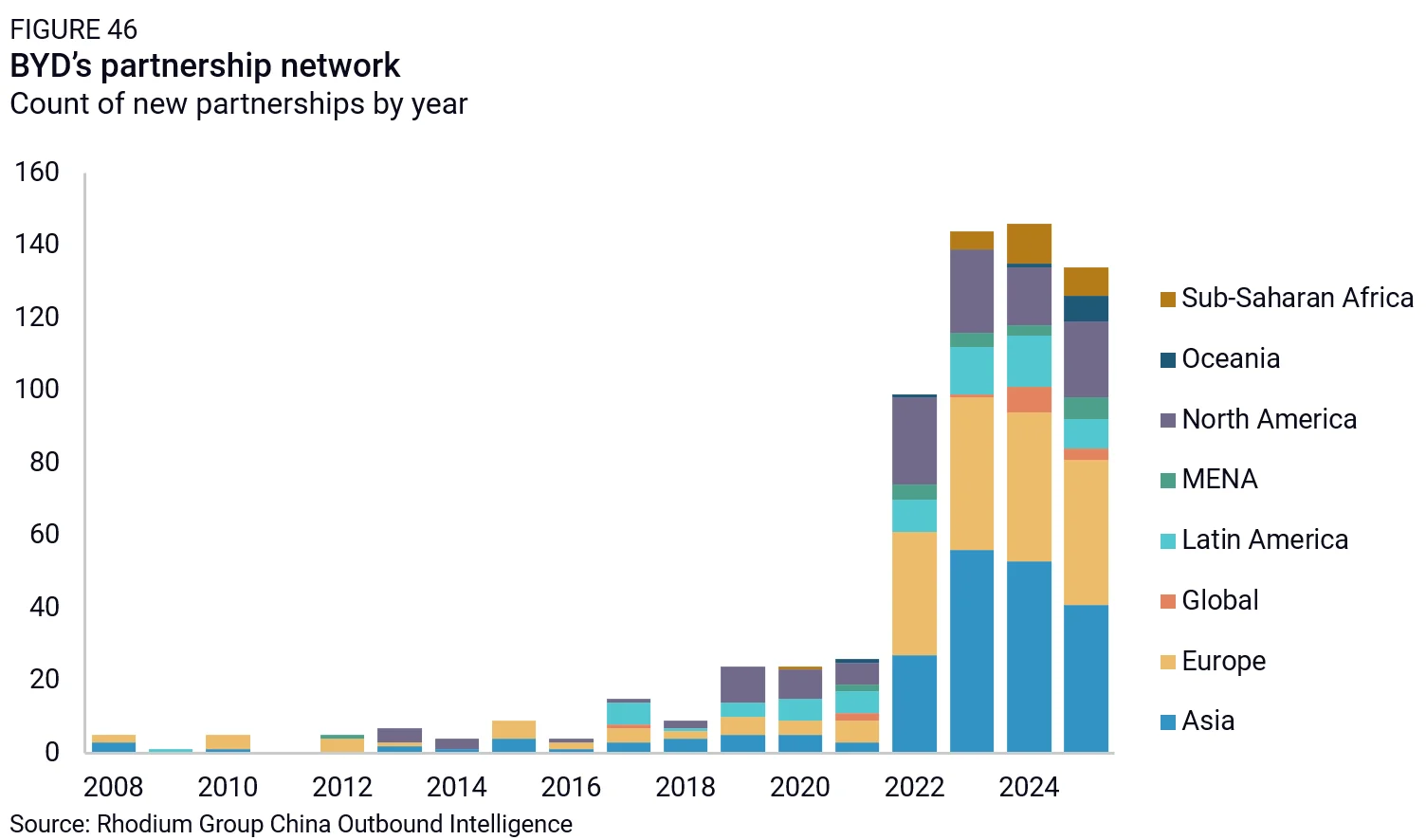
Despite this rapid growth, outbound investment remains small relative to the scale of domestic production and export expansion. Among listed firms, greenfield investment abroad has increased as a share of total capital expenditure since 2021 but still accounted for only around 3% in 2024 (Figure 47). That share is highest in extractive industries such as metals and mining, as well as low-tech consumer product sectors, and in automotive. For example, in the aluminum, rubber, and steel sectors, the ratio of FDI to capex increased by respectively 34, 28, and 7 percentage points between 2021 and 2024, against a backdrop of overcapacity at home. In the automotive sector, the ratio of FDI to capex has reached 10%, and 8% for automotive parts in 2024.
Besides these sectors, the relative weakness of Chinese firms’ localization overseas reflects both macroeconomic and political factors. First, China retains significant cost advantages in manufacturing, that often outweigh the benefits of relocating production abroad, even after accounting for transport costs. These advantages are reinforced by state support across logistics and shipping, as well as favorable macroeconomic conditions. Second, in sectors such as electric vehicles and clean technology, supply chains remain deeply anchored in China, making full offshore production less efficient. Third, many industries face substantial excess capacity at home, reducing incentives to duplicate production overseas. But the weak localization of Chinese firms overseas also reflects a system deliberately designed to anchor production at home. Industrial policy, subsidies, capital controls, export controls, and regulatory constraints all tilt firm incentives toward keeping capacity in China.
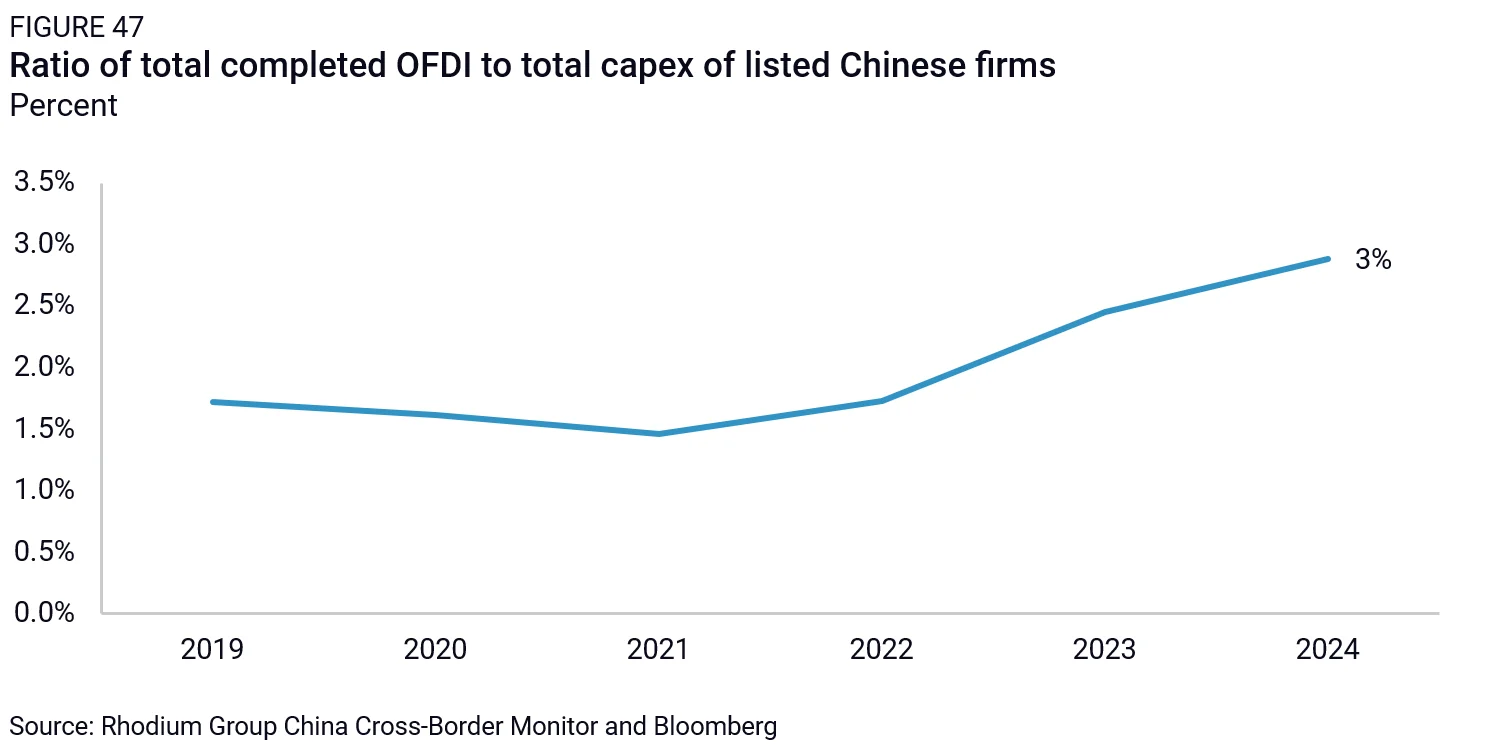
As a result, the rise in OFDI is too limited to slow down the growing dominance of China-based manufacturing in the global economy. In most industries, Chinese firms continue to rely primarily on domestic production to serve global markets, with exports—not overseas manufacturing—remaining the main channel of international expansion. This stands in contrast to earlier industrializers, such as Japan, where production progressively localized in end markets over time (Figure 48).
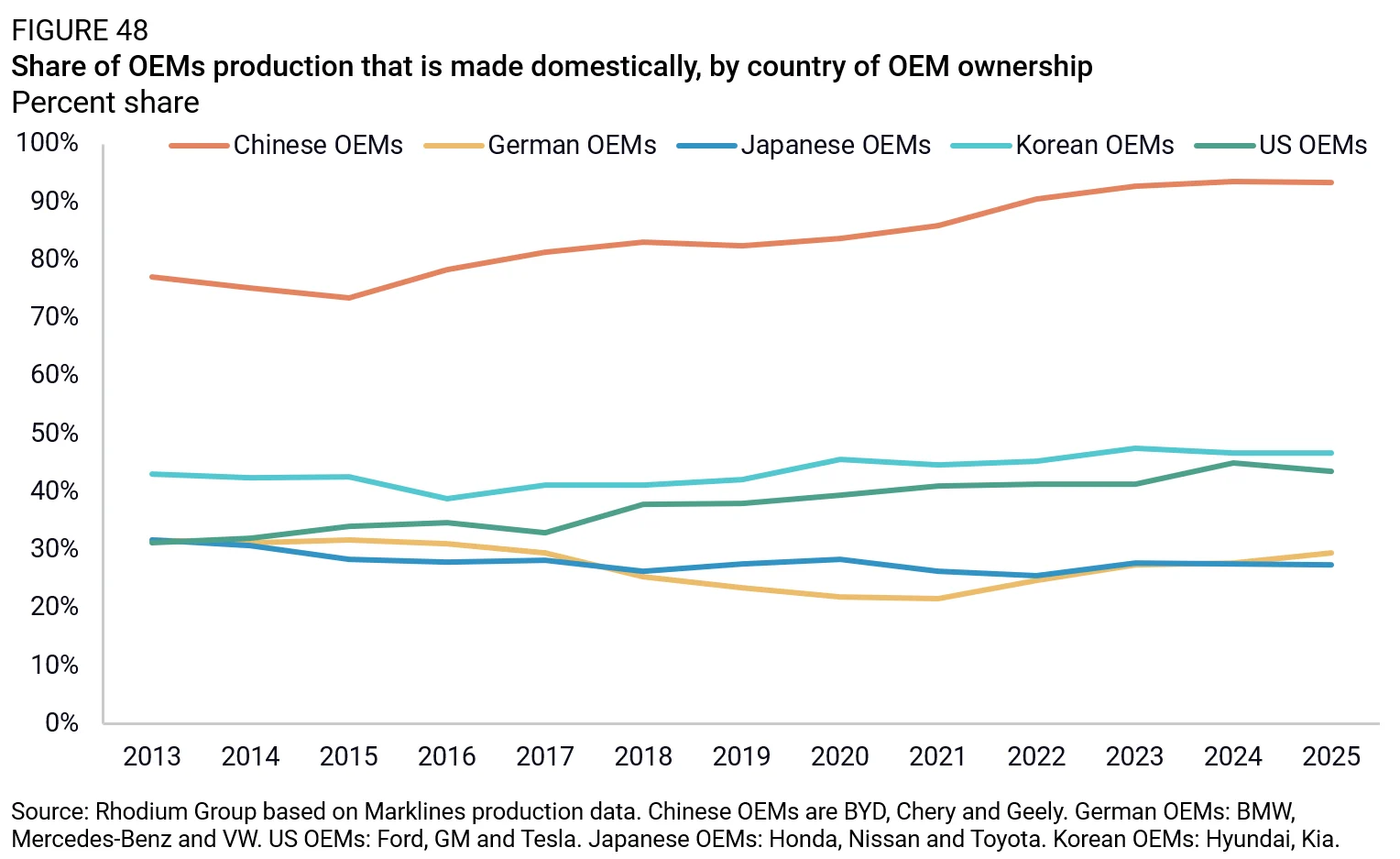
International workforce composition points to the same pattern. Chinese firms’ global talent utilization remains limited, with the share of employees located outside China typically well below 10%—far lower than that of multinational peers.24 This underscores that, despite rising overseas revenues and investment, most production and operations remain firmly anchored in China.
Taken together, these dynamics suggest that Chinese firms today face weaker structural incentives to localize production internationally than earlier generations of exporters. While rising trade barriers, local content requirements, and industrial policies in key markets may gradually push more production offshore, current trends point to a model in which global expansion is still primarily driven by exports and selectively targeted investment—rather than a meaningful shift of manufacturing activities out of China.
Overseas investment fuels Chinese exports
Faced with a surge of low-cost imports from China, many countries are courting Chinese firms to localize production rather than export directly. ASEAN economies, in particular, are actively pursuing this strategy, attracting Chinese manufacturing investment in the hopes of expanding exports to G7 markets. Thailand, for example, has positioned itself as a regional electric vehicle hub by offering incentives to Chinese automakers. Vietnam has deepened economic cooperation with China to attract investment in higher value-added sectors, including semiconductors. Brazil and Turkey have adopted similar approaches, combining higher trade barriers on Chinese EV imports with policies designed to attract Chinese production facilities. The European Union is moving in the same direction, pairing its investigation into Chinese EV subsidies with efforts to attract localized production, including major investments by firms such as BYD and CATL.
However, the benefits of Chinese investment may not materialize if it takes the form of “screwdriver” assembly operations with limited local value added. There is early evidence that Chinese firms tend to maintain tight control over the value-added segments of their supply chains. Even when production is localized overseas, upstream inputs are often still imported from China. In that case, outward investment can, in practice, reinforce the expansion of Chinese exports rather than substitute for them. This is consistent with academic research, which has showed that after being acquired by Chinese shareholders, target firms tend to gain market shares, become less profitable, but also grow more integrated into China-related supply chains.25
The case of Mexico illustrates this dynamic clearly. A significant share of imports from China is purchased by Chinese firms operating locally. This is particularly evident in the two largest import categories: smartphones for wireless networks and parts and accessories for automatic data-processing machines, where Chinese-owned companies account for a large share of demand. A similar pattern is emerging in the automotive sector: Among the top importers by shipment volume are Chinese firms such as CFMoto Mexico, SAIC, and Anji Logistics (Figure 49).
Supply chain patterns in the United States point in the same direction. Comparing battery producers highlights stark differences in sourcing strategies. Korean firm LG Energy Solution has diversified part of its supply of lithium compounds, nickel, and related inputs toward non-Chinese suppliers (Figure 50). By contrast, Chinese firm CATL continues to rely almost entirely on Chinese-owned production globally, even when operating overseas.
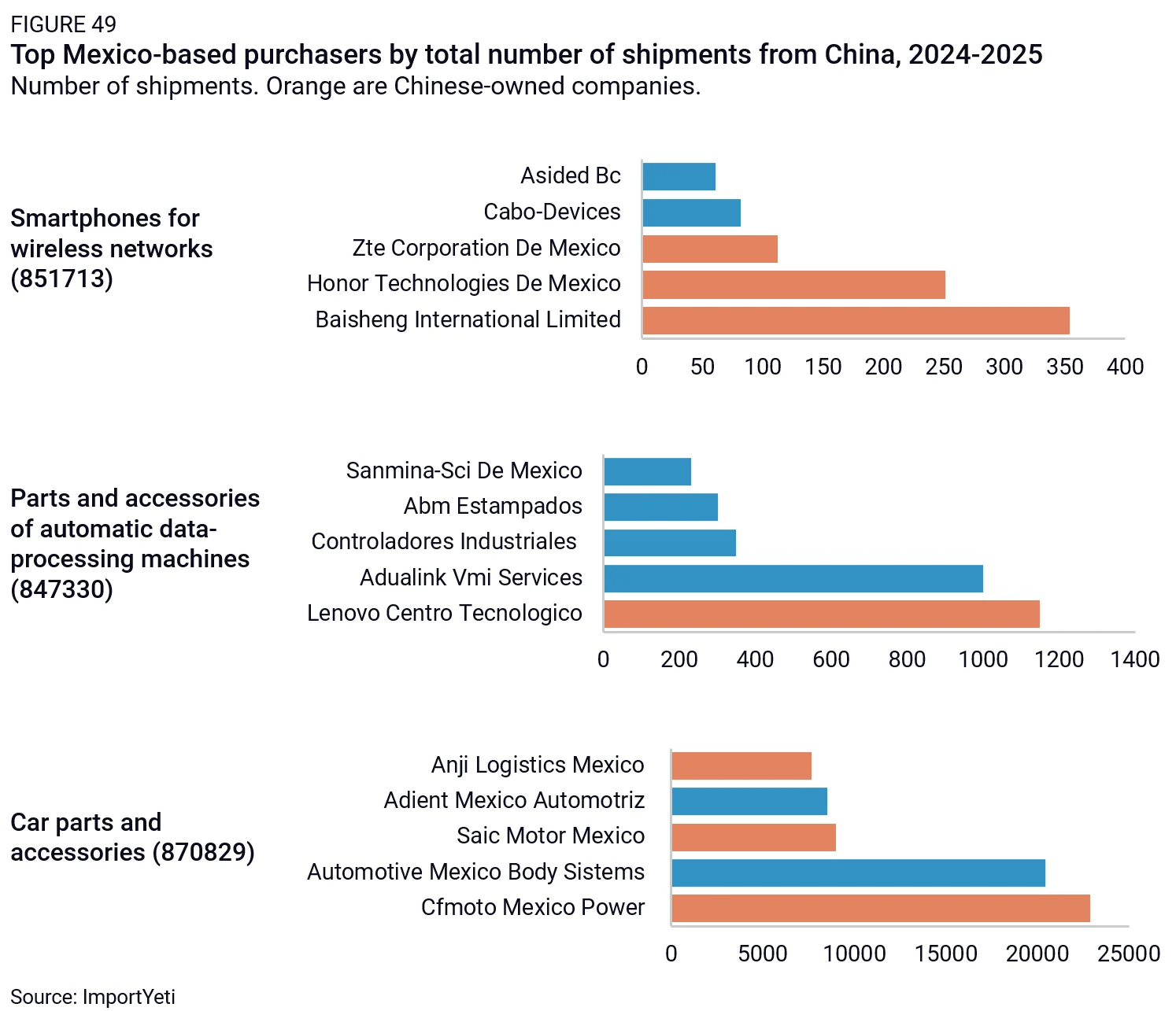
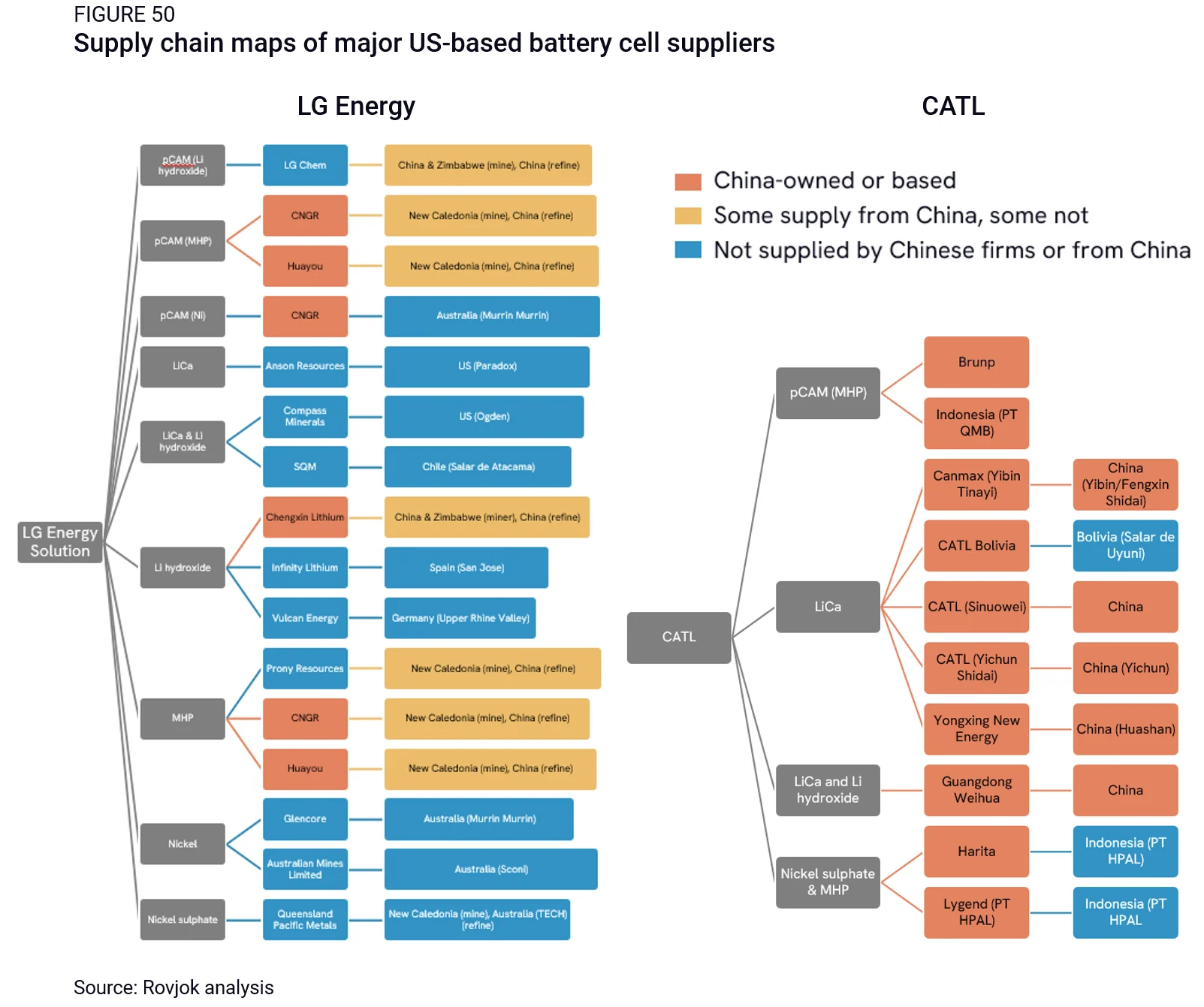
This reliance is further reinforced by the high degree of vertical integration among leading Chinese firms. BYD, for example, produces a large share of its components in-house—particularly batteries, which account for around 30–40% of an electric vehicle’s value—limiting the scope for local sourcing and reducing potential spillovers to host economies (Figure 51).
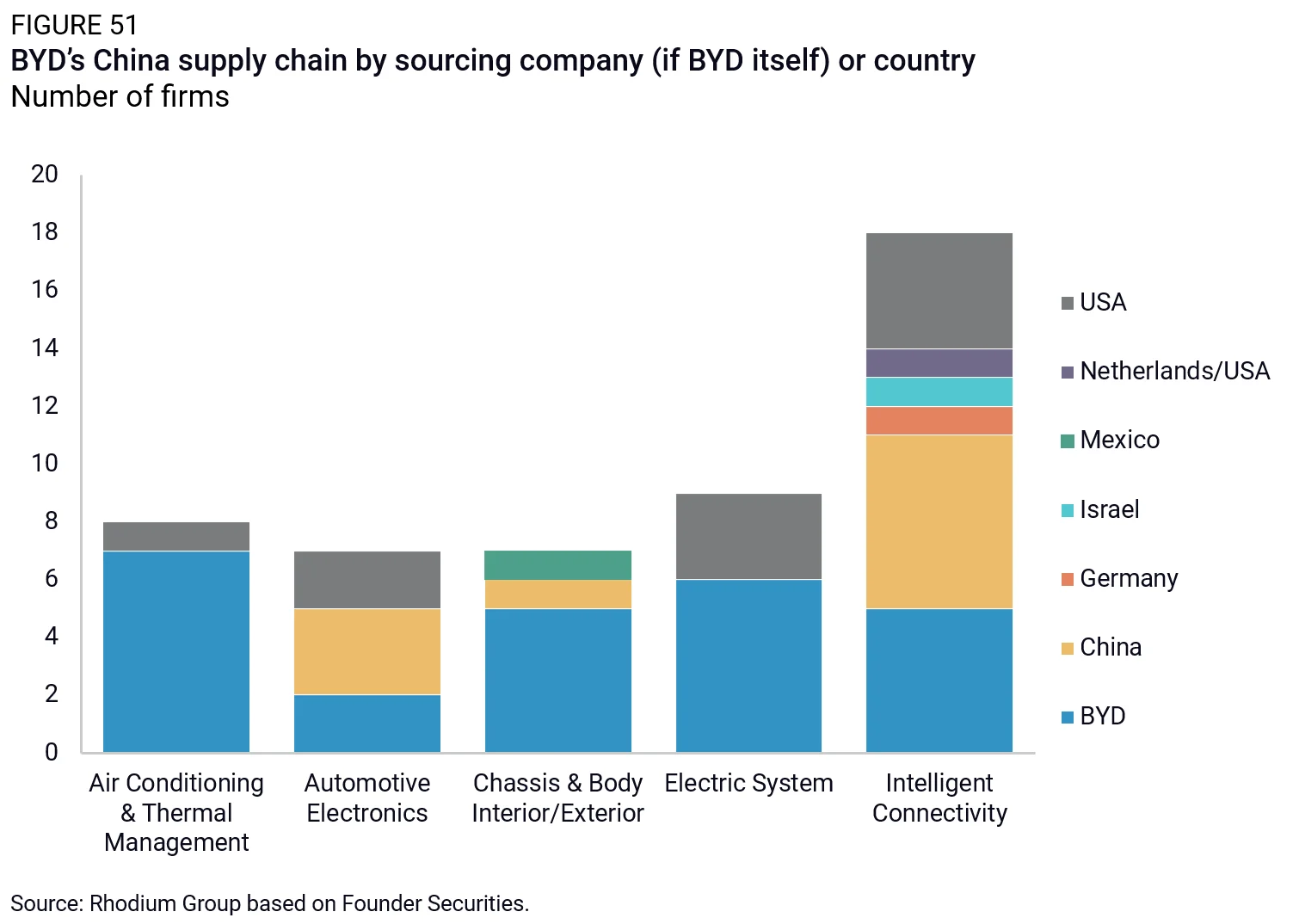
The experience of Thailand highlights the spillovers of Chinese investment on the local economy. Chinese EV firms are rapidly gaining market share, displacing domestic and Japanese incumbents while continuing to rely on Chinese suppliers for key components. Despite Thai regulation to incentivize supply chain localization—Thailand offers extended tariff exemptions and EV subsidies if manufacturers commit to local assembly and companies pledge to source locally—local industry participants have warned that this expansion is undermining existing local producers upstream in the auto supply chain.
Beijing’s policy increasingly shapes Chinese investment abroad
In other historical cases, foreign automakers from Japan, South Korea, Europe, and the United States have tended to deepen localization over time, progressively building out supplier networks, transferring technology, and increasing local value added as they expand production abroad and compete for market share. In the recent expansion of greenfield manufacturing investment abroad, Chinese firms have remained very connected to Chinese value chains in the early stages of their presence overseas, limited the positive spillovers for local economies. But it is possible Chinese firms may be following a similar path of localization later on. In the automotive sector, for example, BYD has begun signing supply agreements with European firms such as Brembo and Forvia, while CATL’s operations in Germany show a gradual shift toward local hiring and the emergence of upstream suppliers such as Kedali’s local subsidiary.
However, Beijing is increasingly intervening to prevent the offshoring of high-value activities and the erosion of China’s domestic industrial base. As Chinese companies’ success abroad becomes increasingly important in offsetting domestic economic pressures, maintaining the centrality of China-linked supply chains globally remains a key priority for Beijing. In this context, Beijing is ramping up its control over investment abroad, to ensure it serves strategic objectives without undermining China’s manufacturing base.
The 15th FYP outlines even more oversight of OFDI to protect domestic technology, calling for “strengthening security reviews for outbound investment and improving laws, and regulations for monitoring, preventing, and addressing outbound investment risks.” This increased worry about overseas tech leakage can also be seen in recent investments that have reportedly been delayed by regulators (Table 9). For example, MOFCOM reportedly slowed the approval process for BYD’s proposed first electric vehicle plant in Mexico due to fears that proprietary technology could spill over to the United States. BYD subsequently canceled the project. Moving forward, Chinese firms will likely be increasingly hesitant to move higher value-added portions of their manufacturing abroad, lest they become bogged down in approval delays as MOFCOM reviews increasingly reflect this principle of preserving Chinese technology leadership.
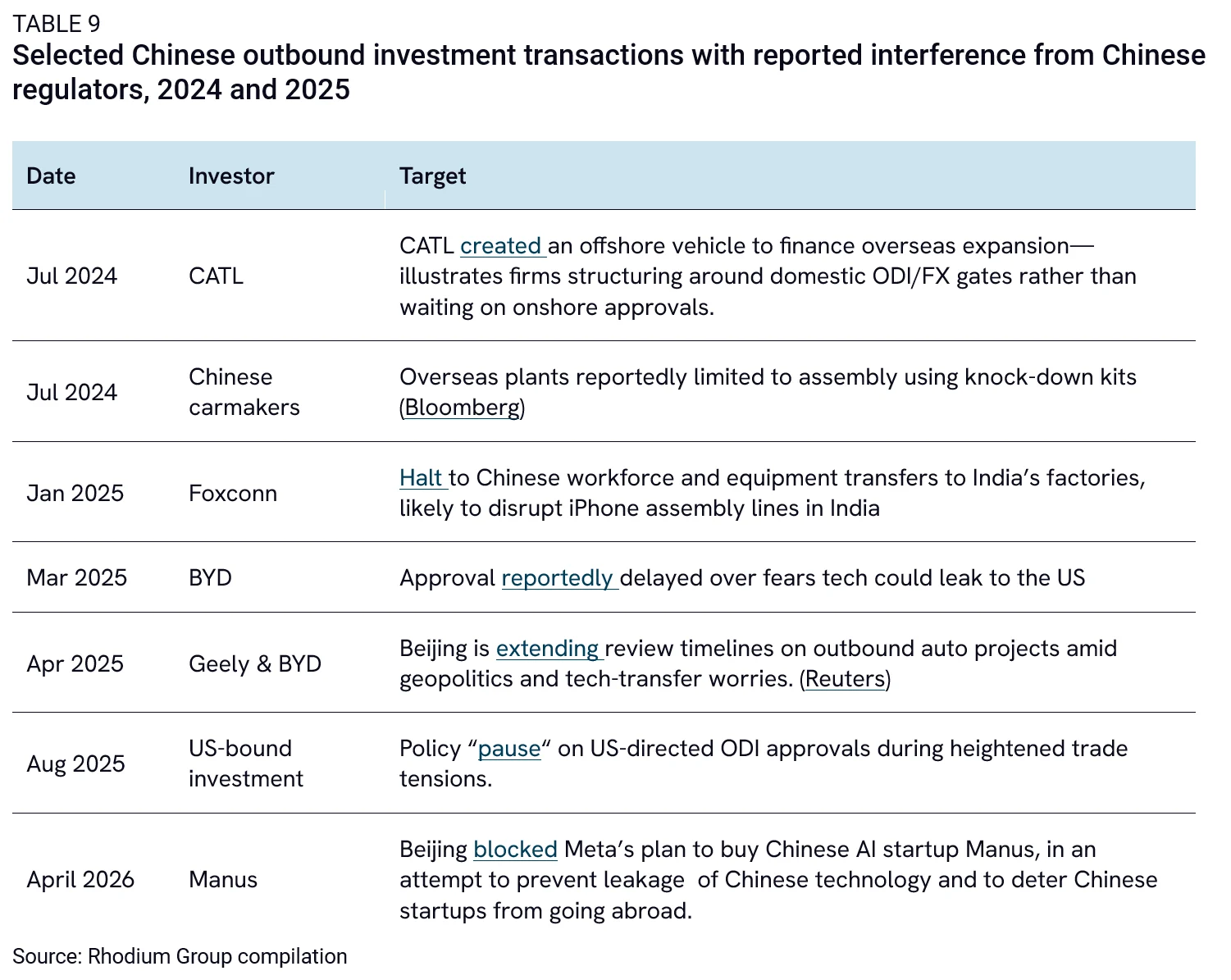
Beijing’s emerging legal architecture is moving in the same direction. There were reports in March 2026 on a proposed law to protect China’s overseas interests described the goal as building a more comprehensive legal framework to safeguard Chinese assets, infrastructure projects, personnel, and enterprises abroad, while improving coordination among government agencies in response to geopolitical, security, and regulatory challenges. This suggests that future outbound investment regulation will not only screen Chinese firms before they leave China but will also seek to protect and discipline China-linked assets, firms, and personnel once they are abroad. The recent decision by Beijing to block Meta’s planned acquisition of the Chinese AI startup Manus, despite the firm being based in Singapore, illustrates this trend and highlights how Beijing’s definition of what constitutes a “Chinese” firm is becoming increasingly expansive, extending beyond legal domicile to include firms with Chinese origins or strategic assets.
Beijing’s primary goal for international economic engagement is to increase China’s role in global value chains while also protecting their assets in an increasingly hostile environment. This focus on expanding China’s role in global supply chains is evident in the 15th 5YP, where the concept of “trade and investment integration” has gained traction, after it first appeared in the 15th 5YP Proposals in October 2025 and was reiterated at the Central Economic Work conference in December 2025. A Xinhua piece describes the concept as “leveraging outbound investment to expand overseas marketing networks, thereby fostering a mutually reinforcing relationship between investment and trade.” A commentary in Qiushi elaborates further claiming overseas investment should be a lever to boost trade while trade demands guide the flow of investment.
Increasingly, Beijing also uses outbound FDI as a tool of geopolitical leverage and economic statecraft, alongside export controls and other instruments described earlier. Investment decisions are not only screened for technology leakage and domestic impact but also shaped to influence foreign policy positions and limit diversification away from China. For instance, Chinese EV investment in Europe has been heavily concentrated in politically aligned countries such as Hungary, raising concerns in Brussels about the fragmentation of EU China policy. Beijing has reportedly instructed automakers to pause large investments in member states that supported EU tariffs on Chinese EVs. Beyond Europe, interventions in projects such as Foxconn’s operations in India, where Chinese engineers and equipment transfers have reportedly been curtailed, highlight Beijing’s willingness to directly constrain overseas expansion that could accelerate supply chain diversification.
Overall, these patterns indicate that China’s outbound investment is becoming more tightly governed, more strategic, and more explicitly aligned with Party-defined objectives. As with the broader economic toolkit, this trajectory reflects a deliberate effort to ensure that global expansion strengthens China’s position at the center of global value chains.
Implications
G7 governments and companies should not expect China to change course. As this report has argued, the end of MIC25 did not mark a retreat from state-led industrial policy, but its expansion into a more pervasive, whole-of-economy strategy. Beijing continues to direct capital, shape markets, and channel resources toward strategic sectors, while weak domestic demand and excess capacity will continue to push firms outward. Although Chinese policymakers now speak of addressing involution and overcapacity, their actions tell a different story that prioritizes competitiveness, capacity upgrading, and export strength over meaningful rebalancing.
Absent a strong, unexpected change in policy strategy, China’s industrial policy will likely translate into a significant shift in global industrial competition. Within this timeframe, China is likely to achieve global competitiveness across nearly all major sectors that underpin growth in G7 manufacturing—including automotives, semiconductors and electronics, pharmaceuticals, and medical devices. This will translate into rapid global market share gains for Chinese firms, products, and services, swiftly hollowing out manufacturing capacity and capabilities in advanced economies.
China’s export competition and import substitution will have the greatest impact on advanced industrialized economies. China’s top 100 goods export categories currently overlap most significantly with those of South Korea and Japan, but Europe is likely to bear the brunt of the next wave of Chinese market share gains, as its export strengths are heavily concentrated in sectors where Chinese firms are making rapid inroads. Cars, chemicals, and machinery will be at the forefront of this exposure. These sectors account for the largest value at risk from China’s growing global market share—cars appear on a separate axis in our chart because their scale of exposure is an order of magnitude larger than other sectors (Figure 52). In aggregate, up to $650 billion—equivalent to around 12% of G7 manufacturing exports—could be directly exposed to incremental Chinese market share gains by 2030 if current trends persist. $224 billion would be lost just in the EU.
These projections may prove conservative. Once technological parity is reached, Chinese firms tend to expand globally at exceptional speed, often moving from marginal to dominant market shares within just a few years. For example, China increased its share of global exports of image projectors from 10% to 30% in four years, and then to 80% in just two additional years. Current estimates focus on sectors where China has already made recent gains but may understate future risks in industries, such as pharmaceuticals and medical devices, where Chinese firms are only now approaching the technological frontier. Moreover, the analysis largely excludes services, where China still lags but is rapidly advancing. The 15th Five-Year Plan explicitly targets expansion into high-value service sectors, including digital services and artificial intelligence. According to UNCTAD, the global AI market is projected to grow from $189 billion in 2023 to $4.8 trillion by 2033, a 25-fold increase. That market could well be the next competitive frontier where Chinese companies make fast inroads, if Beijing’s industrial policy strategy is successful. If that is the case, the United States, currently the largest player in this area, will be the most affected by rising Chinese competitiveness overseas.
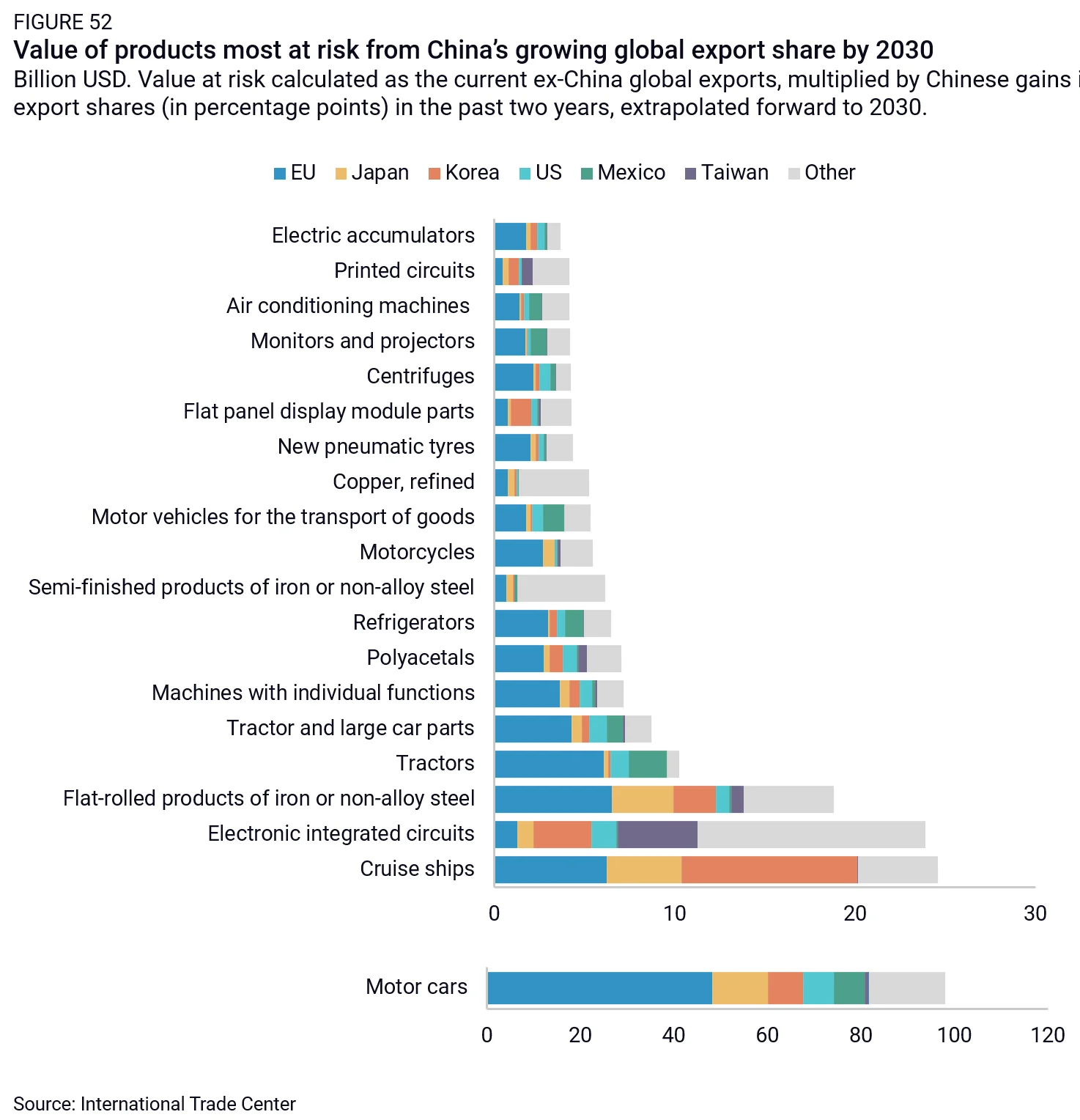
As China substitutes away from foreign goods to domestic alternatives, weakening Chinese import demand will compound the problem for foreign producers. The sectors most affected by import substitution mirror those under pressure from exports—autos, chemicals, and machinery—and again disproportionately impact the European Union (Figure 53). Overall, up to $200 billion, or roughly 4% of G7 manufacturing exports, could be at risk from declining Chinese import demand by 2030. $76 billion could be at risk just in the EU.
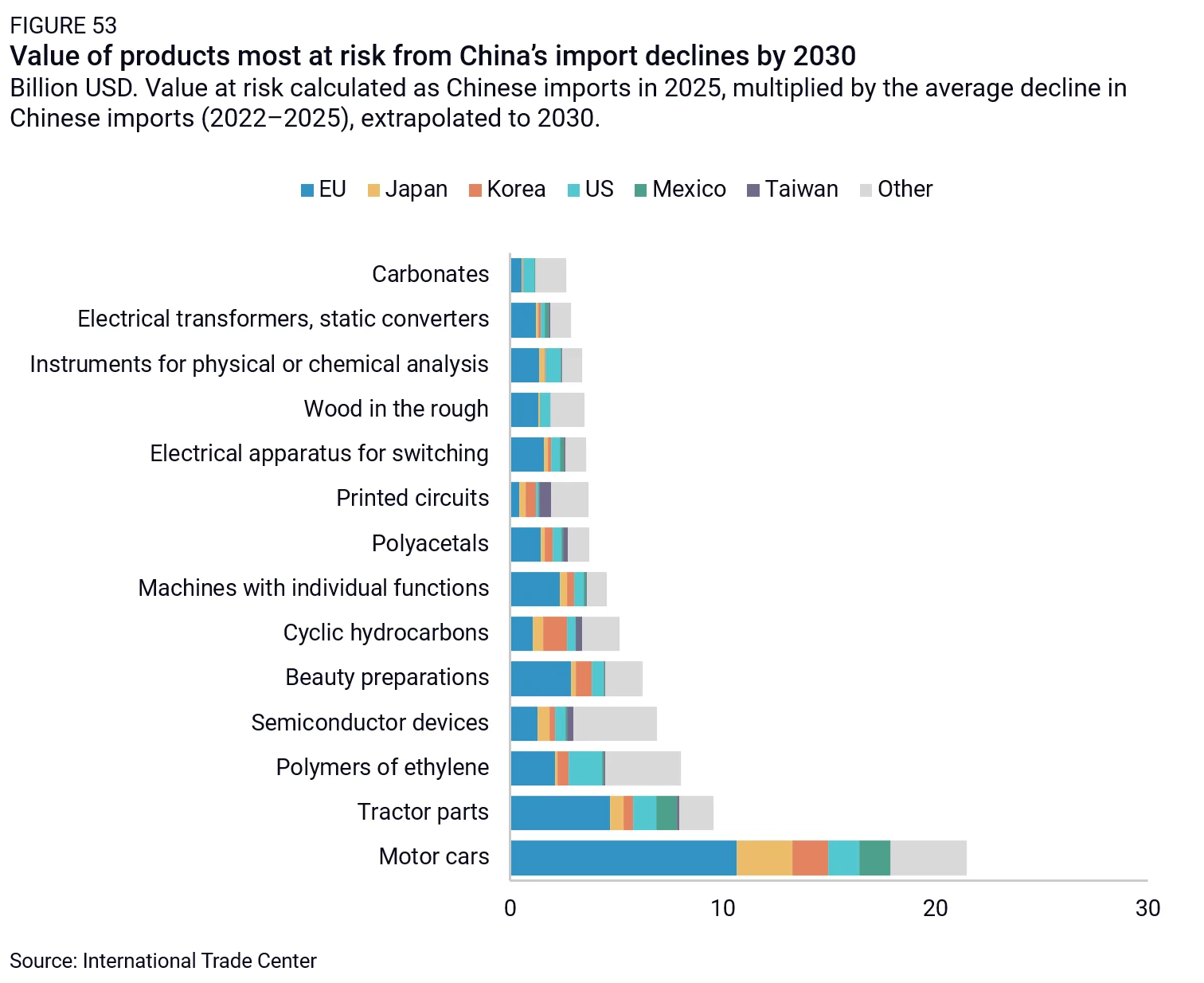
Germany, in particular, emerges as the primary casualty from both rising Chinese market share and declining Chinese imports. German export performance, long a bellwether for Europe’s industrial competitiveness, is deteriorating across key markets. The country lost over 120,000 manufacturing jobs in 2025 alone. Nearly half of those losses have come in the auto sector, where German exports to China plunged by 66% between 2022 and 2025. Over time, this trend risks hollowing out core industrial regions, raising the prospect of long-term industrial decline, similar to what occurred in parts of the US rust belt.
However, the impact is not limited to advanced economies. Emerging markets also stand to lose—often less visibly, but in some cases more severely. While China is advancing in high-tech sectors, its continued support for traditional industries means it is not relinquishing labor-intensive production to lower-income countries as earlier development models assumed. Instead, Beijing is actively intervening to prevent the loss of these sectors by upgrading automation and scale, so that China can remain competitive despite rising labor costs. In practice, China’s manufacturing imports from countries such as Malaysia, Thailand, and the Philippines have declined sharply: by 35%, 30%, and 31% respectively. These declines represent a significant share of their export base, exceeding 10% of total exports for Malaysia and the Philippines. Given Beijing’s emphasis on ensuring that overseas investment by Chinese firms remains tightly linked to exports of inputs from China, emerging economies (especially in ASEAN, where Chinese investment has surged) risk being relegated to low-tech assembly nodes within China-dominated value chains.
Foreign multinationals will also come under sustained pressure. Many G7 firms have deeply localized their operations in China, relying on the Chinese market both as a source of revenue and as a production base. But as Chinese competitors gain scale and technological capability, these firms are increasingly squeezed across the board: losing market share in China, facing intensified competition in third markets, and encountering rising barriers to expansion in sensitive sectors. As Chinese firms grow their competitive pressure in overseas markets, G7 firms’ footprint will narrow and may retreat into smaller high-end or protected segments. Over time, this could translate into lower revenues, reduced margins, and diminished capacity to reinvest in R&D and innovation, weakening their long-term competitiveness.
The de-industrialization that will result from China’s rapid market share gains will have profound economic and social implications. For many OECD countries, manufacturing represents a relatively small share of GDP (around 8–10% in the UK, Canada, and France). However, in economies such as South Korea, Japan, Germany, Italy, and Hungary, manufacturing accounts for 17–25% of economic activity and up to 21% of employment—representing roughly 28 million jobs across these countries. In these contexts, even modest declines in manufacturing employment can have outsized economic and political consequences. As industrial activity declines or shifts, income disparities between regions and sectors will also widen. Communities built around manufacturing clusters such as automotives in Germany, electronics in Japan, or machinery in Italy will face prolonged adjustment pressures. Historical experience shows that such shocks often trigger cascading effects, including declining local tax revenues, reduced public services, and regional stagnation that can trigger broader economic ramifications.
The loss of industrial competitiveness will set in motion a self-reinforcing downward spiral. As firms lose market share, they scale back investment, and as investment declines, so too does innovation capacity. Skilled labor migrates elsewhere, eroding the industrial knowledge base. Entire ecosystems—suppliers, research institutions, specialized services—begin to hollow out. Venture capital and private investment will increasingly avoid industries dominated by Chinese firms or prioritized by Chinese planners, rendering entire segments of advanced manufacturing effectively “uninvestable.“ In sectors where China establishes both cost and technology leadership, firms may be structurally precluded from entering the market outside China. Because these ecosystems are highly interdependent, the decline of one sector can weaken competitiveness across multiple industries simultaneously.
China’s increasing industrial dominance will give it more geopolitical influence. As China expands its dominance across industrial value chains, dependencies on Chinese supply chains will deepen across critical sectors, from energy to healthcare, industrial, and defense ecosystems. This concentration will put countries more at risk of Chinese coercion and retaliation. China’s control over key inputs will not just allow it to restrict supply but also to further shape industrial geography. It can incentivize firms to relocate production inside of China and carefully implement export controls to target key downstream nodes to prevent foreign firms from developing alternative supply chains. In other words, as dependence on China increases, the capacity of foreign governments to mitigate that dependence diminishes. Economic and security vulnerabilities reinforce one another, making them increasingly difficult to reverse once established. Meanwhile, the decline of industrial capacity in advanced economies in sectors such as shipbuilding, electronics manufacturing, and advanced materials constrains the ability of these nations to sustain military production in a conflict scenario.
Another long-term consequence is the erosion of advanced economies’ ability to build and sustain coalitions. China’s growing leverage through critical raw materials, pharmaceutical supply chains, infrastructure embeddedness, and financial flows, creates powerful incentives for individual governments to avoid actions that Beijing might punish.
Taken together, these dynamics point to a narrowing window to respond effectively. Many countries are already acting: In 2024, overcapacity spillovers prompted countries around the world to launch an unprecedented 198 anti-dumping and countervailing duty investigations. However, these responses remain uneven in scope and largely uncoordinated across jurisdictions. The result is a more fragmented policy landscape, characterized by trade diversion, duplicative investment, and rising protectionist pressures among advanced economies themselves. These dynamics could increase economic costs and dilute the effectiveness of individual measures. Failure to develop a coordinated response may leave underlying competitive imbalances largely unaddressed, while shaping the future geography of production and trade in ways that may prove difficult to reverse.
Footnotes
See Shandong Coal Machinery Industry Association, “详细解读’专精特新’最新认定标准和流程 [A Detailed Interpretation of the Latest Identification Standards and Processes of ‘Specialized, Streamlined, Characteristic, and Novel (SSCN)’],“ March 2, 2023, http://www.sdmjw.org.cn/HYPY/03021506.html; People’s Daily, “财政部:进一步加大对国家级专精特新’小巨人’企业支持力度 [Ministry of Finance: Further Increase Support for National-Level Specialized and New ‘Little Giant’ Enterprises],“ February 18, 2022, https://baijiahao.baidu.com/s?id=1725093696186722910&wfr=spider&for=pc; Jiangsu Association for Science and Technology, “31省市’专精特新’政策汇总(一) [Summary of 31 Provinces and Cities’ ‘Specialized, Streamlined, Characteristic, and Novel’ Policies (1)],“ October 25, 2022, http://www.jscxxh.org.cn/detail.html?id=1124.
See European Union Chamber of Commerce, Overcapacity in China: An Impediment to the Party’s Reform Agenda (2016); Chen Linxi et al., “China’s Capacity Reduction Reform and Its Impact on Producer Prices,“ IMF Working Papers 2018, no. 216, https://doi.org/10.5089/9781484375914.001.
During the 2016-2018 overcapacity campaign, M&As were a core restructuring tool. In steel, M&As were incentivized through credit support and dedicated fiscal funds, while in aluminum it was embedded in a binding capacity-replacement mechanism. In the current framework, M&A is no longer binding: In steel, incentives are limited to more favorable capacity-replacement ratios, while in aluminum it is only encouraged. Recent measures have expanded financing channels for M&A but remain non-sector specific and do not introduce binding enforcement mechanisms.
OilChem, https://en.oilchem.net/.
Barry Naughton, The Rise of China’s Industrial Policy, 1978 to 2020 (Mexico City: Centro de Estudios China-México (CECHIMEX), Facultad de Economía, Universidad Nacional Autónoma de México, 2021).
Early examples of scenario based development include Ministry of Science and Technology et al., “关于加快场景创新以人工智能高水平应用促进经济高质量发展的指导意见 [Guiding Opinions on Accelerating Scenario Innovation to Promote High-Quality Economic Development Through High-Level Application of Artificial Intelligence],“ July 29, 2022 (published August 12, 2022), https://www.most.gov.cn/xxgk/xinxifenlei/fdzdgknr/fgzc/gfxwj/gfxwj2022/202208/t20220812_181851.html.
Rhodium Group analysis of Peking University, PKU Law (ChinaLawInfo) database, https://www.pkulaw.com/.
See Jeffrey Ding, “ChinAI #275: What Does China’s Government Procurement Market Tell Us about Large Model Diffusion?,“ ChinAI Newsletter, July 29, 2024, https://chinai.substack.com/p/chinai-275-what-does-chinas-government; Tech Buzz China Insider, “The State of Chinese AI Apps 2025,“ October 27, 2025, https://techbuzzchina.substack.com/p/the-state-of-chinese-ai-apps-2025.
China Academy of Information and Communications Technology, “China Artificial Intelligence Industry Development Report (2025) [人工智能产业发展研究报告(2025年)],“ January 2026, http://caict.ac.cn/kxyj/qwfb/bps/202602/t20260202_712679.htm.
Ibid.
US-China Economic and Security Review Commission, Two Loops: How China’s Open AI Strategy Reinforces its industrial Dominance (Washington, DC: US-China Economic and Security Review Commission, March 2026).
Brian Deese et al., “Global Clean Investment Monitor: Government Support for Electric Vehicles and Batteries,“ Massachusetts Institute of Technology Center for Energy and Environmental Policy Research, July 2025, https://ceepr.mit.edu/wp-content/uploads/2025/07/MIT-CEEPR-RC-2025-02.pdf.
See Yifan Wei, Yuen Yuen Ang, and Nan Jia, “The Promise and Pitfalls of Government Guidance Funds in China,“ The China Quarterly 256 (2023): 939–959, https://doi.org/10.1017/S0305741023000280; Ngor Luong, Zachary Arnold, and Ben Murphy, “Understanding Chinese Government Guidance Funds,“ Center for Security and Emerging Technology, March 2021, https://doi.org/10.51593/20200098.
Ngor Luong, Zachary Arnold, and Ben Murphy, “Understanding Chinese Government Guidance Funds,“ Center for Security and Emerging Technology, March 2021, https://doi.org/10.51593/20200098.
Tracked by the National Bureau of Statistics for companies above a certain threshold.
Tiago Devesa, et al., “Geopolitics and geometry of global trade: 2026 update: Tariff splashes, AI waves, and the ripples reshaping global trade,“ McKinsey Global Institute, March 2026.
European Chamber of Commerce, “Overcapacity in China: An Impediment to the Party’s Reform Agenda,“ 2016.
According to ADB MRIO input-output tables at constant 2010 prices.
European Union Chamber of Commerce in China, Exporting Control: China’s New Strategic Toolkit (Beijing: European Union Chamber of Commerce in China, 2026).
“Xi Jinping Presided over the Second Meeting of the Central Committee for the Comprehensive Rule of Law and Delivered an Important Speech,” Xinhua, February 25, 2019, www.gov.cn/xinwen/2019-02/25/content_5368422.htm
“Make Good Use of Legal Weapons to Safeguard National Interests: Strengthen the Construction of Foreign-Related Rule of Law System,” People’s Daily, January 11, 2021, www.npc.gov.cn/npc/c30834/202101/2e4dafe2a53342609191ab522b88dfc2.shtml.
Chang An Jian, “Chen Yixin Published a Signed Article in the People’s Daily: Studying and Implementing Xi Jinping’s Rule of Law Needs to Grasp the Ten Major Relationships,” Legal Daily, December 7, 2021, www.legaldaily.com.cn/index_article/content/2021-12/07/content_8639612.htm.
Figures sourced from listed firm financial disclosures on Bloomberg.
According to Rhodium Group’s China Outbound Intelligence data
Jennie Bai, et al., “The Ripple Effects of China’s Global Ownership,” The American Finance Association, April 2024.