Manufacturing Growth and Grid Modernization: Impacts of Expanding 45X
For all its success, the Advanced Manufacturing Production Credit (45X) is limited in scope, omitting technologies that have become increasingly important. This analysis models the economic impacts of expanding 45X.
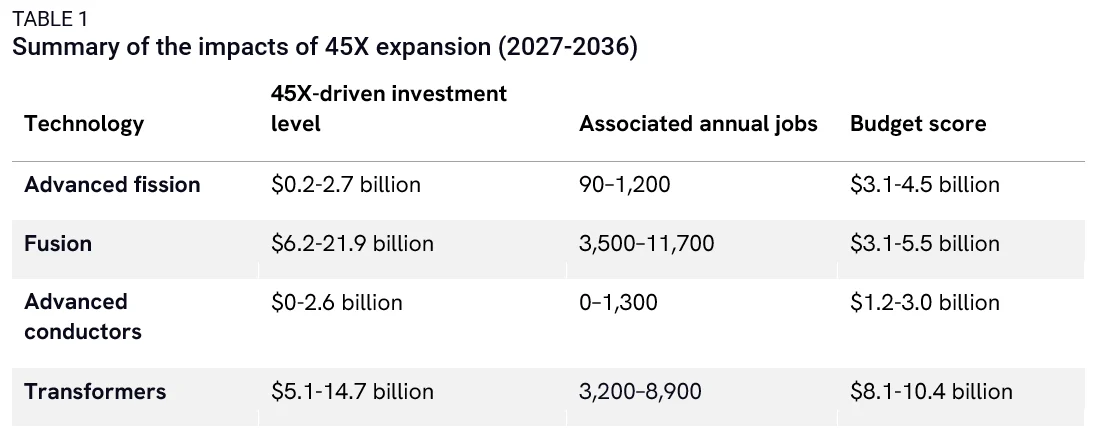
The Advanced Manufacturing Production Credit (45X), enacted in the Inflation Reduction Act and modified in the One Big Beautiful Bill Act, was designed to drive domestic manufacturing in clean energy supply chains, reducing US dependence on China and other foreign producers for clean energy and critical mineral components by making domestic manufacturing cost-competitive with imports. Since its enactment, the US has seen billions of dollars in investment across its clean energy manufacturing base. For all its success, the credit is limited in scope, omitting technologies that have become increasingly important. This analysis models the economic impacts of expanding 45X to cover additional grid and firm clean-power components—specifically those for advanced nuclear, fusion, advanced conductors, and transformers, each foundational to a modernized, reliable grid. We find that expanding 45X eligibility to these technologies could catalyze between $19-84 billion in new private domestic manufacturing investment and support 12,200-54,200 average annual US manufacturing jobs.
Expanding the US industrial base of clean energy technologies and components
The US is currently at a critical juncture to expand its domestic clean energy manufacturing base. Historically, the country has relied heavily on imported components for a range of clean energy technologies and critical minerals, including components for new types of electricity generators and grid infrastructure technologies. Production of these components is often concentrated in countries like China and other major manufacturing hubs. It is this reliance on foreign supply chains that has exposed the US to a range of economic and strategic risks, including potential trade disruptions, fluctuating input costs, reduced onshore retention of value, and limits on the pace and robustness of clean energy deployment.
These vulnerabilities increase when supplies are concentrated in geopolitical rivals like China, where economic policy is often used as geopolitical leverage. Building domestic manufacturing capacity is especially important in critical industries like energy infrastructure, where disruptions delay investment, increase component costs, and exacerbate national security risks.
Expanding domestic manufacturing can also promote economic growth by generating new high-quality jobs, strengthening industrial capacity, and retaining technical knowledge and expertise within the country. More broadly, domestic manufacturing supports not only factory jobs, but also engineers, suppliers, and skilled trades. However, building this capacity can be costly and time-intensive. As a result, federal policymakers have recently considered additional industrial policy support to expand domestic clean energy manufacturing.
The Advanced Manufacturing Production Credit today
Recent federal policy, including the Advanced Manufacturing Production Credit (often shortened to 45X, referring to its section of the Tax Code), incentivizes investments in domestic manufacturing capabilities across key clean energy supply chains. Originally enacted under the Inflation Reduction Act of 2022 (IRA) and modified under the fiscal year 2025 budget reconciliation bill, the One Big Beautiful Bill Act (OBBBA), the core objectives of the existing 45X tax credit are to strengthen the economics of domestic clean energy manufacturing relative to imported components and expand domestic capacity for certain clean energy components. Manufacturers can receive a per-unit tax credit for producing eligible components in the US if they also meet certain foreign-ownership requirements and foreign-sourcing requirements for their inputs. Credit amounts vary by component type and may be calculated by output, capacity, weight, production cost, or sales price.
The primary advantage of production-based incentives like 45X is their ability to reduce investment risk by providing manufacturers with a predictable revenue stream tied to domestic production, thereby reducing their exposure to volatile prices and uncertain demand, which often discourages investment in early-stage or less developed supply chains. These lower risk premiums help attract private capital that might otherwise sit on the sidelines. The case for production-based incentives like 45X is strongest when three conditions exist: few domestic suppliers for the product, a shortage of a specific component that is actively impeding federal deployment efforts the government has already committed to, and credible near-term demand for the component, independent of the credit itself.
The 45X tax credit has been a potent industrial policy tool. It is challenging to attribute manufacturing investment directly to 45X, but the credit’s availability has clearly helped fuel the post-enactment clean energy manufacturing boom. From Q3 2022 through Q1 2026, US clean energy manufacturing project investments totaled $131 billion (Figure 1). This is more than a 400% increase relative to a comparable period before its enactment. A surge in employment has accompanied this investment. An analysis commissioned by the Political Economy Research Institute at the University of Massachusetts Amherst estimated that clean manufacturing tax credits like 45X could help create more than 670,000 new clean manufacturing jobs. According to the Clean Economy Tracker, which monitors private investments and jobs in clean energy and technology manufacturing across the US, currently operating US facilities producing 45X-eligible components are associated with nearly 51,000 jobs and $59.1 billion in manufacturing investments. Most of this is in battery and solar energy component manufacturing.
That said, 45X alone did not drive this unprecedented growth in clean manufacturing. Manufacturers will only invest in building capital-intensive facilities to produce these components when there is a clear demand signal for them. They can only claim the 45X credit if there is a domestic market for the products they manufacture. As we’ll discuss in greater detail below, our estimates of the impacts of expanding components covered by 45X are, in most cases, predicated on the strengthening of demand-side policies as well.
New candidate technologies under an expanded 45X
In this note, we assess the impacts of expanding the 45X tax credit to four new technology categories—advanced nuclear reactors, fusion, advanced conductors, and transformers—each of which can play a critical role in a modernized, reliable electric grid. Although 45X has had a considerable impact, its design largely reflects 2022-era priorities: supporting scale-up of domestic manufacturing for a range of commercial technologies for which the US was largely dependent on China.
A few things have changed since its original passage. First, the US is now facing generationally large increases in electricity demand, driven largely by data centers and other large loads. This amplifies the need not just for new generating technologies but also for grid components that connect new generators to end users. Second, because of the high-capacity utilization rates of some of these new sources of load, there has been an increased interest in technologies that can deliver firm power to the grid—that is, that aren’t reliant on variable inputs like wind or solar. Finally, policymakers and stakeholders have looked back at the impact of the early days of the 45X credit and recognized its value in supporting critical components.
There is a range of technologies and related components that 45X could expand to cover. For this analysis, we focus on four technologies in two main categories: advanced fission and fusion, two early-stage clean energy technologies, and advanced conductors and transformers, grid equipment critical to the reliable operation of the world’s most complex machine. Industry stakeholders, such as the Clean Air Task Force, highlight the importance of domestic manufacturing of components for technologies like fusion. Members of Congress have already introduced bills to expand the credit for fusion components. For other technologies, such as advanced conductors and transformers, stakeholders have proposed 45X expansion as an effective way to scale domestic manufacturing. While the full bill text is not yet publicly available, we reviewed draft legislation to identify the components covered and the credit level they would receive.
Advanced nuclear reactors
Advanced nuclear reactors are a series of next-generation fission technologies intended to improve on today’s commercial nuclear technologies in terms of safety, economics, flexibility, reduced technical and regulatory uncertainty, and applications beyond conventional power generation. Their core value proposition lies in providing firm, low-carbon energy that complements fossil, renewables, transmission, and demand flexibility.
Advanced nuclear technologies represent improvements over the existing commercial fleet. They include evolutionary Generation III+ (Gen III+) light-water reactor (LWR) designs, characterized by improved safety, modularity, and economics, and Generation IV (Gen IV) non-water-cooled reactors with advanced fuels and higher operating temperatures. Gen IV technologies include high-temperature gas-cooled reactors (HTGRs), molten-salt reactors (MSRs), sodium-cooled fast reactors (SFRs), lead-cooled fast reactors (LFRs), fluoride salt-cooled high-temperature reactors (FHR), and supercritical water-cooled reactors (SCWRs). These technologies span a wide range of scales, from large gigawatt-class plants to small modular reactors (SMRs) to compact microreactors. Currently, the only advanced nuclear technology operating commercially in the US is the Gen III+ large LWR—specifically, two Westinghouse AP1000 units at Plant Vogtle in Georgia.
Overall, the US nuclear supply chain is not yet equipped to support the large-scale deployment of advanced nuclear reactors. In a recent Rhodium Group note, we identified key supply chain constraints facing nuclear power plant scale-up, which include limited domestic availability of high-assay, low-enriched uranium (HALEU), limited standardization of designs, insufficient manufacturing capacity for reactor components, and shortages of a specialized labor force. Broadly speaking, any efforts to substantially scale advanced fission in the US will require addressing these constraints.
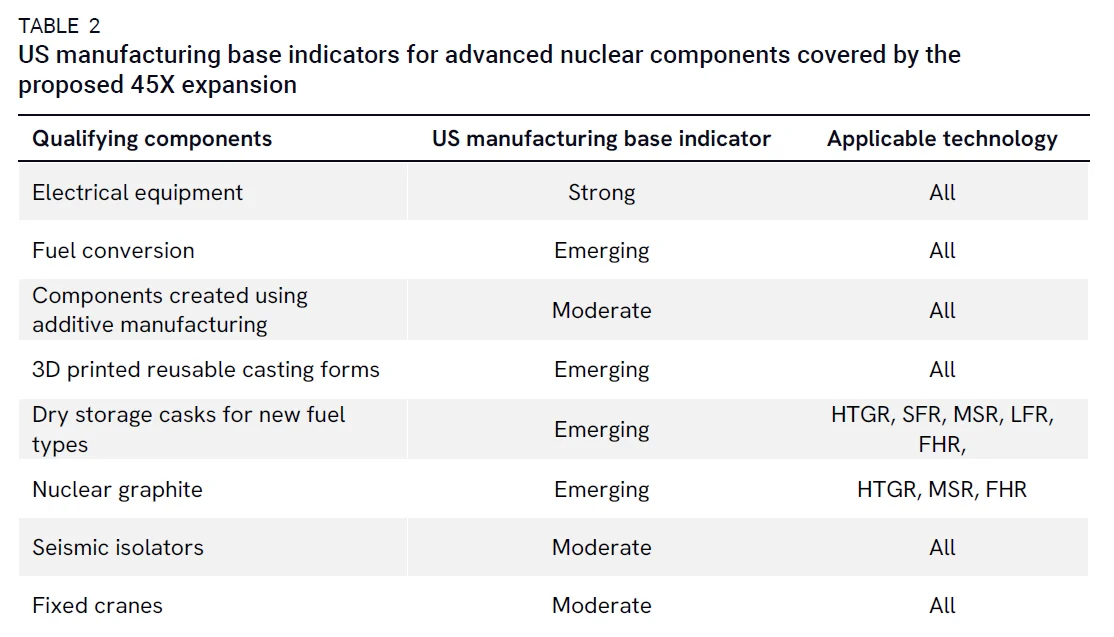
The 45X credit could be expanded to cover multiple advanced nuclear components to address major supply chain gaps and strengthen domestic manufacturing capacity (Table 2). Domestic manufacturing readiness is uneven across the components covered by the proposed credit expansion. We assess the current US manufacturing base across four capacity levels: weak, emerging, moderate, and strong. A weak base reflects little to no domestic production and a high dependence on foreign suppliers, while an emerging base indicates early-stage capacity, limited suppliers, and ongoing investment. A moderate base characterization reflects an established, yet constrained industry that faces scaling difficulties. A strong industrial base reflects a mature, competitive domestic industry with multiple qualified suppliers able to support future deployment demand.
Electrical equipment is the only relevant industry with a strong domestic manufacturing base. Seismic isolators, fixed cranes, and additive manufacturing have moderate domestic industrial bases, which we define as credible suppliers facing capacity constraints, relying on foreign inputs, or not fully developed for specific applications. The domestic industrial bases for most of the remaining components are emerging, with active investment and demonstrating some production capability, but not yet at commercial scale. In the case of fuel conversion, having a single domestic supplier that can meet only roughly 60% of domestic demand justifies its characterization as an emerging industry.
The proposed 45X-eligible components relevant to a given project vary by reactor technology type, as distinct design requirements produce different component profiles across the advanced fission fleet. Electrical equipment, components created using additive manufacturing, and fixed cranes are broadly universal, while dry storage casks and nuclear graphite are the most reactor-type-specific.
We largely focus on the deployment of AP1000s in this analysis, both because the design has the strongest commercial track record among commercially viable or near-viable options, with units currently operating at Vogtle in Georgia, and because data for it are more widely available. Deploying new advanced nuclear technologies in the US is subject to two compounding lead-time constraints: the multi-year timeline from regulatory licensing to commercial operation, and the time required to establish a sufficient domestic manufacturing capacity. As a result, we assume new advanced fission capacity can begin coming online in 2035. The 2035 timescale also roughly aligns with the recently announced conditional loans from the US Department of Energy’s Energy Dominance Financing, which aim to have new reactors under construction by 2030. In addition, we capture fuel conversion investments associated with meeting incremental new fuel demand from uprates and restarts at existing LWRs.
Given the early commercial stage and the diversity of SMR designs, we do not model the deployment of new SMRs. The only exception is that we incorporate fuel demand from six newly announced SMR projects into our fuel conversion impacts. As a result, our impact estimates for advanced fission can be considered conservative relative to a world with substantial SMR deployment.
To align the expanded tax credit with this deployment window, we begin by modeling a tax credit that provides 30% of the production cost of eligible components through the end of 2040, then steps down in value until it expires at the end of 2043. Due to the lack of publicly available cost data for seismic isolators, dry storage casks, 3D-printed casting forms, and additive manufacturing, we assess only 45X impacts on electrical equipment, fuel conversion, and fixed crane manufacturing. Qualifying entities include both existing and new manufacturing facilities.
It is important to note that although a tax credit can help lower production costs for eligible components, domestic suppliers are unlikely to invest in specialized facilities, workforce, tooling, etc., unless they foresee a durable market for these components. In the case of an expanded 45X including advanced nuclear components, the credit could help reduce production costs once a market for advanced nuclear exists. It by itself will not be enough to justify investment in domestic manufacturing capabilities.
Fusion
Fusion refers to the generation of power by combining light atoms, usually forms of hydrogen, to release large amounts of heat that can be used to produce electricity. Like advanced nuclear, its role in the power system would be providing clean, firm power, complementing renewables, energy storage, transmission, and demand flexibility, helping to support grid flexibility and reliability.
While a range of fusion technologies are under development, the nearest contenders for commercial viability based on current timelines, technical progress, and funding are magnetic confinement fusion (MCF) and inertial confinement fusion (ICF). The global fusion supply chain remains in its earliest stages, only now beginning the transition from laboratory research to commercial manufacturing. Today’s fusion supply chain mirrors the early wind and solar supply chains of the 1990s—fragmented, low-volume, and heavily reliant on a small set of suppliers. The US, however, currently leads in a range of fusion-related science breakthroughs and private investment, positioning it to be a leader in the global fusion supply chain.
Although expectations are that the US will not likely see its first commercially viable fusion plant until at least the early 2030s, introducing policy interventions today, like expanding 45X to cover critical fusion components, could help ensure the US manufacturing base is primed and ready to support fusion at scale. We analyze expanding 45X to cover a range of critical fusion components (Table 3). US domestic capabilities across the broader fusion component supply chain are largely emerging to moderate, with no segment yet at a strong level, reflecting the technology’s early commercial stage. Moderate capacity exists for components that leverage adjacent industrial and defense bases—fusion chambers, vacuum vessels, high-energy lasers, heating and cooling systems, high-voltage conductors and insulators, fused quartz and ceramics, dielectric fluids, and controls. Fusion-specific inputs like high-temperature (HTS) magnets and tape are still emerging or weak, and the weakest links—blanket systems and fuel processing and storage—are central to any commercial fusion plant. As a result, even successful demonstration reactors will require a domestic supply chain build-out over multiple decades before fusion can deploy at scale. As with advanced nuclear, the proposed 45X-eligible components relevant to a given project vary by fusion type (Table 3).
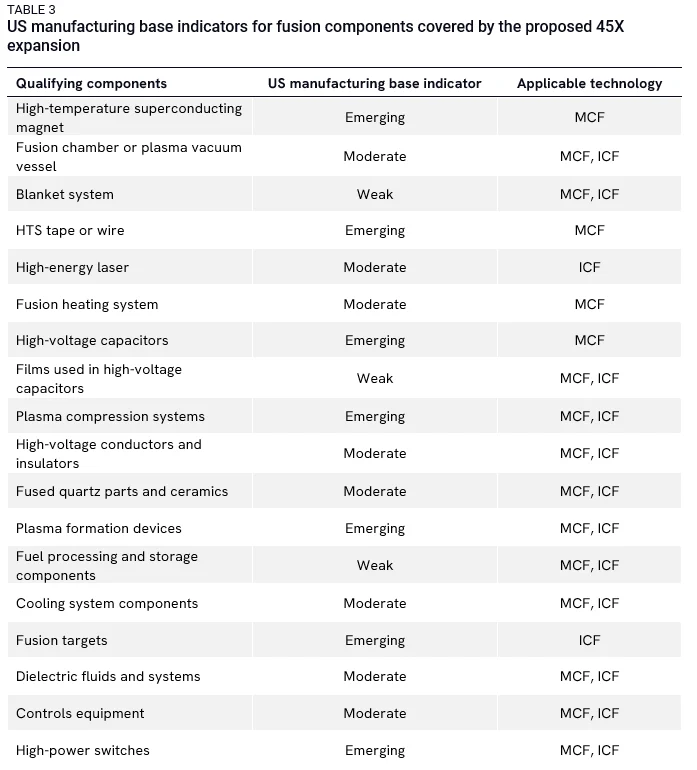
We model initial fusion deployment as MCF, which leads ICF in private investment, number of active developers, and proximity to commercial demonstration, reflecting its larger and more mature private-sector ecosystem. Commercial-scale fusion development generally faces the same lead-time issues as advanced nuclear, which are further compounded for technologies earlier in the development cycle. Therefore, we assume MCF will be the first technology to be deployed, starting in 2035. We assume that ICF, which is still in its early stages of technology development, will not be deployed until at least 2040. The credit for fusion largely mirrors the credit for advanced fission, providing a 25% credit on production costs through 2040, then stepping down through 2043 before expiring altogether.
Advanced conductors
Advanced conductors are a new class of electricity transmission technologies designed to provide greater power capacity and efficiency compared to conventional aluminum conductor steel reinforced (ASCR) lines that serve as the backbone of today’s grid. Unlike conventional conductors, advanced conductors use composite cores designed to transmit power with increased efficiency, higher capacity, and improved performance. The most immediate and high-impact application of advanced conductors is reconductoring—replacing aging ASCR wire on existing transmission lines with composite-core advanced conductors. The types of composite-core advanced conductors include aluminum conductor composite core (ACCC), aluminum conductor composite reinforced (ACCR), aluminum conductor carbon fiber reinforced (ACFR), aluminum conductor polymer reinforced (ACPR), and aluminum encapsulated carbon core (AECC). Reconductoring can increase transmission capacity by up to 2x on existing towers without new rights-of-way and is faster and substantially cheaper than building new transmission lines.
Despite their clear performance advantages, the adoption of advanced conductors in the US has been slow. They are 2-4x more costly than conventional conductors, and the current US regulatory model, by design, consistently favors lower upfront costs over long-term energy savings. Although an additional manufacturing tax credit lowers the cost of manufacturing advanced conductors, the current lack of a strong demand signal for either type has limited market growth, making it unlikely that advanced conductor manufacturers will invest in new manufacturing capacity. Absent meaningful regulatory reform or targeted policy interventions, the uptake of advanced conductors will remain below their potential.
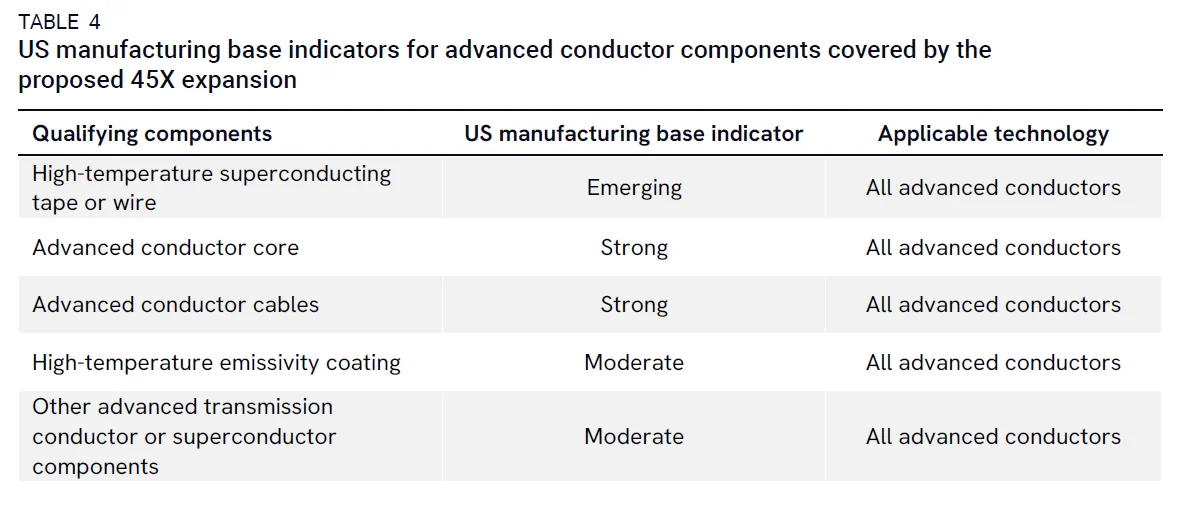
Expanding 45X to advanced conductors would not directly affect their adoption rates, but it would help make their domestic manufacturing more economically viable. It would also help produce domestically manufactured conductors that are price-competitive with imports at the material cost level, while accelerating the supply chain development needed to support potential large-scale reconductoring programs or the uptake of superconducting cables. We analyze expanding 45X to cover advanced conductor components (Table 4). The US manufacturing base for superconducting cable components is nascent, with capabilities ranging from emerging to moderate. The domestic manufacturing base for advanced conductor components is generally well-established, with moderate to strong capabilities across most components. The emerging characterization for HTS tape or wire suggests that broader transmission deployment will require continued domestic investment to scale. Because superconducting cables have very niche applications, our analysis considers only the impacts of 45X on domestic advanced conductor manufacturing capabilities. We model a tax credit that provides 30% of the production cost for eligible components that are used in the US grid, produced by existing and new manufacturing facilities, available through the end of 2036.
Transformers
Transformers are electrical devices that step up or down voltage by electromagnetic induction, connecting every aspect of the electricity supply chain, from generation to end use. Transformer types differ by function and application. Generation step-up (GSU) transformers connect generation sources to the grid by raising voltages at the point of generation for long-distance transmission. Transmission transformers operate at the highest voltages on the grid and regulate voltage across the bulk transmission network. Substation transformers step down the voltage from transmission to distribution levels, while distribution transformers—the most widely deployed transformer type on the grid—reduce it further to end-use levels.
The ongoing transformer shortage has become one of the most significant bottlenecks across the electrical grid, housing construction, and data centers. However, AI data centers have become the single largest force amplifying the US transformer crunch. Nearly half of the data centers planned for 2026 are facing delays or cancellations due to constrained supply and long lead times for large power transformers (LPTs) and switchgear. Transformer shortages in the US have persisted for some time. On the supply side, decades of underinvestment in domestic manufacturing capacity and materials exacerbate the challenges posed by this surging transformer demand. For example, the US currently has only a single domestic producer of grain-oriented steel (GOES), which meets only 20% of annual US demand.
Recently, there have been both federal and industry responses to the current transformer shortage. In April of this year, the Trump administration invoked the Defense Production Act (DPA) to address shortages and long lead times in critical grid infrastructure, such as large power transformers. It classified them as essential to US national security. Coupling these efforts with an expanded 45X tax credit covering transformers could further accelerate the scaling of US transformer manufacturing capacity.
We analyze expanding the 45X credit to critical transformer components (Table 5). The current state of US capabilities across the 45X-eligible components is both uneven and heavily weighted toward downstream and commodity inputs. Insulating fluid and metal enclosure manufacturing bases are strong, while coils, cores, and insulation paper are considered moderate. The most critical upstream and specialty inputs (i.e., GOES, amorphous electrical steel, and on-load tap changers), however, remain weak or emerging. Even finished transformer and bushing assemblies are still emerging domestically, which explains why LPT lead times have continued to stretch multiple years. The US can supply much of the surrounding material, but the binding constraints occur where domestic capacity is weakest.
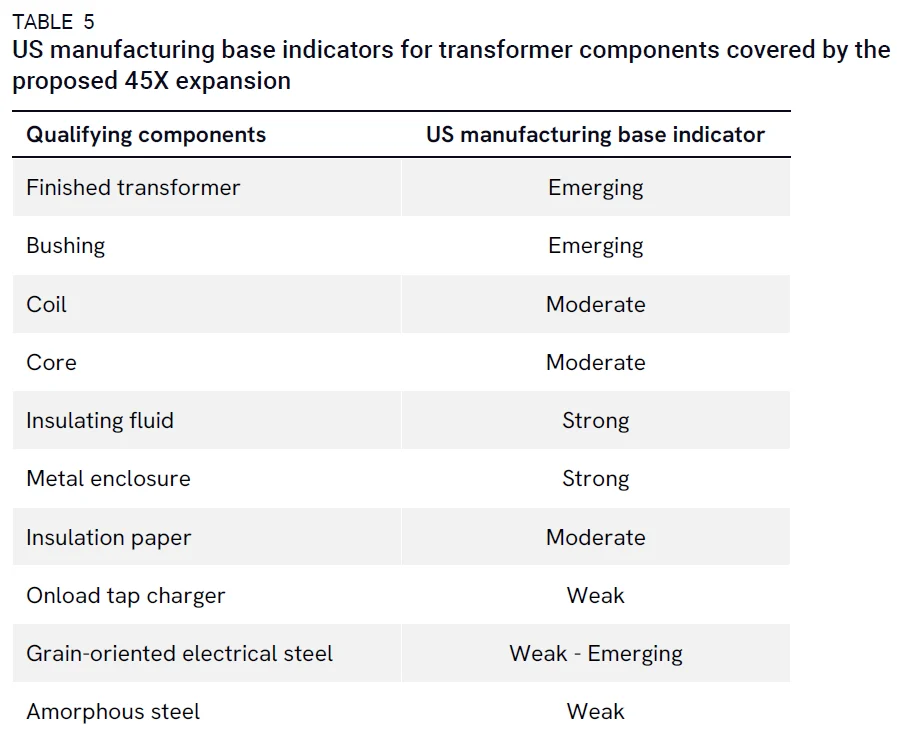
Companies like Prolec GE and Hitachi have recently announced major US investments in medium and large-power transformer component manufacturing capacity. Given the levels of these investments, their execution could lead to improvements in critical aspects of the US transformer manufacturing base and the broader supply chain. For example, Hitachi’s $1 billion investment package includes $106 million for a bushings facility expansion in Alamo, Tennessee, making it the largest bushings manufacturing site in North America. Bushings are a key bottleneck in the overall US transformer supply chain. This type of investment, if successful, could have major implications for domestic bushing production capabilities, helping to transition the US industrial base from emerging to moderate.
We analyze expanding the 45X credit to include a 10% tax credit for the production costs of all qualifying transformer components listed in the table, except electrical steel, through 2036. New or expanded GOES production is eligible for a tax credit of up to $4,700 per metric ton through 2036, depending on the measured total core loss per unit mass, while amorphous electrical steel is eligible for a $750 credit per metric ton through 2036. For non-electrical steel eligible components, production at both existing and new manufacturing facilities qualifies for the credit. For electrical steel, only production from newly expanded or newly built facilities qualifies for the credit.
Modeling approach
In this section, we discuss the approach used to assess the economic and fiscal impacts of a 45X expansion. We begin by estimating the size of the addressable US market for each of the four technologies—that is, the portion of the total US market each technology can realistically serve through at least 2036—to gauge potential demand for key components covered under 45X expansion proposals. We develop these market sizes using a combination of Rhodium Group modeling, especially our Taking Stock 2025 report, and other external sources.
In most cases, current policy does not drive sufficient demand for 45X-eligible components. For advanced fission, fusion, and advanced conductors, we model the impact of 45X in a future policy environment with sufficient demand signals. For example, advanced nuclear projects are only cost-competitive when they qualify for the federal Clean Electricity Investment Tax Credit (48E) and the Energy Community adder. This credit is scheduled to phase out by the end of 2035, but for this analysis, we assume it is extended throughout the study period. Fusion is also eligible for 48E. However, current technology projections suggest it will not be enough to make the technology economically viable to deploy. Therefore, we assume that other mechanisms are driving fusion deployment (e.g., federal procurement, regulatory support). Similarly, for advanced conductors, we assume that a more supportive regulatory environment drives deployment to economically optimal levels. Existing demand signals for transformers are already strong, so we do not assume any additional demand-side policy support is needed.
Next, for each eligible component, we assess the current US manufacturing supply gap relative to projected future demands, as well as the potential to scale up domestic manufacturing capacity. Drawing on these estimates, we then size the manufacturing investment driven by expanding the 45X tax credit. The extent to which 45X drives incremental manufacturing capacity additions depends on the existing manufacturing base, the duration of credit availability, and the size of the credit. It also depends on the degree to which additional demand for eligible components is likely to drive some new manufacturing capacity even in the absence of supportive supply-side policy like 45X. In some cases, sufficient domestic capacity already exists to meet projected demand. In others, 45X can clearly support scaling up domestic manufacturing to meet anticipated demand levels. When we discuss the economic impacts of the credit, we focus on areas where it can drive incremental investment.
To reflect uncertainty about the relative impact of 45X compared to demand-pull policies for eligible components, we model low- and high-end estimates of 45X’s incremental impact. We combine this uncertainty in incremental policy impact with low and high capital costs to capture uncertainty in long-term cost trajectories for these technologies. Together, these are the two pieces that constitute our “low” and “high” impacts.
Once we’ve estimated the economic impacts of these policy changes, we translate them into tangible economic benefits (i.e., direct and indirect jobs) associated. To do so, we use IMPLAN, an economic input-output modeling tool that captures both the direct and indirect employment effects of private investment in new domestic manufacturing capacity. Direct jobs are those created at the point of the activity itself (e.g., manufacturing a component). In contrast, indirect jobs are created in the supply chain that supports the direct activity (e.g., freight transport, circuit assembly). We chose IMPLAN for this analysis because it can translate investment figures into direct and indirect job estimates across the full supply chain. It is also widely recognized and accepted as a standard policy tool by policymakers and federal agencies. IMPLAN job outputs are expressed in job-years, which is a measure of cumulative labor input. We convert job-year outputs to average annual job figures, as this better reflects what exists at any given time rather than a running total and is more useful for policy audiences.
Lastly, we estimate the budget score for the 45X expansion based on our domestic manufacturing projections. This usually means that any eligible component that is produced domestically receives a tax credit, regardless of whether it’s from a new or existing manufacturing facility, whether it’s sold for domestic use or exported, or whether it counts as “45X-induced” under our framework. We capture limited exceptions to this approach based on statutory text. The credit for electrical steel used in transformer cores is only available if manufactured at new or expanded production lines only, and the high-performance conductor credit is only available for components installed on the US power grid.
The budget score serves as an indicator of the policy’s cost to the federal government. Following the Congressional Budget Office (CBO) and Joint Committee on Taxation (JCT) conventions, we provide a budget score for each eligible technology based on the standard 10-year budget window (2027-2036). For advanced fission and fusion, which see the bulk of their projected deployment beyond this window, we also calculate budget scores over an extended period spanning 2027-2043. For all technologies, we also report a current demand-side policy budget score, representing the anticipated revenue effects from enhancements to 45X alone, without the additional demand-side policies we discussed above.
To test the robustness of our results, we also evaluate them across alternative deployment scenarios, which we term the Enhanced Deployment scenario, that reflect potential accelerated deployment of these technologies relative to our baseline Moderate Deployment scenarios. This sensitivity analysis ensures that key conclusions hold under varying adoption pathways, rather than reflecting any single set of assumptions.
Our approach provides a rigorous and defensible framework for estimating the impacts of an expanded 45X. But it is not without limitations. Unlike the other technologies in this assessment, transformers benefit from a mature industrial base and sufficient domestic demand. However, the lack of publicly available data on the age distribution of LPTs undermines the robustness of the retirement-driven demand projections. To address this, we estimate future replacement demand using an average annual retirement rate derived from total US LPT stock estimates and average transformer lifetimes. Natural disasters like wildfires and hurricanes drive transformer demand both directly (e.g., destruction-driven replacements) and indirectly (e.g., storm-hardening programs). Their unpredictability makes transformer demand planning extremely difficult. Thus, we have chosen not to capture these additional demands in our transformer demand projections.
Expanding 45X can drive meaningful private investment and jobs
Advanced nuclear reactors
We model two scenarios to capture how differences in deployment pathways affect the estimated impacts of expanding 45X’s coverage to nuclear reactor components. In the Moderate Deployment scenario, advanced fission is deployed once economically viable, based on current expectations for fission capital costs and future fossil and clean technology prices, with 20 GW of new capacity coming online between 2035 and 2043 (the end of our analysis window). In the Enhanced Deployment scenario, we assume additional policy support and a higher willingness-to-pay for the reliability and emissions attributes of advanced fission to drive further deployment, leading to 41 GW between 2035 and 2043. The Enhanced scenario is aligned with a 2050 deployment level of 60 GW, consistent with a 2024 US Department of Energy analysis of hosting capacity at operating and recently retired nuclear facilities.
We find that, for the select advanced nuclear components we assessed, an expanded 45X could mobilize $3.1-13.1 billion in additional manufacturing investment between 2027 and 2043 (Figure 2). Electrical equipment manufacturing capacity accounts for the largest share of this investment, representing nearly 70% of the total 45X-induced investment across the three eligible components under consideration. Electrical equipment refers to the electrical instrumentation, operations, maintenance, and inspection equipment that is exposed to or used in nuclear radioactive environments. The second-largest driver of 45X-induced investment is fixed crane manufacturing, which includes polar cranes and other heavy lifts used in nuclear plant operations. The investments associated with expanding fuel conversion capacity in the US largely support meeting new demand based on the projected deployment of AP1000s through 2043. But, as discussed above, we also account for new fuel demand from announced reactor restarts, uprates, and announced SMR projects expected to come online during this period.
We find that, in addition to investments in new domestic manufacturing capabilities, 45X expansion also leads to considerable job creation. In the Moderate case, advanced nuclear component manufacturing supports between 700 and 1,900 average annual direct jobs and between 1,100 and 2,800 average annual indirect or “upstream supply-chain” jobs (Figure 3). In the Enhanced scenario, 45X expansion supports an average of 1,100 to 3,000 direct jobs and 1,700 to 4,400 supply chain jobs.1
In the near term, the expansion of the 45X credit for fuel conversion accounts for most of the federal budget of this policy change. As proposed, the 45X enhancement provides a credit for any fission fuel conversion activities in the US, including conversion at existing facilities and new conversion capacity. As a result, domestic producers receive credit for uranium destined for existing nuclear plants, restarts, uprates, announced SMR projects, and our modeled increase in AP1000 deployment.
We calculate the ten-year budget score for this proposed policy change (2027-2036) based on demands for fuel-conversion services from the existing nuclear fleet, future demands associated with newly announced nuclear restarts, uprating, and SMR projects planned through 2036, as well as demands from the projected deployment of AP1000s in 2035 and 2036. This scoring accounts for fuel conversion at both existing and recently announced US fuel conversion facilities. We also account for new fixed crane and electrical equipment manufacturing capacity needed to support AP1000 deployment through 2036. In the Moderate case, we estimate a budget score between $3.1 and $3.2 billion, while in the Enhanced scenario, the budget score ranges from $4.0 to $4.5 billion. These budget scores correspond to a subset of investments reported in Figure 2, totaling $0.2-2.7 billion through 2036. The revenue impact from the enhancement to 45X but otherwise under current demand-side policies is $2.9 billion through 2036.
Extending the budget window to capture the full analysis timeframe, we account for additional AP1000 deployments at the levels discussed above, with our budget score estimate rising to $6.9-7.8 billion in the Moderate case and $9.1-10.7 billion in the Enhanced scenario.
As mentioned above, our estimates are likely conservative. The lack of publicly available data prevented us from capturing the full range of components that could qualify under the proposed 45X expansion language, so we are only able to model a subset of potential eligibility. Also, with the limited exceptions we highlight, we focus solely on the deployment of new AP1000 units and not SMR designs, which remain at an earlier stage of development and differ in component selection. However, if one or more of these designs were to achieve large-scale deployment, the impact could be much greater than we have estimated here.
Fusion
For fusion, we model two scenarios to capture how differences in deployment pathways affect the estimated impacts of expanding 45X’s coverage fusion components. In the Moderate Deployment scenario, we model fusion deployment assuming a logistic growth trajectory and a 25 GW target by 2060. The Enhanced scenario doubles the Moderate case’s 2060 deployment target. Given MCF’s greater scalability compared to ICF, we assume that achieving this higher target will require greater deployment of MCF.
In our Moderate scenario, a 45X expansion could mobilize $9.5-44.3 billion in additional manufacturing investment between 2026 and 2043 (Figure 4). Roughly one-third of this investment is dedicated to scaling up domestic manufacturing capacity for HTS magnets, which are the single most important enabling technology driving the current private fusion wave. HTS tape—the key bottleneck for nearly the entire private fusion industry—is the second-largest driver of additional manufacturing investments, accounting for 12% of estimated investment needs. In our Enhanced scenario, additional manufacturing investment levels for MCF are nearly 1.5 times those of our Moderate scenario.
In both the Moderate and Enhanced scenarios, 45X expansion spurs between $0.8 and $10.4 billion in additional manufacturing investment for ICF-related components through 2043 (Figure 5). The key driver behind these investments is high-energy lasers, the driving technology for laser-driven ICF. These lasers compress and heat the fuel target to fusion conditions, playing a role like magnets in MCF.
We find that, in addition to new manufacturing investment, credit expansion spurs significant job creation. In the Moderate case, new MCF component manufacturing supports between 3,200 and 10,200 average annual direct jobs, and between 3,700 and 11,800 average annual supply-chain jobs (Figure 6). ICF-related average annual direct jobs range between 100 and 1,600 direct jobs. The associated average annual supply chain jobs range from 200 to 3,000. Our Enhanced scenario job estimates, like investment, are roughly 1.5 times those of the Moderate case.
We calculate the near-term budget score based on recently announced commercial MCF projects eligible for the tax credit, as well as our projected deployment of MCF plants in 2035 and 2036.2
Under the standard 10-year budget window, we estimate a budget score of roughly $3.1-5.0 billion in the Moderate case. This figure rises to $3.4-5.5 billion in our Enhanced scenario. These budget scores correspond to a subset of investments reported in Figures 4 and 5, totaling $6.2-21.9 billion through 2036. The revenue impact from the enhancement to 45X, but otherwise under current demand-side policies, is $2.3-3.8 billion through 2036.
Extending the budget window to capture the full analysis timeframe through 2043, accounting for the more substantial fusion deployment that we model occurring after 2036, we estimate a budget score of $4.8-9.7 billion in the Moderate case and $6.6-12.5 billion in the Enhanced scenario. The full analysis timeframe in both cases captures the commercial deployment of MCF and ICF plants.
Advanced conductors
For advanced conductors, we develop both a Moderate Deployment scenario and an Enhanced Deployment scenario to represent differences in demand levels through 2036, based on varying expectations for grid growth driven by rising electricity demand. In our Moderate case, based on Taking Stock 2025, we project a total addressable market for advanced conductors of roughly 116,000 conductor-miles through 2036, of which 55% represents demand for reconductoring existing transmission lines, and the other 45% accounts for demand for new lines. Our Enhanced scenario scales up the reconductoring demands of the Moderate scenario to achieve levels consistent with the Idaho National Laboratory’s Advanced Conductor Scan Report, which identifies near-term reconductoring opportunities across the US grid.
We find that in our Moderate case, existing domestic advanced conductor manufacturing capacity is more than sufficient to meet demand. In this case, an expanded 45X credit helps spur additional utility adoption by narrowing the cost gap with traditional ACSR conductors, but this demand could be met by current capacity. For a few years in our window, existing producers would need to divert some of their output from the export market to meet this domestic need, but this does not reflect the net new production of advanced conductors. In the Enhanced scenario, domestic manufacturing capacity would expand by an additional 22,130 conductor-miles-worth to meet demand projections over the period. This coincides with cumulative 45X-induced investment levels ranging from $1.0 billion to $2.6 billion (Figure 7).
Under the Moderate case, the lack of new manufacturing capacity results in no associated job creation. We do, however, find in the Enhanced scenario that expanding 45X to cover advanced transmission conductors will support between 100 and 400 average annual direct jobs and 300 and 900 average annual supply chain jobs over our analysis period (Figure 8).
Because the tax credit is available to all operating domestic manufacturers, existing manufacturers can claim it in both scenarios. So, despite no additional investments in advanced conductor manufacturing capacity, we estimate a near-term budget score of $1.2-1.6 billion under the Moderate case. The revenue impact from the enhancement to 45X, but otherwise under current demand-side policies, is the same: $1.2-1.6 billion. In the Enhanced scenario, the expanded credit and the associated new investment lead to a higher near-term budget score of roughly $2.2-3.0 billion.
Transformers
As with previous technologies, we develop both a Moderate Deployment and an Enhanced Deployment scenario for transformers. The Moderate scenario aligns with the electrification levels in Taking Stock 2025, while the Enhanced scenario assumes higher growth in data center electricity demand, consistent with previous Rhodium Group research. In the Enhanced scenario, we model the impacts of higher data center loads as an increase in demand only for large power transformers, including generator step-up units, transmission substation units, and distribution substation units. In this scenario, there is no assumed impact on distribution transformer demands.
Under the Moderate scenario, the cumulative investment associated with the 45X expansion is approximately $5.1-13.6 billion (Figures 9 and 10). Cumulative total investment associated with 45X in the Enhanced scenario increases to approximately $5.4-14.7 billion through 2036. This reflects higher LPT demand—particularly distribution substation transformers—driven by higher data center load growth.
In the Moderate scenario, the 45X credit results in approximately 1,800-4,500 average annual direct jobs and approximately 1,400-3,700 average annual supply chain jobs through 2036 (Figure 11). In the Enhanced scenario, credit expansion spurs roughly 1,800-4,800 average annual direct jobs and 1,500-4,100 average annual supply chain jobs.
In both scenarios, the 45X credit could be claimed by both new and existing transformer manufacturers. We estimate a budget score of $8.1 to $10.1 billion over the ten-year timeframe in the Moderate scenario. In the Enhanced scenario, we estimate a slightly higher budget score of $8.3-10.4 billion.
Closing domestic manufacturing gaps through 45X expansion
Congress has an opportunity to expand the 45X manufacturing tax credit to help address growing domestic manufacturing gaps for critical components that now constrain the deployment of key technologies. The US has already committed to modernizing the US electrical grid. Advanced nuclear fission, fusion, advanced conductors, and transformers share many of the same structural problems: supplier bases have consolidated to only two or three global vendors, increasing lead times have become a binding constraint on deployment, and other policies often drive demand for the technologies.
Across the four technologies, the impact of a 45X expansion is most substantial when three conditions coincide: a relatively weak existing domestic vendor base, a supply shortage of a critical component that constrains the deployment efforts the federal government has already committed to, and a credible near-term demand signal independent of the 45X credit itself. We find that large power transformers and distribution transformers meet all three conditions today. Advanced fission-eligible components satisfy these conditions only when there is a strong and sustained demand signal for new nuclear plant construction. Fusion satisfies the first condition, but does not yet fully meet the second, and only partially satisfies the third. This implies that expanding 45X to cover fusion components in the near term would help build manufacturing capacity in preparation for future fusion plants, rather than addressing existing supply chain constraints. Of the four technologies, advanced conductors are the exception. A strong domestic manufacturing base already exists, and 45X expansion would do little to accelerate its uptake. However, the case for including them in an expansion of 45X rests on reinforcing existing capacity to withstand potential future import competition and preserving the domestic supplier base as transmission demand scales.
Our analysis finds that under our Moderate scenario expectations of future market conditions, expanding 45X to cover these four technologies could catalyze up to $63 billion in new domestic manufacturing investments and support up to 39,500 average annual jobs (direct and indirect) across the analysis windows. Under more Enhanced deployment scenarios, catalyzed investment increases to $84 billion, supporting up to 54,200 average annual direct and indirect jobs.
Taken together, these modifications to the 45X credit represent another important step in US industrial policy to support meeting the current moment, ensuring reliable, low-cost electricity is consistently available to meet surging demand. Building out this manufacturing base secures these critical supply chains at a time when the US is relying on them more than ever.
This nonpartisan, independent research was conducted with support from ClearPath. The results presented reflect the views of the authors and not necessarily those of the supporting organization.
Footnotes
We average job numbers over the deployment period so hiring estimates reflect when projects are built, rather than the broader analysis window.
Announced ICF projects, like our own deployment assumptions, are not expected to arrive until the early 2040s. Therefore, ICF plants are not included in our near-term budge score calculations.