China’s Economy: Rightsizing 2025, Looking Ahead to 2026
China's actual 2025 GDP growth fell short of 3%. For domestic demand to lift China above 2% GDP growth in 2026, Beijing must reverse the systemic causes of household and business malaise or pile on costly demand subsidies.
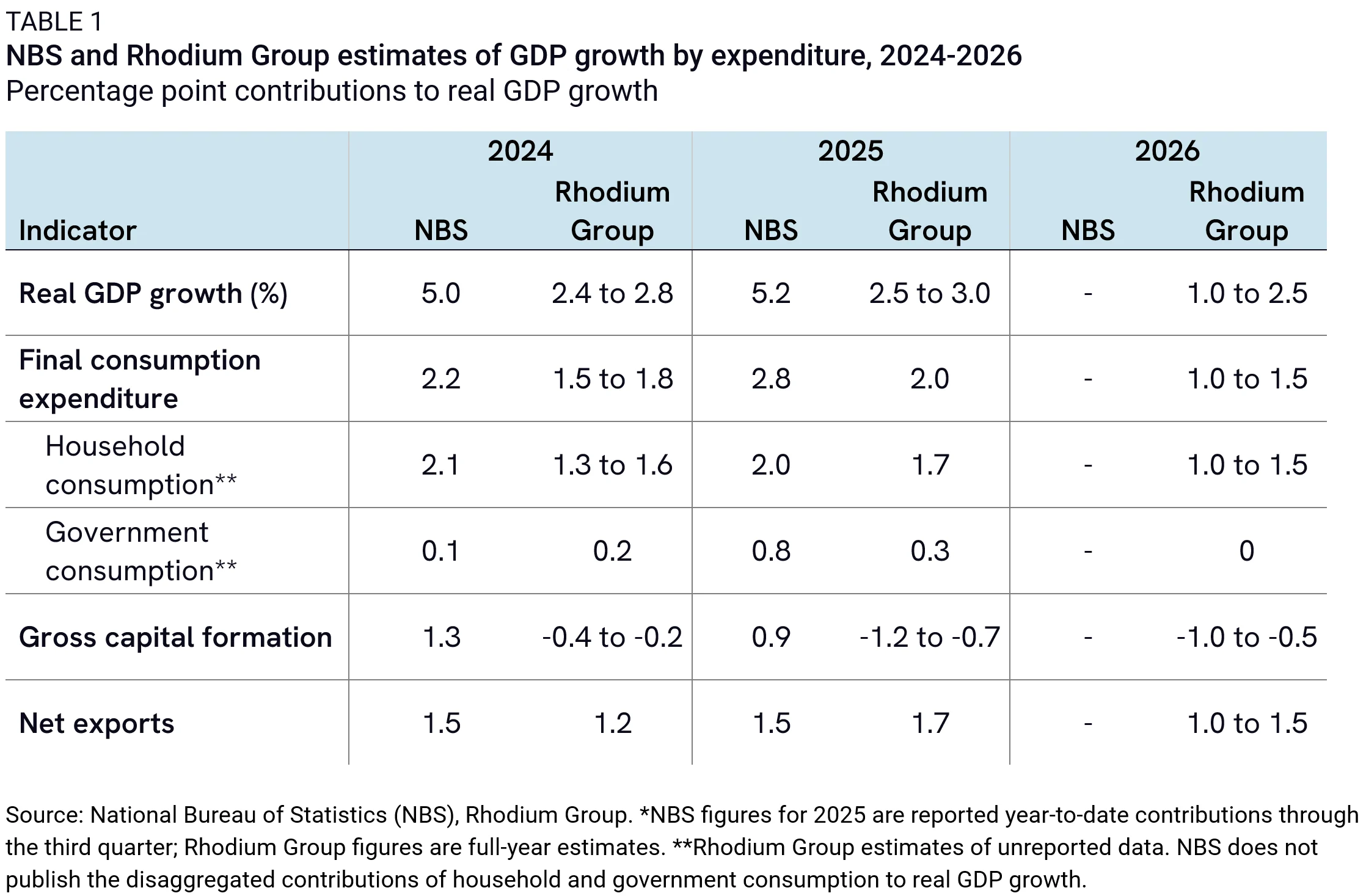
China’s statistics show real GDP growth of 5.2% year to date through the third quarter of 2025, an acceleration from 2024. They will almost certainly claim 5% growth or better for the full year. A year ago, we said China could perform better in 2025, hitting 3 to 4.5% if Beijing prioritized growth after a poor 2024 performance in the mid-2s. But actual 2025 growth fell short of 3% again, with a strong first half and then a badly down-sloping second half. With late-2025 growth sputtering around 1% and a charm offensive aiming to encourage American hopes for a great power deal, Beijing is talking loudly about supporting domestic growth in 2026. But domestic growth hasn’t stalled for want of talk: Pledges have been abundant, yet China remains dependent on a trillion-dollar (and growing) trade surplus that steals growth from others. For domestic demand to lift China above 2% GDP growth in 2026, Beijing must reverse the systemic causes of household and business malaise or pile on costly demand subsidies.
A tale of two halves
Officially, China’s economic growth accelerated in 2025, from 5.0% in 2024 to 5.2% in the first three quarters this year, slowing only marginally to 4.8% y/y in Q3. Beijing paints a picture of internal economic resilience, but reality is different. China’s economy started 2025 solidly, thanks to export-oriented industries frontloading activity ahead of US tariffs, consumption subsidies for home appliances, automobiles, and electronics, and a positive fiscal impulse (net increase in government support) of around 1.4% of gross domestic product (GDP). But positive momentum was a first half story: In the second half of 2025, credit growth hit all-time lows, household consumption weakened as subsidies tailed off, and even export growth contributed less. Fiscal support growth weakened as well, producing a neutral—or maybe even negative—fiscal impulse for the third and fourth quarters. Investment, the largest component of GDP, is declining substantially, with the official fixed asset investment (FAI) data falling so fast that it calls into question their reliability.
Our current argument with China’s GDP narrative dates to the property sector implosion starting in 2021. Beijing reported 3% growth for 2022, but we believe growth was actually negative that year, as activity was locked down under COVID-19 restrictions. Since then, domestic demand has been anemic and confined to modest household consumption expansion, as a still-shrinking property sector dragged on aggregate business investment. Growth has remained well below the official target, probably hitting at best 1.5-2.0% in 2023 and 2.4-2.8% in 2024.
History offers no examples of economies that have recorded 5% real GDP growth while facing years of persistent deflation, as China has for ten consecutive quarters. We doubt China is the first.
2025 in review
Throughout 2025, Beijing projected confidence in achieving 5% growth despite domestic challenges and an unaccommodating external environment. Party propaganda organs emphasized economic resilience and called for strengthened management of economic expectations, essentially mandating that this story be amplified.
We estimate that China’s real GDP grew between 2.5% and 3.0% in 2025, about half of the 5.2% the National Bureau of Statistics (NBS) reported through Q3. As in past years, the largest divergence between official numbers and ours was in investment estimates (Table 1).
Investment
China’s 2025 economic growth story turns on whether investment merely declined in the second half of the year or collapsed. FAI data points to an outright collapse, declining by 11% in nominal terms between July and November 2025 compared to the same period last year. Gross capital formation (GCF) data—the official investment component of GDP—reportedly still contributed 0.9 percentage points (pp) to real GDP growth during Q3, despite the FAI decline (-8% y/y for the quarter). This makes no sense, and the NBS has provided no compelling explanation.1
Of course, FAI is not the same as GCF, and FAI has overstated investment in the past, notably failing to reflect the property market collapse since 2021. But the other indicators of investment demand point to a broader decline too. After briefly showing signs of stabilizing, property sector investment continued to weaken in 2025, with declines in sales, new starts, and land sales all exceeding 20% y/y and intensifying in the second half of the year. New starts are now more than 75% below the peak level in early 2021 and are at the lowest point since the early 2000s (Figure 1).
The drop in property investment has spread to manufacturing and infrastructure. Manufacturing investment has come under pressure in the second half, falling from 9.2% growth in 2024 to 1.9% through November 2025, likely tracking trade war uncertainties. Industrial capacity utilization rates are declining. Even the Central Economic Work Conference (CEWC) statement acknowledged that investment is falling, with policymakers calling for a “stabilization and recovery of investment.” While a positive fiscal impulse boosted infrastructure investment in the first half, by Q3 that had ended, so all important FAI components—manufacturing, infrastructure, and real estate—now show malaise.
Overall credit growth to finance investment (Figure 2) reached all-time lows on multiple measures this year, including RMB loans, rising by only 6.3% y/y through November. Private sector credit has been particularly weak, with household operating loans for sole proprietorship businesses rising by only 4.1% y/y, a nine-year low since the 2016-2018 deleveraging campaign. Growth in overall household borrowing, which includes loans to small service sector businesses, has reached an all-time low at only 1.1% in November.
This is logical given the persistence of high real interest rates and deflationary pressures in producer and consumer prices, reducing incentives for new investment. The PBOC has been easing monetary conditions, but actual borrowing rates have barely fallen in 2025, by only 4 basis points on average since 2024, according to the PBOC’s quarterly monetary policy reports.
Household consumption
Positive first half conditions delivered a slight pickup in consumption growth on a full year basis. Stronger household consumption was Beijing’s highest economic policy priority for 2025, as outlined at the December 2024 CEWC and Premier Li Qiang’s March government work report. Expanded trade-in subsidies for consumer durables helped lift retail sales (a proxy for household consumption, Figure 3) for some months.
Momentum faded as subsidies wound down and base effects kicked in by Q3. Other policy efforts, such as a special consumption action plan unveiled in March, are longer-term in nature and have yet to yield tangible results. The result was a drop-off in headline retail sales growth from 6.4% y/y in May to just 1.3% y/y in November, with spending in trade-in goods categories now declining outright. E-commerce sales on Jingdong and Alibaba’s Taobao and Tmall platforms have contracted 4.3% YTD. As mentioned previously, household credit growth reached all-time lows this year (+1.1% y/y in November), as households continued to pay down mortgages early, reducing the scope for new spending.
Weak demand is also reflected in stagnant prices. The aggregate consumer price index has not increased on net in three years. While declining food and fuel costs explain some of the drag in 2025 (Figure 4), CPI growth would likely still be negative if not for surging gold prices and if falling real estate prices were properly measured. Structural factors have shown little improvement: among these are impaired consumer confidence, wealth effects of the property sector fallout, and labor market stress.
Results from the NBS quarterly household survey, the best predictor of consumption in official GDP data, show 4.7% year-to-date growth in real per capita household spending through Q3. This is equivalent to a real GDP growth contribution of around 2 pp. We estimate that the contribution came in slightly lower, at 1.7 pp, in line with price-adjusted retail sales growth.
Government consumption
Coming into the year, Beijing previewed a “more proactive” fiscal policy stance and expanded the official fiscal deficit target to 4% of GDP for the first time. The fiscal impulse has been positive this year, particularly in the first half, when tax collection contracted alongside increased government spending and debt issuance. China is on track for an aggregate 2025 fiscal deficit (including the government funds budget account) in the neighborhood of 9% of GDP, up from 7.7% in 2024.
We proxy government consumption growth using monthly fiscal data from the Ministry of Finance. Aggregate (central plus local) spending on the general budget account, which best aligns with the government component of GDP, has risen 1.4% year to date through November. With many local governments now prioritizing debt management over infrastructure investment, debt swaps are diverting resources away from other spending priorities. Spending has increased by just 0.6% year to date at the local level, compared with 6.2% growth at the central level. Overall revenue growth is nearly flat as well.
Official GDP data show a 2.8 pp contribution of final consumption expenditure to real GDP growth through the third quarter. Given an estimated 2.0 pp household consumption contribution, NBS data imply a 0.8 pp contribution from the government sector. Based on fiscal spending trends, however, we think the true government contribution was around half that amount.
Net exports
Net exports were a significant contributor to China’s 2025 economic growth: We estimate they added 1.7 pp, or more than half of this year’s aggregate GDP growth. We use monthly goods and services trade data and trade price indices reported through November for these estimates.
China’s trade surplus, which reached nearly $1 trillion in 2024, already surpassed that total through November 2025. As the real exchange rate has depreciated consistent with domestic deflationary pressure, China’s export prices have declined for their third consecutive year. The net result has been 10% growth in the volume of China’s exports (Figure 5). Import demand similarly appears subdued with only 0.1% growth in RMB terms through November.
These lower prices have allowed China to diversify its exports away from the United States. Direct exports to the US have declined sharply—by 20-30% y/y every month since April—but exports to all other regions are increasing, especially in Africa, the European Union, and ASEAN (Figure 6). Obviously some of this growth is transshipment through third countries for exports still bound for the United States, but US tariffs have also accelerated trade diversion and broader supply chain realignment.
Looking ahead to 2026
A reasonable forecast of China’s GDP growth is important for a number of reasons. First, Chinese and foreign companies alike must make sales projections, input availability plans, and competitor strategies based on how fast the world’s second-largest economy is growing. The difference between China growing 2% and 5% is half a trillion dollars in demand and the profitability of many Fortune 500 firms hinges on which is right. Second, the Chinese people themselves need policies built on sound forecasts. More than 600 million Chinese live on less than $2,000 a year. If Beijing cannot acknowledge the extent of the macroeconomic slowdown, it cannot address their needs. Finally, accurate economic projections are the acid test of what China can offer in deal-making. Without domestic demand growth, Beijing cannot offer Africa market access. It cannot fulfill promises to the Trump administration to engage in a constructive, mutually beneficial trading relationship that dials down global imbalances. The strategies of major nations must be calibrated to how China is actually doing, not to how China wishes it were doing.
After pivoting to prioritize household income and consumption in late 2024, Beijing stepped up its policy rhetoric in the fourth quarter of 2025, signaling that it would restore consumer and business expansion in 2026. The December 15 edition of the Communist Party’s theoretical journal Qiushi led with a ten-year compilation of commentaries by Xi Jinping, entitled “Expanding Domestic Demand is a Strategic Move.” One day earlier, Xi was quoted on the front page of People’s Daily calling on local cadres to stop inflating economic growth for the sake of self-serving political promotion. The National Development and Reform Commission and Qiushi editorial board have followed with their own commentaries making the strategic case for promoting consumption as the key pillar of domestic demand.
Taken together, these are the strongest pledges to address the demand problem in China’s system since 2015. However, similar pledges have been made throughout the past decade without follow-on action to produce durable structural adjustment. Fundamentally, unlocking new sources of domestic consumption growth requires an overhaul of the fiscal system, as we have discussed in detail the past two years (see No Quick Fixes: China’s Long-Term Consumption Growth and How Can China Boost Consumption?). This revamp would need to address the rural-urban divide, the precarious position of migrant workers, and the systemic misallocation of capital by SOEs and banks. There is no concrete sign of such a restructuring underway, and these changes would certainly slow growth before lifting it, with a lag time of more than a year before benefits arrive and even longer before consumers and business decision-makers behave with confidence.
Though Beijing’s recent rhetoric is significant, we recommend doing the 2026 math on the assumption that present reform signals will not alter expenditure component trajectories as projected based on 2025. And while the extent of the decline in investment was the key uncertainty for 2025, the most important variable influencing the real economic growth rate in 2026 will be China’s export performance.
Investment
The year begins with weak momentum for new investment, given slowing credit growth and declining producer prices. Manufacturing investment remains under pressure, while the fading fiscal impulse should also limit infrastructure spending. Even a successful anti-involution campaign based on restricting capacity to boost profitability and prices will discourage new manufacturing investment in the short term. But more likely, nascent policies to restore profitability—and thus the appetite of businesses to invest beyond a handful of export industries—will fall short of that goal.
The property market is also likely to weaken early in 2026, even though the case for a medium-term stabilization in activity is intact: Construction appears to be trending below our estimated long-term equilibrium levels of activity. Support from the property sector will largely depend upon sales picking up and subsidized mortgage rates stabilizing prices. Given no meaningful support from fiscal policy, any acceleration in investment will need to come from the private sector, either from the prospect of an end to deflation or a significant acceleration in credit growth from its current pace of 6-7%. As a result, we would expect an ongoing decline in aggregate investment in 2026.
Household consumption
Consumption momentum is weak heading into 2026, with year-on-year retail sales growth barely exceeding 1% and declining in sequential terms. The range of expectations for next year mainly depends on the size and product scope of trade-in subsidies, but these are unlikely to expand significantly relative to 2025. Any strength is more likely to appear in services spending, which held up better than goods consumption toward the end of this year. In a best-case scenario, consumption could contribute 1.5 pp to growth, similar to recent years.
The continued shortfall in domestic demand has reinvigorated longstanding public debate among Chinese economists regarding the sources of and solutions for China’s low consumption rate. Some economists have argued that China’s goods consumption is adequate by international standards, but that policy focus should shift to boosting services. In September, ten economic ministries released a set of policy measures specifically aimed at promoting services consumption. This may help 2026 spending on the margins, but more fundamental reforms that lift income growth and reduce China’s high savings rate would take multiple years to bear fruit.
Government consumption
We expect a flat contribution of government consumption to growth in 2026. The CEWC statement stated that Beijing will “maintain” a necessary fiscal deficit and spending levels, in sharp contrast to last year where it said Beijing would “increase” the fiscal deficit ratio and spending. The readout suggested that the central government will increase investment, but this mainly rebalances burden-sharing with local governments rather than creating an overall spending increase.
Given widening deficits and the need to improve revenue collection, significant fiscal stimulus is unlikely next year. Fiscal constraints will only intensify going forward as Beijing continues to prioritize local debt resolution and looks to boost revenue amid persistent pressure on value-added tax, enterprise income tax, and land sales. Beijing has previewed some incremental expansions to public spending on social services, for instance a pledge to fully cover childbirth costs starting in 2026. Official messaging is more strongly emphasizing the need to balance “investment in people” with the traditional “investment in things” such as physical infrastructure. However, fiscal and political realities will cap new social spending at a modest level.
Net exports
The most important variable for China’s 2026 growth is exports, hinging on how long they will hold up and whether or not China can continue to expand its global export market share. Beijing appears to believe that export strength will continue, which was reflected in a more neutral characterization of the external environment in the CEWC statement.
As of the start of the year, net exports are more likely to contribute to growth in 2026 than represent a drag on the economy. So far, there has been no coordinated global pushback against Chinese exports, in part because US tariffs have prevented some countries from fighting a trade war on two fronts, particularly in Europe. In addition, Chinese exports will remain competitive as the RMB continues to depreciate in real terms against a broad currency basket. Structural weakness in imports is also likely to continue.
However, there is a significant downside risk to our expectation of 1.0 to 1.5 pp of GDP growth from net exports. Europe or emerging markets could push back more strongly against Chinese trade practices. External demand and inventory restocking in developed economies (both a function of global macroeconomic performance, which the IMF sees slowing again in 2026 after slowing in 2025) also remain risks to China’s export hopes.
Conclusion
Our 2025 GDP estimate depended on how bad investment was for the year: Capital formation was worse than any time since early-COVID, and at the end of the year it was still deteriorating. Surging net exports kept China’s growth afloat, but at the expense of larger deficits for the rest of the world this year. In 2026, China will be even more dependent on that surplus for growth. A downturn in export growth would have a much larger effect, given weak domestic demand and the limited scope for fiscal policy.
Beijing’s talk of domestic demand spurring reforms will be the water cooler conversation in Davos, Washington, and meetings with foreign friends. But any belief that changes are truly being enacted should be tempered by a close understanding of China’s present systemic growth problems, its track record of similar pledges, and hard evidence.
The gap between China’s official narrative and economic reality has been widening for some years. Our adjustments to China’s official data from 2022-25 suggest that the level of real GDP this year is around 11% lower than official numbers claim, with most of the adjustment in the investment (or gross capital formation) component of GDP. This would imply a decline of roughly 9 pp of global investment share from 2021 to 2025, which would go a long way to explaining the surge in Chinese exports and growing concerns about China’s external imbalances (Figure 7).
Counting national GDP is part art and part science, even in the most advanced economies. The miscalculation for China’s economy has been persistent for too long though, and always in the same direction of overstatement. This has obscured global imbalances that threaten systemic risks, as countries are compelled to deal with China’s vast overcapacity. After years of turning a blind eye to this, the IMF is finally pointing it out. France and other G7 nations beyond just the US are tagging these imbalances as strategic concerns. And while President Trump’s plan to chart a constructive course with Beijing in 2026 appears benevolent at first blush, it risks a dangerous collision if it is based on a faulty map of China’s economic directions.
Footnotes
In explaining the FAI decline, NBS has emphasized the property sector downturn and the impact of weak corporate profitability on investor sentiment. It has not, however, explained why the FAI decline is not reflected in GDP data. There are important definitional differences between FAI and GCF, including separate treatment of land sales, second-hand equipment purchases, and inventory adjustments, among others, but these differences are unlikely to fully account for the data discrepancy that emerged in Q3.